
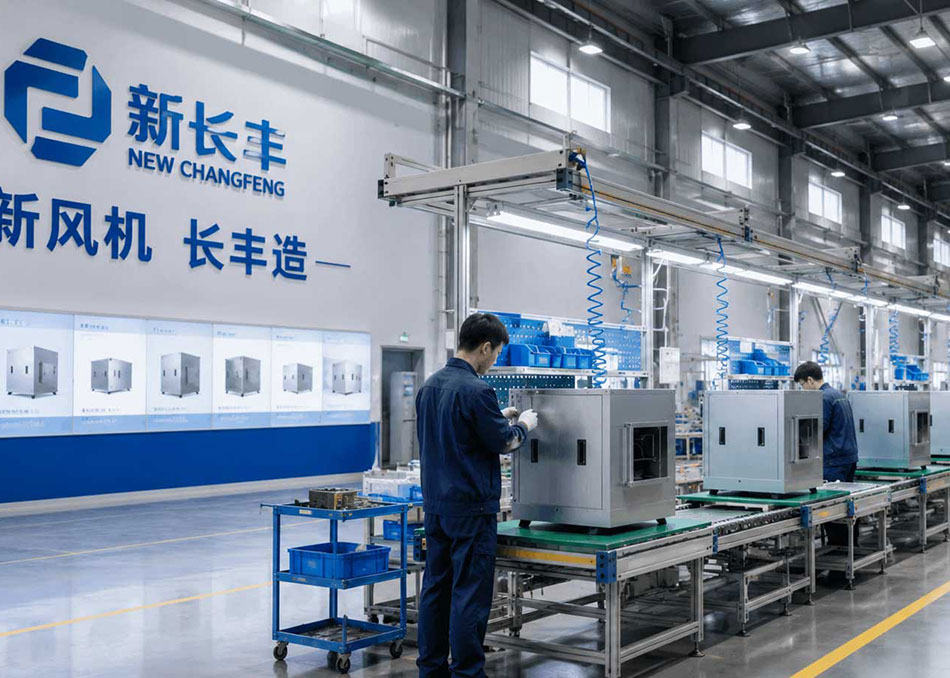
Ventilation problems in commercial kitchens are rarely about failing to exhaust air — they are usually about failing to bring air in. Many large kitchens complete a hood and exhaust upgrade only to find burners flickering, grease-laden air spilling over hood edges, doors that pull hard against the hand, and staff working in stifling heat. In most cases the root cause sits in the make-up air strategy. The more air a kitchen exhausts, the stronger the negative pressure becomes, and without a properly designed make-up air path even a well-built hood cannot capture fumes reliably. The water-cooled fresh air unit is designed for exactly this role: it delivers filtered, temperature-controlled make-up air to the kitchen while doubling as cooling equipment for large cooking areas.
Where Kitchen Negative Pressure Comes From: The Chain Reaction of Unbalanced Exhaust and Supply
Commercial kitchen exhaust systems are typically sized around the number of burner positions, hood perimeter, and cooking intensity. Make-up air, by contrast, is often simplified or left out of the design entirely. Basic ventilation engineering requires a dynamic balance between exhaust and supply. Once a kitchen develops excessive negative pressure, outdoor air can only force its way in through door gaps, pass-through windows, floor drains, and other unintended paths. Airflow organization collapses, and the capture efficiency of the exhaust hood drops accordingly.
The consequences of negative pressure are interconnected. Burners need adequate oxygen; under negative pressure, flames lift and drift, combustion becomes incomplete, plating speed suffers, and gas consumption rises. Grease-laden air spills around the edges of the hood, accelerating buildup on walls and equipment surfaces. If make-up air is drawn directly from hot outdoor air or a corridor, summer kitchen temperatures climb further and working conditions deteriorate. No single piece of equipment solves all of this — exhaust, make-up air, and cooling have to be planned as one system, which is the design premise behind the water-cooled fresh air unit.
Unstable Flames and Falling Combustion Efficiency: The Hidden Cost of Starving a Kitchen of Air
Every gas burner is an air-consuming device. When a kitchen is held under strong negative pressure, the combustion air available at the burner is reduced and unstable, and the flame responds by lifting, yellowing, or pulsing. Beyond the obvious effect on cooking quality, this represents wasted fuel and increased carbon output per meal served. A properly sized make-up air path restores stable combustion conditions and lets burners run at their rated efficiency.
Grease capture is the second casualty. Hood capture velocity depends on an undisturbed airflow field around the cooking surface. Cross-drafts from door gaps and unbalanced supply jets push fumes past the hood lip, which is why grease deposits appear on walls and ceilings even when the hood appears to be running normally. Introducing make-up air through a dedicated unit with controlled delivery — rather than through random openings — keeps the airflow field predictable and supports consistent capture performance in line with the principles behind GB 18483 kitchen fume emission requirements.
Why a Water-Cooled Fresh Air Unit Fits the Make-Up Air Role
A water-cooled fresh air unit combines filtration, cooling, and controlled air delivery in a single packaged unit. Instead of dumping hot outdoor air into the kitchen, it conditions the incoming air through a water-cooled heat exchange process before distributing it to the cooking zone. This directly addresses the two problems that make-up air usually creates: heat gain and draft disturbance. Because the cooling circuit is water-based, the unit avoids the large condenser heat rejection and refrigerant charge associated with conventional DX make-up air systems, which simplifies placement in tight back-of-house areas.
In system terms, the unit is sized to supply a meaningful share of the exhaust volume so the kitchen stays close to neutral or slightly negative — enough to contain odors, not enough to starve the burners. Supply air is typically introduced low and away from the hood face, or delivered as a tempered blanket over the cooking line, depending on the layout. For large kitchens, multiple units can be zoned so that the make-up air volume tracks the exhaust stages actually running, rather than running at full output all day.
- Restores pressure balance: reduces door-pull, whistle, and uncontrolled infiltration through gaps and drains.
- Stabilizes combustion: consistent supply air supports steady flames and more complete gas burning.
- Improves hood capture: controlled delivery avoids cross-drafts that push fumes past the hood lip.
- Cools the workspace: tempered supply air lowers kitchen temperature instead of adding to the heat load.
- Supports compliance: helps kitchens meet fume emission and ventilation requirements with documented, repeatable performance.
Design and Selection Points for Kitchen Make-Up Air Systems
Start with the exhaust side. Total exhaust volume should be established from hood design, burner count, and cooking style, and the make-up air target set as a proportion of that figure — commonly in the range of 70–90 percent, with the balance drawn through controlled openings. Fan performance should be verified against GB/T 1236 test methods, and fan energy efficiency evaluated against GB 19761 so the system does not trade one operating cost for another. Where the kitchen forms part of a building with smoke control requirements, coordination with GB 51251 provisions for smoke and heat exhaust is essential; make-up air dampers and controls must not interfere with emergency smoke extraction.
Duct layout matters as much as unit capacity. Supply runs should be short and direct, with diffusers positioned to avoid blowing directly onto burner flames or hood faces. Filtration on the supply side protects the heat exchanger and keeps the kitchen clean. Controls should interlock make-up air with exhaust fan staging so the two move together, and a slight negative pressure should be maintained as the setpoint rather than a hard balance that can drift with filter loading.
Noise is a frequent complaint after make-up air retrofits. Selecting a unit with a low specific sound level, using acoustic attenuation on the supply duct, and avoiding oversizing all help. Commissioning should include measurement of kitchen pressure relative to adjacent spaces, hood capture checks with a smoke pencil, and verification that burner flames are stable at all exhaust stages.
FAQ
Q: Can a water-cooled fresh air unit replace the exhaust hood or exhaust fan?
A: No. It is a make-up air and cooling device, not an exhaust device. It works alongside the hood and exhaust fan to balance pressure and condition incoming air. Removing or downsizing the exhaust system would defeat the purpose.
Q: How much make-up air does a commercial kitchen need?
A: There is no single figure — it depends on exhaust volume, burner count, hood design, and building pressure relationships. A common starting point is 70–90 percent of exhaust volume, with the remainder drawn through controlled openings. Final sizing should come from a ventilation design calculation, not a rule of thumb alone.
Q: Why does the kitchen still feel hot after make-up air is installed?
A: If the make-up air is untempered, hot outdoor air simply replaces hot exhausted air. A water-cooled fresh air unit conditions the supply air before it enters the kitchen, which is why it is specified as cooling equipment for large kitchens as well as a pressure-balance solution.
Q: Will make-up air cause drafts or disturb the burners?
A: Not when it is designed properly. Supply diffusers are positioned away from the hood face and cooking line, and delivery velocity is controlled. Poorly placed supply air is the usual cause of draft complaints, not make-up air itself.
Kitchen negative pressure is a system problem, and it needs a system answer: exhaust sized to the cooking load, make-up air delivered in a controlled and conditioned way, and cooling that works with the ventilation design rather than against it. A water-cooled fresh air unit addresses all three in one package, making it a practical choice for large kitchens, hotel back-of-house operations, school canteens, and central kitchens that need stable flames, reliable fume capture, and a workable environment for staff. To discuss make-up air sizing and unit selection for your project, contact XCFFJ at www.xcffj.com.