
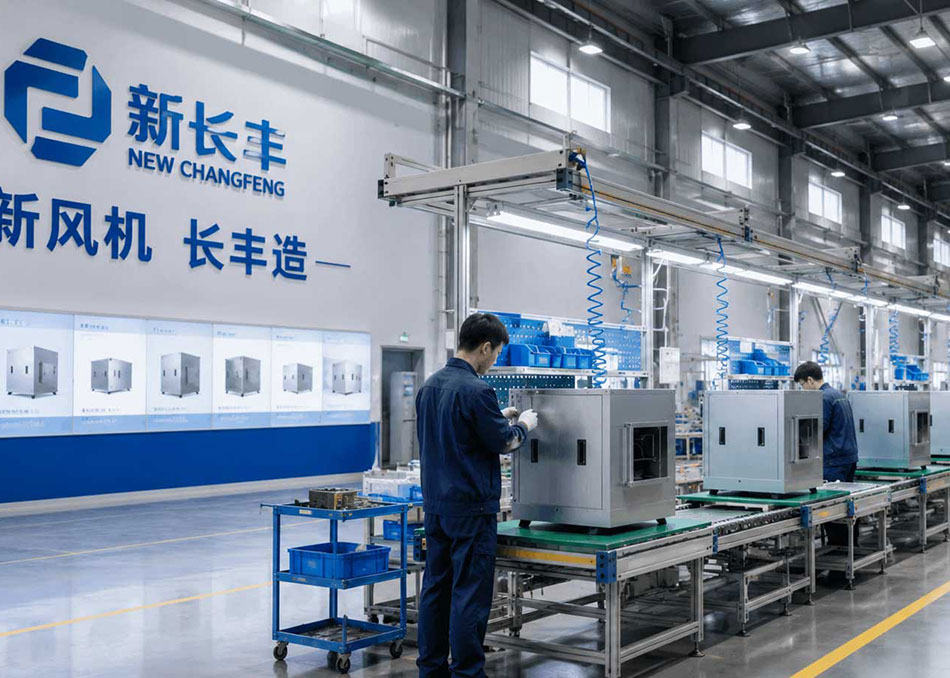
During hot summer months, industrial workshops often become unbearably hot due to heat accumulation and poor air circulation. Processes such as welding, casting, injection molding, textile production, and packaging generate continuous heat, while large roof areas absorb solar radiation and dense equipment layouts hinder natural ventilation. Workers feel stifled, their attention wanes, and productivity and product quality can suffer. To systematically address this challenge, a comprehensive approach considering ventilation method, equipment selection, and installation layout is essential. Negative pressure fans are a mainstream solution for workshop ventilation and cooling. XCFFJ (Xinchangfeng) has long focused on product development and engineering practices for industrial scenarios. This article provides a complete overview, from technical principles to practical implementation.
1. How Negative Pressure Ventilation Works: Why It Suits Large Workshops
The core principle of negative pressure ventilation is straightforward: exhaust fans are installed on one side of the workshop's exterior wall or roof to forcibly expel hot, stale air, creating a slight negative pressure relative to the outdoors. Fresh outdoor air then continuously enters through opposite doors, windows, louvers, or air inlets, forming a directed airflow path inside the workshop. Unlike fans that merely stir indoor air, this method achieves true air exchange, effectively removing heat, odors, and dust concentrations.
From an aerodynamic perspective, negative pressure fans typically use axial impellers, where blades push air along the axis. Combined with the outer frame and louver structure, this design achieves high airflow with low resistance. Performance can be evaluated according to GB/T 1236 Industrial Fans – Performance Testing Using Standardized Airways, and energy efficiency should meet GB 19761 Minimum Allowable Values of Energy Efficiency and Energy Efficiency Grades for Fans. For workshop cooling, the key is to match fan specifications to the space volume and heat load, ensuring sufficient air changes per hour without excessive noise or energy consumption.
2. Key Selection Criteria for Negative Pressure Fans
Selecting the right negative pressure fan involves several factors:
- Airflow and static pressure: Calculate the required airflow based on workshop volume, heat generation, and desired air changes. Static pressure must overcome resistance from louvers, ducts, and external wind.
- Energy efficiency: Choose fans that comply with GB 19761 to minimize operating costs. High-efficiency motors and optimized blade profiles contribute to lower power consumption.
- Noise levels: Industrial environments require attention to noise. Look for fans with low sound power levels, and consider acoustic accessories if needed.
- Durability and maintenance: Fans should be constructed with corrosion-resistant materials and easily accessible for cleaning and maintenance, especially in dusty or humid environments.
- Safety and compliance: For applications involving smoke and heat exhaust, refer to GB 51251 Technical Standard for Smoke Control Systems in Buildings. For kitchen exhaust, GB 18483 Emission Standard of Cooking Fume applies.
XCFFJ offers a range of negative pressure fans designed for industrial use, with options to suit different workshop sizes and ventilation requirements. Our team can assist in sizing and selection to ensure optimal performance.
3. Installation and Layout Best Practices
Proper installation is critical to achieving the desired ventilation effect. Consider the following guidelines:
- Strategic placement: Install exhaust fans on the leeward side or at high points where hot air accumulates. Ensure unobstructed air inlets on the opposite side to allow smooth airflow across the workshop.
- Airflow path: Avoid obstacles that block the airflow. Arrange equipment and workstations to maintain clear pathways for air movement.
- Zoning: For large workshops, divide the space into zones with separate fans to provide targeted ventilation and avoid short-circuiting of air.
- Regular maintenance: Schedule periodic cleaning of fan blades and louvers to maintain performance. Check belts and bearings for wear.
XCFFJ provides technical support and installation guidance to ensure your negative pressure ventilation system operates efficiently.
4. Integrating Negative Pressure Fans with Other Cooling Solutions
While negative pressure fans are effective on their own, they can be combined with other cooling methods for enhanced comfort:
- Evaporative air coolers: These units cool incoming air through water evaporation, providing a refreshing breeze. When used as the fresh air source for negative pressure ventilation, they can significantly lower indoor temperatures.
- High-volume low-speed (HVLS) fans: These large ceiling fans circulate air gently, complementing negative pressure ventilation by improving air mixing and destratification.
- Ducted systems: For targeted cooling of specific areas, ducting can direct cooled air where needed.
XCFFJ offers a comprehensive portfolio including evaporative air coolers, axial fans, and centrifugal fans, enabling integrated solutions tailored to your workshop's needs.
Frequently Asked Questions
Q: How do I determine the right number of negative pressure fans for my workshop?
A: The number depends on workshop volume, heat load, and desired air changes per hour. A common approach is to calculate total required airflow (workshop volume × air changes) and divide by the airflow capacity of a single fan. Consult with a ventilation engineer or XCFFJ's technical team for precise sizing.
Q: Can negative pressure fans be used in workshops with dust or corrosive fumes?
A: Yes, but choose models with appropriate protection. For dusty environments, consider fans with easy-to-clean blades and filters. For corrosive fumes, select corrosion-resistant materials or explosion-proof motors if flammable gases are present.
Q: What maintenance do negative pressure fans require?
A: Regular maintenance includes cleaning blades and louvers, checking belt tension (for belt-driven models), lubricating bearings, and inspecting electrical connections. Frequency depends on operating hours and environmental conditions; typically, quarterly inspections are recommended.
Q: Are negative pressure fans energy-efficient?
A: Modern negative pressure fans can be highly efficient, especially those compliant with GB 19761. Look for fans with aerodynamic blade designs and high-efficiency motors. Variable frequency drives (VFDs) can further optimize energy use by adjusting fan speed to demand.
Negative pressure fans are a proven, cost-effective solution for industrial workshop ventilation and cooling. By understanding the principles, selecting the right equipment, and following best installation practices, you can create a more comfortable and productive work environment. XCFFJ is dedicated to providing high-quality ventilation and cooling products backed by technical expertise. Contact us today to discuss your workshop's specific requirements and discover how our solutions can help you beat the heat.