
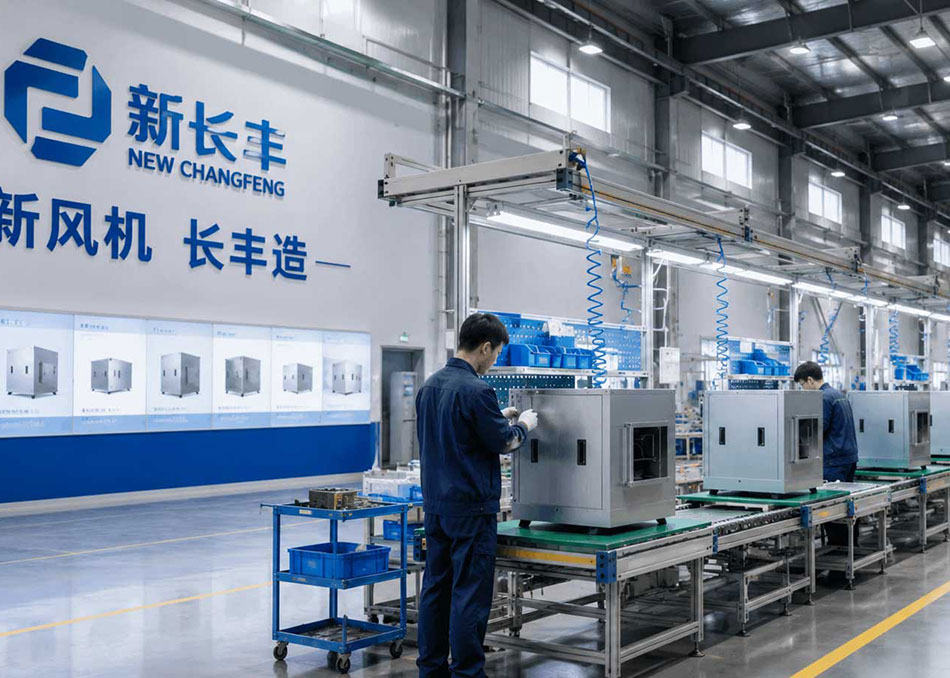
Internet cafés and commercial kitchens may look like unrelated businesses, but they share a surprisingly similar ventilation problem: enclosed spaces, dense occupants or heat sources, and indoor air quality that directly affects customer experience, staff stability, and regulatory compliance. For internet cafés, air quality influences how long customers stay and whether they return. For restaurant kitchens, it affects food safety, employee retention, and environmental acceptance. Water-cooled fresh air units—combining evaporative cooling with mechanical supply air—are stepping into a key role in both settings. This article starts from the real ventilation and cooling needs of internet cafés, then extends to kitchen cooling support equipment and the system logic behind kitchen negative pressure and make-up air, offering practical selection guidance for facility managers, restaurant operators, and HVAC contractors.
Why Ordinary Fans and Air Conditioners Fall Short in Internet Cafés
Internet cafés typically combine high occupant density, continuous heat output from computer equipment, and doors and windows that stay closed for long periods. Body heat and equipment heat stack up, so indoor temperatures often run higher than outdoors, while CO₂ levels and odors rise in parallel. Relying on split-system air conditioners alone means a large share of cooling capacity is consumed by sensible heat, and because no fresh air is introduced, air quality never improves. Floor fans merely stir hot air around; they do not lower perceived temperature or resolve stuffiness and oxygen depletion.
The working principle of a water-cooled fresh air unit is “supply fresh air + evaporative cooling + directed airflow organization.” The unit draws outdoor air through a wet cooling pad, where evaporative cooling lowers its temperature before it is delivered indoors. At the same time, a slight positive pressure path forms through door and window gaps or dedicated exhaust openings, pushing hot, stale air out. Compared with conventional air conditioning, this approach does not rely on compressor-based refrigeration, so operating energy consumption is lower, and it continuously introduces oxygen-rich fresh air—precisely the resource internet cafés lack most.
Zoned by Seating: Making Airflow Work Where It Matters
An internet café is not a uniform box. Gaming zones, VIP rooms, smoking areas (where permitted), and rest areas have different heat loads and occupancy patterns. Treating the whole floor with a single air strategy usually leaves some corners stuffy while over-cooling others. A better approach is to zone by seating: identify the densest, hottest zones and position supply air outlets so fresh, cooled air reaches occupants directly before mixing with room air.
Directional airflow organization matters as much as cooling capacity. Supply outlets should be placed to create a gentle, draft-free flow across seating rows, with return or exhaust paths located on the opposite side to prevent short-circuiting. Because water-cooled fresh air units deliver air at a lower temperature than ambient but not as cold as compressor-based systems, the perceived comfort depends heavily on air velocity and distribution. Adjustable louvers, diffusers, and zone-level control help match airflow to actual occupancy throughout the day.
From Internet Café to Kitchen: Cooling Support Equipment and Negative Pressure
The same fresh-air logic applies to commercial kitchens, but with a critical twist: kitchens need more than cooling—they need controlled negative pressure. Cooking generates heat, grease vapor, moisture, and odors. If the exhaust hood extracts air faster than make-up air enters, the kitchen goes into strong negative pressure, causing doors that are hard to open, fume leakage into dining areas, and poor hood capture efficiency.
Kitchen cooling support equipment and make-up air units solve this by balancing extraction with conditioned supply air. A water-cooled fresh air unit can deliver cooled make-up air directly into the kitchen, reducing the temperature of the incoming air while maintaining the pressure balance the exhaust system needs. The goal is a slight negative pressure relative to the dining area—enough to contain fumes and odors—without starving the hoods or creating uncomfortable drafts at workstations.
- Balance exhaust and supply: Size make-up air to match hood extraction, accounting for natural infiltration.
- Cool the make-up air: Untreated outdoor air can be hotter than the kitchen itself; evaporative cooling reduces the heat load on staff.
- Protect hood capture: Excessive negative pressure pulls fumes past the hood; insufficient make-up air causes the same problem from the other direction.
- Route supply away from hoods: Deliver make-up air to occupied zones, not directly into the exhaust plume.
Selection and Design Considerations
Choosing a water-cooled fresh air unit should begin with a clear load calculation rather than a rule of thumb. For internet cafés, estimate heat gain from occupants, monitors, lighting, and building envelope, then determine the fresh air volume needed to keep CO₂ within comfortable limits. For kitchens, start with hood exhaust volume and work backward to the make-up air requirement, then factor in the cooling load of the incoming air.
Fan performance should be verified against recognized testing standards such as GB/T 1236 for airflow and pressure, and energy efficiency evaluated in line with GB 19761. Where smoke and heat exhaust systems are involved, GB 51251 provides the relevant design framework, and kitchen fume emissions should be checked against GB 18483. These references help ensure that equipment selection is defensible to inspectors, consultants, and operators alike.
Practical factors also matter: water quality and pad maintenance for evaporative cooling, noise levels near seating or workstations, ease of filter and pad replacement, and the ability to integrate with existing exhaust and control systems. A unit that performs well on paper but is difficult to maintain will lose efficiency quickly in daily operation.
Frequently Asked Questions
Q: Can a water-cooled fresh air unit replace air conditioning in an internet café?
A: In many cases it can serve as the primary cooling and ventilation solution, particularly in dry climates where evaporative cooling is effective. In humid regions or spaces with very high sensible loads, it may work best as a fresh-air and pre-cooling system alongside conventional cooling. The right answer depends on climate, load calculation, and comfort targets.
Q: Why does my kitchen have strong negative pressure even with an exhaust hood running?
A: Strong negative pressure usually means the exhaust system is removing more air than is being supplied. Without adequate make-up air, the hood starves, doors become difficult to open, and fumes can leak into dining areas. Adding a properly sized make-up air unit—ideally with cooling—restores balance and improves hood capture.
Q: How do I know what airflow capacity I need?
A: Avoid guessing. For internet cafés, calculate based on occupant density, equipment heat, and fresh-air requirements per person. For kitchens, base the figure on hood exhaust volume and the desired pressure relationship between kitchen and dining areas. A qualified HVAC engineer can verify the numbers against GB/T 1236 testing data and local code requirements.
Q: Does evaporative cooling increase humidity to an uncomfortable level?
A: Evaporative cooling does add moisture to the supply air, and the effect depends on the starting humidity of the outdoor air. In dry conditions the increase is usually welcome; in already humid conditions, the cooling benefit diminishes. Ventilation rate and air changes also help manage indoor humidity, which is why proper system design matters more than the unit alone.
Bringing Ventilation and Cooling Together
Internet cafés and commercial kitchens sit at opposite ends of the hospitality spectrum, yet both depend on the same fundamentals: sufficient fresh air, controlled pressure, and cooling that does not come at the expense of air quality. Water-cooled fresh air units offer a practical way to deliver cooled, oxygen-rich supply air while supporting the pressure relationships that keep spaces comfortable and compliant. Whether the goal is keeping gamers cool through a long session or keeping kitchen fumes where they belong, the starting point is the same—calculate the load, balance the airflow, and choose equipment that can be maintained for the long run.
For facility managers and contractors evaluating options, XCFFJ manufactures water-cooled fresh air units and a broader range of industrial and commercial ventilation equipment. A conversation about your space, climate, and exhaust configuration is the fastest route to a workable specification.