
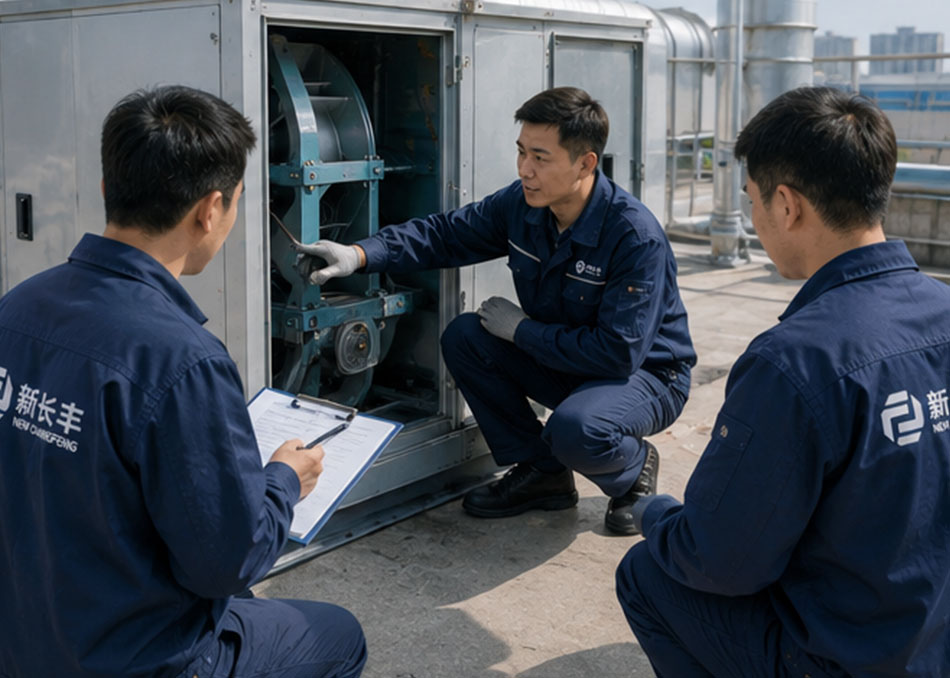
Commercial kitchen exhaust systems are a persistent headache for restaurant owners and HVAC engineers alike. Greasy smoke, poor ventilation, noise complaints, and fines for substandard emission control – these problems often trace back not to the hood or the purifier, but to the misselection of the ventilation equipment that serves as the system's heart. Among the various fan types, cabinet centrifugal fans have emerged as the mainstream choice for commercial kitchen exhaust, thanks to their high static pressure, oil-resistant construction, and stable airflow. This article dives into the real-world conditions of kitchen exhaust, offering a systematic look at centrifugal fan selection logic, installation essentials, and common pitfalls – helping you avoid procurement traps and build an efficient, compliant, and low-noise exhaust purification system.
Why Centrifugal Fans Are the Preferred Choice for Commercial Kitchen Exhaust
Kitchen exhaust differs fundamentally from general workshop ventilation: the air is hot, laden with grease, and must travel through long duct runs with multiple elbows, while also overcoming the resistance of downstream components like electrostatic precipitators and silencers. Axial fans, though capable of moving large volumes of air, generate very low static pressure. When duct resistance increases or the purifier's pressure drop rises, their airflow drops sharply, leaving smoke unable to be extracted effectively. Centrifugal fans, by contrast, use the centrifugal force of a rotating impeller to raise the air's pressure, enabling them to overcome the resistance of longer ducts and purification equipment. This ensures that the capture hood maintains sufficient negative pressure to collect grease-laden fumes at the source before they spread.
Moreover, the interior of kitchen exhaust ducts accumulates grease over time, causing resistance to climb steadily. Cabinet centrifugal fans are typically designed with belt-drive or direct-drive configurations and feature access doors for easy cleaning of the impeller and volute casing. High-quality models also incorporate sealed bearings and corrosion-resistant coatings, extending service life even under harsh, greasy conditions.
Key Selection Criteria: Matching the Fan to the Kitchen's Real Needs
Choosing the right centrifugal fan for a commercial kitchen requires a careful assessment of several factors beyond just airflow. Here are the core criteria to evaluate:
- Static Pressure Capability: Calculate the total system resistance – including duct length, number of elbows, the pressure drop across the purification unit, and the exhaust hood's required negative pressure. The fan must be able to deliver the required airflow at that static pressure, not just at free-air conditions.
- Airflow (CFM/CMH): Determine the required exhaust rate based on the kitchen's size, cooking equipment heat output, and local ventilation codes. A common rule of thumb is 40–60 air changes per hour for commercial kitchens, but always verify with applicable standards.
- Construction and Materials: The fan housing and impeller should be made of materials that resist corrosion and grease buildup. Galvanized steel is standard, but stainless steel may be necessary for highly corrosive environments. Look for a drain plug at the bottom of the volute to remove accumulated oil.
- Drive Type: Belt-driven fans allow for adjustable speed by changing pulley sizes, offering flexibility to fine-tune performance. Direct-drive fans are more compact and require less maintenance but are less adjustable. For kitchen exhaust, belt-driven models are often preferred for their ease of balancing and maintenance.
- Noise Considerations: Noise is a major complaint in urban settings. Check the fan's sound power level and consider integrating silencers or choosing a fan with a lower RPM for the required duty. Some cabinet fans are specifically designed with acoustic insulation.
- Compliance and Certification: Ensure the fan meets relevant local and international standards, such as AMCA (Air Movement and Control Association) for performance testing, and that the overall system complies with fire safety and emission regulations (e.g., NFPA 96 in North America or EN 12101 in Europe).
It's also vital to consider future maintenance. A fan that is difficult to access or clean will quickly degrade in performance. Look for features like hinged access doors, removable impellers, and tool-less latches that simplify routine servicing.
Installation and Commissioning: Avoiding Common Pitfalls
Even a perfectly selected fan will underperform if installed incorrectly. Here are some best practices for installation and commissioning:
- Proper Mounting: The fan should be mounted on a solid, level foundation to minimize vibration. Use vibration isolators (spring or rubber) to prevent transmission of vibration to the building structure.
- Ductwork Connections: Use flexible connections between the fan and ductwork to isolate vibration and accommodate thermal expansion. Ensure that ductwork is properly supported and does not impose additional weight on the fan.
- Adequate Clearance: Provide sufficient clearance around the fan for maintenance access. Check the manufacturer's recommendations for minimum clearances.
- Electrical and Control: Ensure the motor is correctly wired and protected. Variable frequency drives (VFDs) are increasingly used to allow soft-starting and speed control, which can save energy and reduce noise.
- System Balancing: After installation, measure the actual airflow and static pressure to verify they meet design specifications. Adjust the fan speed or dampers as needed to achieve the desired performance.
One of the most frequent mistakes is neglecting to account for the pressure drop of the air pollution control device (e.g., electrostatic precipitator). As the device loads with grease, its resistance increases, which can starve the fan of airflow if the fan was not specified with sufficient static pressure margin. Always include a safety factor of 10–20% in static pressure calculations.
Common Misconceptions and Selection Errors
Several misconceptions can lead to poor fan selection. By understanding these, you can make a more informed decision:
- Bigger is always better: Oversizing a fan leads to higher energy consumption, increased noise, and potentially excessive airflow that can cause draft issues or reduce capture efficiency. Proper sizing is key.
- Airflow is the only metric: As mentioned, static pressure is equally critical. A fan that moves 10,000 CFM at free air may only deliver 5,000 CFM when connected to a duct system with 2 inches of static pressure.
- All centrifugal fans are the same: There are different impeller designs (forward-curved, backward-curved, airfoil) each with specific performance characteristics. Forward-curved fans are common in kitchen exhaust due to their compact size and high airflow at low static pressures, but backward-curved fans are more efficient and handle higher static pressures. The choice depends on the specific system requirements.
- Ignoring the total system: The fan is just one component. The hood design, duct layout, and purification equipment all interact. A holistic approach to system design is essential.
Another common error is selecting a fan based solely on the kitchen area without considering the type of cooking equipment. A charbroiler or wok station generates far more smoke and heat than a standard range, requiring higher exhaust rates and possibly additional capture hoods. Always perform a detailed load calculation.
FAQ: Addressing Your Key Questions
Q: How do I calculate the required static pressure for my kitchen exhaust system?
A: Sum the pressure losses of all components: the exhaust hood (typically 0.1–0.5 in. WG), duct friction (based on length, diameter, and number of elbows), the grease filter, the air pollution control device (e.g., electrostatic precipitator, typically 0.5–1.0 in. WG), and any silencers. Add a safety margin of 10–20%. For accurate calculations, consult ASHRAE Fundamentals or use specialized duct design software.
Q: Can I use an axial fan for my small restaurant kitchen?
A: In very short, low-resistance duct runs with minimal elbows and no purification device, an axial fan might work. However, for most commercial kitchens where exhaust treatment is mandatory, the added pressure drop from the purifier and longer ductwork means a centrifugal fan is usually required to ensure reliable performance. It's safer to consult an HVAC professional.
Q: How often should I clean or maintain my centrifugal fan?
A: Maintenance frequency depends on the volume of cooking and grease load. As a general rule, inspect the fan monthly and clean the impeller and interior whenever grease buildup is visible (often every 3–6 months). Regularly check the belt tension (if belt-driven), lubricate bearings as per the manufacturer's schedule, and verify that the drain plug is not clogged. Regular maintenance prevents performance degradation and extends fan life.
Q: What is the difference between forward-curved and backward-curved centrifugal fans for kitchen exhaust?
A: Forward-curved fans have blades that curve in the direction of rotation. They are compact, operate at lower speeds, and are suitable for systems with moderate static pressure (up to about 3 in. WG). Backward-curved fans have blades that curve away from the direction of rotation. They are more efficient, handle higher static pressures, and are less prone to overloading the motor. For kitchen exhaust with high static pressure or energy efficiency goals, backward-curved fans are often preferred.
Q: How can I reduce noise from my kitchen exhaust fan?
A: Several strategies can help: select a fan with a lower sound power level, use a VFD to run the fan at a lower speed during off-peak hours, install silencers in the ductwork, and ensure proper vibration isolation. Additionally, the fan should be located away from noise-sensitive areas, and ductwork should be rigid and well-sealed to prevent vibration.
In summary, selecting the right centrifugal fan for your commercial kitchen exhaust is a critical decision that affects not only air quality and compliance but also energy costs and occupant comfort. By understanding the unique demands of kitchen exhaust systems, evaluating key performance metrics, and avoiding common mistakes, you can ensure a reliable and efficient ventilation solution. For expert guidance and a wide range of high-quality cabinet centrifugal fans designed for commercial kitchen applications, consult with XCFFJ's specialists today.