
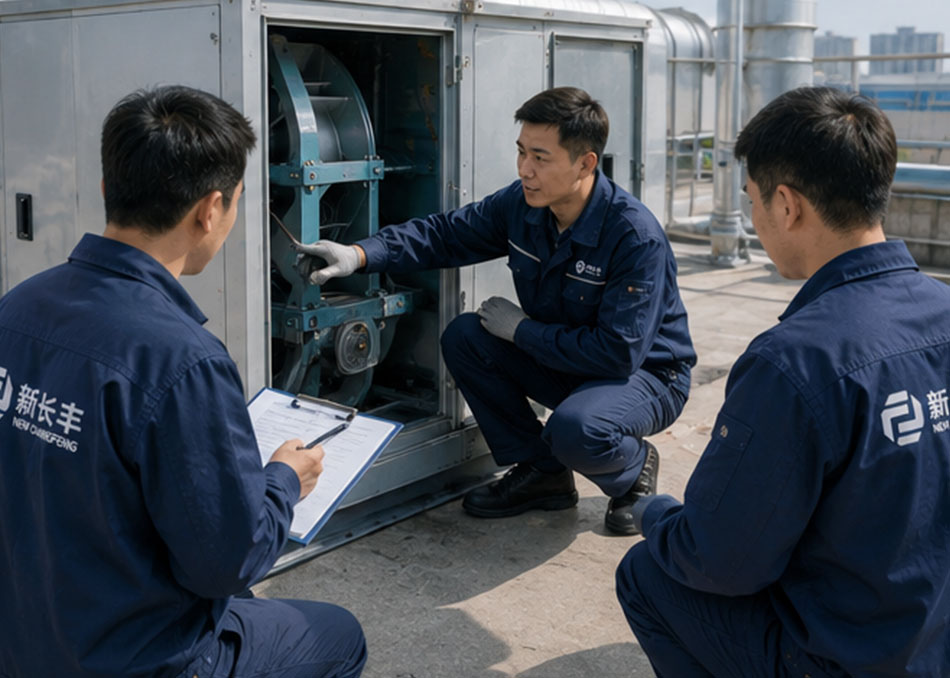
Factory floors, commercial kitchens, and production workshops share a common challenge: when ventilation systems are poorly designed, fume exhaust weakens, grease-laden air leaks into occupied spaces, work zones become stifling, and noise levels creep above acceptable limits. These symptoms often trace back to a single critical component—the centrifugal fan. As the power source of industrial ventilation and fume purification systems, the fan's selection directly determines exhaust effectiveness, energy consumption, and long-term operational stability. This guide examines how centrifugal fans perform in factory ventilation, with a focus on fume exhaust and purification, helping facility managers, HVAC contractors, and equipment buyers build a clear selection framework.
Why Centrifugal Fans Dominate Factory Fume Exhaust
A centrifugal fan works by spinning an impeller at high speed, throwing gas outward by centrifugal force into a scroll casing, and discharging it through the outlet. Unlike axial fans, centrifugal units maintain stable pressure output even against higher system resistance. That characteristic makes them especially suited to exhaust systems with long duct runs, multiple elbows, or integrated purification devices. Factory workshops and production kitchens rarely have simple, straight duct paths—if static pressure is insufficient, extraction weakens and fumes linger.
In terms of construction, cabinet centrifugal fans, DT cabinet centrifugal fans, and multi-wing centrifugal fans are among the most common types in industrial and commercial fume purification. Cabinet designs include an integral enclosure that provides noise attenuation and physical protection—suitable where acoustic limits or installation conditions matter. Multi-wing impellers, meanwhile, deliver relatively smooth airflow at a given size, which helps reduce turbulence and noise in ductwork.
For fume exhaust, the fan must also be compatible with purification stages. Grease filters, electrostatic precipitators, and UV units all add resistance. A fan selected only for bare ductwork will underperform once these components are installed. Evaluating the entire system resistance—not just the fan's free-air performance—is essential.
- Stable pressure under resistance: Centrifugal fans hold airflow better than axial types when filters and long ducts are present.
- Cabinet options for noise control: Enclosed designs help meet workplace noise requirements.
- Multi-wing impeller benefits: Smoother airflow and lower turbulence in complex duct layouts.
- Purification compatibility: Selection must account for added resistance from grease filters, ESP cells, and UV sections.
Key Selection Factors for Fume Exhaust & Purification Systems
Selecting a centrifugal fan for factory ventilation with fume purification requires more than picking a model number. The first step is a clear duty analysis: what is the required exhaust volume at the hood or capture point? What is the total system resistance, including duct friction, elbows, dampers, and purification stages? What is the actual air density and temperature at the fan inlet? These parameters determine the fan's operating point, not its catalog maximum.
Standards provide a useful reference. GB/T 1236 defines fan performance testing methods, helping buyers compare published curves on a consistent basis. GB 19761 establishes fan energy efficiency grades—an increasingly important factor as operating costs accumulate over years of continuous running. For smoke exhaust systems, GB 51251 addresses smoke and heat exhaust ventilation requirements, which may call for fans rated for high-temperature operation. In commercial kitchen applications, GB 18483 sets kitchen fume emission limits, meaning the fan must work in harmony with purification equipment to meet discharge standards.
Beyond performance, practical factors matter: available installation space, duct connection orientation, maintenance access, and whether the fan will handle grease-laden or corrosive airstreams. A fan that is oversized wastes energy and can increase noise; one that is undersized will fail to capture fumes at the source. The goal is a fan that operates near its best efficiency point under real-world resistance.
- Duty analysis first: Determine required airflow, total resistance, and air conditions before choosing a model.
- Use standard test data: Compare fan curves based on GB/T 1236 testing methods.
- Check energy efficiency: GB 19761 grades help estimate long-term power costs.
- Match purification stages: Account for grease filters, ESP, and UV resistance in the system curve.
- Plan for maintenance: Ensure access for cleaning and service, especially in grease-heavy exhaust.
Matching Fan Types to Factory and Kitchen Applications
Not every centrifugal fan suits every exhaust scenario. In factory workshops where welding fumes, oil mist, or dust are present, the fan may need to handle particulate-laden air. Multi-wing centrifugal fans are often chosen for their ability to move large air volumes at moderate pressure, but impeller design and material must resist buildup and wear. In commercial kitchens and school canteens, where grease and moisture are constant, cabinet centrifugal fans with accessible cleaning points are frequently preferred.
For large warehouse logistics or industrial halls requiring general ventilation alongside localized exhaust, a combination approach may work best: axial fans or roof turbo ventilators for general air exchange, and centrifugal fans dedicated to fume capture and purification. This division of labor prevents overloading a single fan type with conflicting duties—general ventilation needs high flow at low pressure, while fume exhaust needs higher pressure to overcome purification resistance.
Noise is another differentiator. Cabinet designs with acoustic lining can reduce sound transmission, but duct-borne noise may still require silencers. In noise-sensitive areas, selecting a fan that operates at lower speed and higher efficiency—rather than throttling a larger fan—often yields a better acoustic outcome. Variable frequency drives can further match fan speed to actual demand, saving energy during partial-load periods.
- Factory workshops: Multi-wing or cabinet centrifugal fans for oil mist, welding fume, and dust-laden exhaust.
- Commercial kitchens & canteens: Cabinet centrifugal fans with easy-clean features and grease-compatible construction.
- Warehouse & logistics: Combine axial or roof ventilators for general air exchange with centrifugal fans for localized fume exhaust.
- Noise control: Consider acoustic cabinets, silencers, and VFD speed control to meet workplace limits.
- Energy management: VFD operation matches output to demand, reducing power use at partial load.
Installation, Commissioning, and Maintenance Practices
Even a well-selected centrifugal fan can underperform if installed poorly. Duct connections should be aligned to avoid unnecessary elbows and abrupt transitions, which add resistance and turbulence. Flexible connectors help isolate vibration but must be installed without sagging or sharp bends that restrict airflow. The fan should sit on a level, rigid base with appropriate vibration isolation, and discharge orientation should match the duct layout to minimize pressure loss.
Commissioning is the step where design intent meets reality. Measuring actual airflow and static pressure at the fan, and comparing them to the design operating point, reveals whether the system is balanced. If airflow is low, the cause may be excess resistance, leakage, or incorrect fan speed—not necessarily an undersized fan. Addressing these issues before adjusting fan speed or replacing equipment saves time and cost.
Maintenance requirements vary with the airstream. Grease-laden exhaust demands regular cleaning of impeller and casing to prevent imbalance and fire risk. Dusty environments require inspection for buildup and wear on impeller blades. Bearings need lubrication according to the manufacturer's schedule, and belts—if present—should be checked for tension and wear. Keeping a maintenance log helps identify recurring issues and supports warranty claims.
- Duct alignment: Minimize elbows and transitions to reduce system resistance.
- Vibration isolation: Use flexible connectors and proper mounts without restricting airflow.
- Commissioning measurements: Verify actual airflow and pressure against design values.
- Cleaning schedule: Grease and dust buildup affect balance, efficiency, and safety.
- Bearing and belt care: Follow manufacturer guidance for lubrication and tension checks.
Frequently Asked Questions
Q: What is the difference between a centrifugal fan and an axial fan for factory ventilation?
A: Centrifugal fans draw air into the center of a spinning impeller and discharge it perpendicular to the intake, generating higher pressure. Axial fans move air parallel to the shaft and are better for high-flow, low-pressure applications. For fume exhaust with long ducts or purification equipment, centrifugal fans are generally more suitable because they maintain airflow against higher resistance.
Q: How do I account for purification equipment when selecting a centrifugal fan?
A: Purification components such as grease filters, electrostatic precipitators, and UV units add resistance to the system. You should calculate the total system resistance—including ductwork, fittings, and purification stages—and select a fan whose performance curve intersects that resistance at the desired airflow. Using only the fan's free-air rating will lead to underperformance once purification is installed.
Q: What standards should I reference when comparing centrifugal fan performance?
A: GB/T 1236 provides standardized fan performance testing methods, allowing consistent comparison of airflow and pressure data. GB 19761 covers fan energy efficiency grades, which helps estimate operating costs. For smoke exhaust applications, GB 51251 addresses smoke and heat exhaust ventilation, and GB 18483 sets kitchen fume emission limits that the overall system must meet.
Q: Can I use a variable frequency drive (VFD) with a centrifugal fan?
A: Yes, VFDs are commonly used to match fan speed to actual demand. This can reduce energy consumption during partial-load conditions and lower noise at reduced speeds. However, ensure the fan and motor are compatible with VFD operation, and avoid operating at speeds that cause resonance or insufficient motor cooling.
Q: How often should a centrifugal fan in a kitchen exhaust system be cleaned?
A: Cleaning frequency depends on grease loading and operating hours. In heavy commercial kitchens, impeller and casing inspections may be needed monthly or quarterly, with cleaning as required to prevent imbalance and fire risk. Establish a schedule based on observed buildup, and keep records for safety and warranty purposes.
Building a Reliable Fume Exhaust System
Centrifugal fans are the backbone of factory ventilation and fume purification, but their effectiveness depends on proper selection, installation, and maintenance. By analyzing the full system resistance, referencing standards like GB/T 1236 and GB 19761, and matching fan type to the application—whether factory workshop, commercial kitchen, or warehouse—you can achieve consistent exhaust, lower energy use, and fewer noise complaints. XCFFJ manufactures a range of centrifugal fans, cabinet fans, and complete ventilation solutions designed for industrial and commercial fume exhaust. To discuss your project requirements or request a selection consultation, visit www.xcffj.com.