
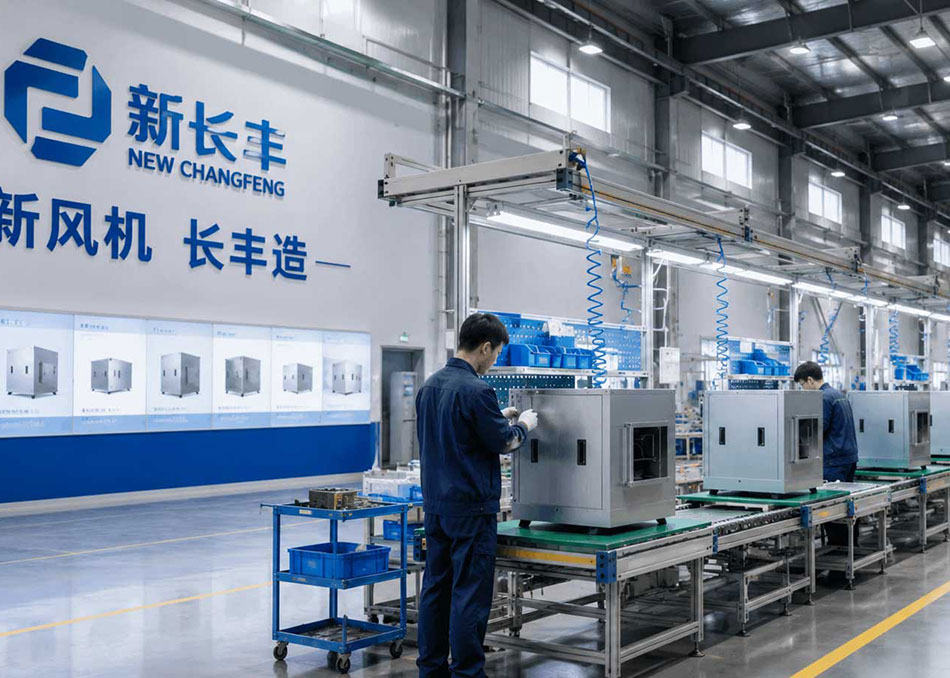
Internet cafe operators across the Pearl River Delta know the pattern well: outdoor condensers roaring through the summer, indoor air that feels sticky and stale, customers leaving early, and gaming rigs throttling under heat. Internet cafes are high-density occupied spaces — rows of PCs and monitors run continuously, doors and windows stay shut, and fresh air is often an afterthought. The result is an environment that may not read as extremely hot on a thermometer but feels clammy, heavy, and stuffy. Split systems and cabinet air conditioners handle sensible heat, yet they do little for air quality or humidity, and the electricity bill keeps climbing. Water-cooled fresh air units — which combine evaporative cooling with filtered outdoor air supply — have entered the conversation as a lower-energy way to reset the whole indoor environment. This article looks at how to select one sensibly, given the Delta's climate and real ventilation engineering constraints.
Start With the Real Pain Points of a Delta Internet Cafe
The Pearl River Delta sits in a subtropical monsoon zone: long summers, high humidity, and a large share of the year in damp conditions. An internet cafe adds its own load profile — extended operating hours, dense occupancy, sealed openings, and concentrated heat sources. That combination means the ventilation and cooling brief differs from a typical office: you need cooling, yes, but also a genuine fresh air supply and humidity control, so the space does not become more oppressive the longer the fans run.
From an engineering standpoint, the common failures cluster into three areas:
- Insufficient fresh air: CO₂ rises in a sealed room, and customers feel drowsy and headachy — which shortens visits and hurts return business.
- No humidity strategy: During the spring damp season and the plum rains, outdoor air carries a heavy moisture load. Conventional air conditioning has limited dehumidification capacity, so the space feels slick and clammy.
- Imbalanced exhaust and makeup air: Where mechanical exhaust is installed without matching makeup air, the space goes negative, doors drag, and outdoor humidity and dust get pulled in through every gap.
A water-cooled fresh air unit addresses all three at once: it delivers filtered outdoor air, drops the supply temperature through evaporative cooling, and — when paired correctly with exhaust — keeps the space at a controlled slight negative pressure rather than an uncontrolled one.
How a Water-Cooled Fresh Air Unit Actually Works
Unlike a refrigerant-based air conditioner, a water-cooled fresh air unit uses evaporative cooling: outdoor air passes through a wetted cooling medium, and as water evaporates it absorbs heat, lowering the dry-bulb temperature of the supply air. Because the unit is continuously drawing in outdoor air, it simultaneously satisfies the fresh air requirement — one device doing the work that would otherwise need a separate fresh air fan plus additional cooling capacity.
Two engineering points matter for internet cafes. First, evaporative cooling is most effective in hot, dry air; in the Delta's humid summers the temperature drop is smaller than in northern China, so the unit should be specified as a fresh air and ventilation solution that reduces cooling load, not as a standalone replacement for all air conditioning. Second, because the unit runs on a fan and a water circuit rather than a compressor, its power draw is typically far lower than equivalent refrigerated cooling — which is precisely why operators in high-electricity-cost areas take interest.
Selection should be grounded in verifiable performance data. Ask suppliers for fan performance tested to GB/T 1236 (industrial fan aerodynamic performance testing) and check energy efficiency against GB 19761 (fan energy efficiency grades and minimum allowable values). For any ductwork serving the space, smoke control provisions should follow GB 51251 where the system doubles as part of the building's smoke and heat exhaust strategy. Units from established manufacturers such as XCFFJ are specified this way — with documented airflow and pressure characteristics rather than marketing claims.
Matching Fresh Air Volume, Exhaust, and Pressure Balance
The most common mistake in internet cafe ventilation is treating the fresh air unit as a standalone purchase. In practice, the supply air volume, the exhaust arrangement, and the building envelope form one system. A practical approach is to establish a slight negative pressure in the gaming hall relative to corridors and service areas — enough to keep odors and heat from migrating, but not so much that doors become hard to open or humidity is drawn in through leaks.
This is where the kitchen-side lesson applies directly. Commercial kitchens solve the same problem with a disciplined negative pressure strategy: the exhaust hood captures fumes, and a dedicated makeup air path supplies replacement air so the hood keeps capturing efficiently instead of starving. An internet cafe should be designed on the same principle — exhaust from the hot zone and restrooms, makeup air delivered to the occupied zone through the water-cooled fresh air unit, and a balanced pressure relationship between the two. Where the cafe includes a small food service counter, kitchen exhaust purification following GB 18483 (cooking fume emission standard) should be coordinated with the overall air balance so fume does not leak into the gaming area.
Concrete design steps:
- Calculate occupancy-based fresh air demand from actual seat count and expected turnover, not nameplate area.
- Size exhaust for the hot zone (PC rows, restrooms, any food prep) and size the fresh air unit to supply slightly less than total exhaust, preserving a controlled negative pressure.
- Route supply air to occupied breathing zones rather than dumping it at the ceiling; use ducting and diffusers to avoid drafts on seated customers.
- Provide a bypass or modulation strategy for the damp season, so the unit does not add moisture when outdoor humidity is already high.
Practical Selection and Installation Checklist
Once the air balance is set, unit selection comes down to matching the equipment to the space and the climate. Avoid specifying by rule of thumb alone; instead, work from the calculated supply volume, the available static pressure for the duct run, and the acoustic environment of the room.
- Airflow and static pressure: Confirm the unit can deliver the design volume against the actual duct resistance, using GB/T 1236 test data.
- Energy efficiency: Compare fan efficiency under GB 19761 and consider annual operating hours, since internet cafes often run near-continuously.
- Noise: Seated customers are close to supply points; specify low-noise fan configurations and isolate the unit from the gaming hall with duct lining or a plant area.
- Filtration: Multi-stage filtration protects the cooling medium and keeps supply air clean in a dusty urban environment.
- Water quality and maintenance: Plan for water treatment, drain and refill access, and periodic medium cleaning — evaporative systems need routine care to stay hygienic.
- Controls: Variable-speed fans and humidity/temperature sensing let the unit modulate rather than run flat out.
Installation matters as much as the spec sheet. Locate the unit where outdoor air is clean — away from kitchen exhaust discharges and vehicle fumes — and keep duct runs short and well-sealed. Commission the system by measuring actual supply and exhaust volumes and adjusting until the intended pressure relationship is achieved.
Frequently Asked Questions
Q: Can a water-cooled fresh air unit replace the internet cafe's air conditioning entirely?
A: In most Pearl River Delta cafes, no. Evaporative cooling delivers a meaningful temperature reduction and a large fresh air benefit at low energy cost, but during the most humid weeks its cooling effect is limited. The practical model is a hybrid: the water-cooled fresh air unit carries the fresh air and ventilation load and trims the cooling demand, while conventional air conditioning handles peak sensible heat. This combination usually lowers overall energy use compared with air conditioning alone.
Q: How do I know the fresh air volume is right for my seat count?
A: Base it on actual occupancy and expected dwell time rather than a fixed per-square-meter figure. Count seats, estimate peak simultaneous occupancy, and design for that figure with a margin. Then verify after installation by measuring CO₂ levels during peak hours — if concentrations stay in a comfortable range, the fresh air strategy is working.
Q: Why does pressure balance matter so much in an internet cafe?
A: Because unbalanced pressure undermines every other measure. Excessive negative pressure pulls hot, humid outdoor air through every crack and makes doors difficult to operate; positive pressure pushes conditioned air out and can spread odors into neighboring spaces. A controlled slight negative pressure in the gaming hall, achieved by matching exhaust to makeup air, keeps the space comfortable and stops humidity and odors from migrating.
Q: What maintenance does a water-cooled fresh air unit need?
A: Regular attention to the water circuit and cooling medium — cleaning, water quality management, and drain checks — plus filter replacement and fan inspection. Establish a service schedule at commissioning, because evaporative equipment that is neglected loses efficiency and can become a hygiene concern.
Summary
For a Pearl River Delta internet cafe, the right water-cooled fresh air unit is not simply the largest or cheapest model — it is the one specified against a calculated fresh air demand, a deliberate exhaust and pressure-balance strategy, and verifiable performance data under GB/T 1236 and GB 19761. Get the air balance right, plan for the humid season, and maintain the water circuit, and the unit will deliver what operators actually want: a comfortable, well-ventilated hall that keeps customers seated longer at a lower energy cost.
If you are planning a ventilation upgrade for a gaming venue, canteen, or commercial space, the XCFFJ team can help you match fresh air volume, exhaust, and equipment selection to your actual layout. Visit www.xcffj.com to review the product range and discuss your project.