
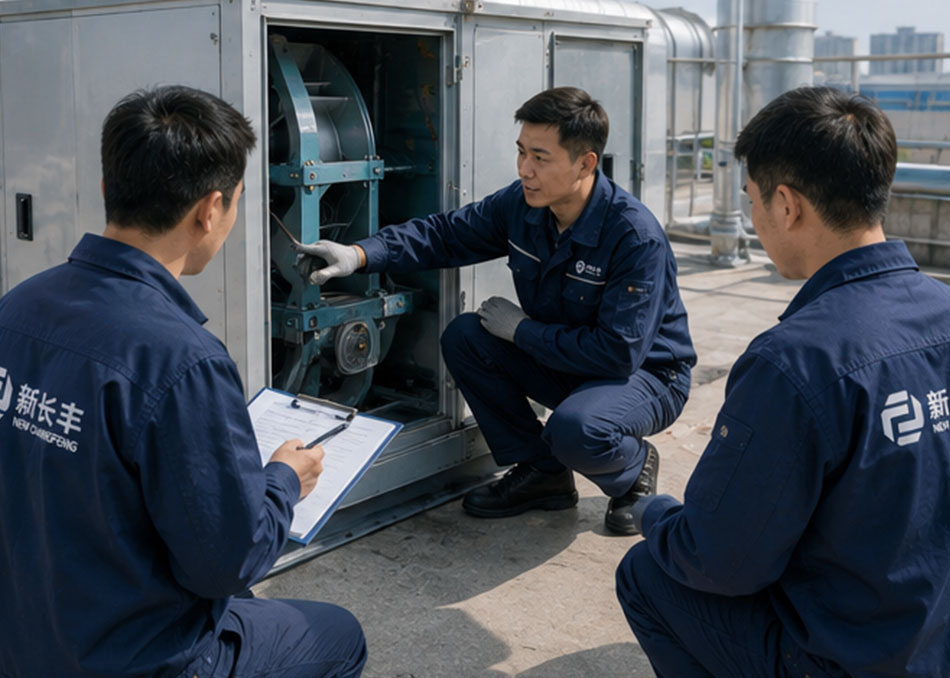
Hot-season factory floors are where production targets and employee satisfaction tend to collide. Welding, injection molding, die casting, textile processing and packaging all release heat continuously, and when you add dense equipment, concentrated workstations, high roof ridges and long air paths, opening doors and windows or placing a few pedestal fans rarely makes a real difference. Conventional compressor-based air conditioning carries high upfront cost, sensitive operating electricity bills and severe cooling loss every time a workshop door opens. That is why many plant managers are turning to evaporative cooling — and why water-cooled evaporative air coolers have become one of the most widely discussed equipment categories for workshop cooling. The selection and matching of the water-cooled core components directly determines whether the cooling effect holds up in daily operation.
Why Evaporative Cooling Suits Large, High-Bay Workshops
An evaporative air cooler belongs to the evaporative air-conditioning family. Its core is water-cooled evaporative cooling: hot outdoor air passes through a wetted cooling pad (wet curtain), water evaporates and absorbs sensible heat, the air temperature drops, and a fan delivers the cooled air into the room. The process does not rely on Freon-based compression refrigeration; energy consumption is concentrated in the fan and the water pump, so at comparable air delivery volumes the operating electricity cost is usually more controllable than compressor-based systems.
For workshops with significant ceiling height, open floor area and unevenly distributed personnel, this "high air volume, full fresh air, workstation-targeted supply" approach tends to fit reality better. Unlike negative-pressure exhaust fans that pull air out of the building, an evaporative air cooler supplies cooled fresh air into the space, creating positive pressure or localized workstation airflow. It suits situations where overall air changes are insufficient, heat sources are scattered, and the workshop cannot be fully sealed.
One caveat: evaporative cooling performance is closely tied to ambient humidity. In dry or semi-humid climates the temperature drop is more pronounced; in hot and humid conditions the achievable cooling range narrows. Honest system design accounts for this rather than promising a fixed temperature reduction.
Water-Cooled Core Components: Where Cooling Performance Is Decided
The water-cooled assembly — cooling pad, water distribution system, pump and cabinet structure — is the heart of an evaporative air cooler. Pad thickness, corrugation geometry, water film uniformity and airflow velocity across the pad all influence saturation efficiency. A pad that dries unevenly or scales up will lose cooling capacity long before the fan shows any problem.
Practical selection points for factory applications include:
- Pad quality and water distribution: uniform wetting across the full pad face prevents hot streaks in the supply air.
- Water quality management: scale and algae control protect pad life and keep cooling efficiency stable across seasons.
- Cabinet construction: corrosion-resistant housing and accessible service panels matter in dusty industrial environments.
- Fan matching: centrifugal or axial fan selection should match ductwork resistance and required throw distance.
- Air distribution: ducted outlets or adjustable louvers direct cooled air to workstations rather than the roof space.
Because air volume, static pressure and power figures vary by model and installation, sizing should always be based on measured workshop volume, heat load and required air changes — not on rule-of-thumb claims.
Designing a Workshop Cooling Layout That Actually Works
A common mistake is treating the evaporative cooler as a drop-in replacement for a fan. Effective layouts consider where heat is generated, where people stand and how air can travel. In high-bay workshops, supply outlets are often positioned at lower level near workstations, with relief openings or exhaust paths at the ridge so cooled air moves through the occupied zone instead of stratifying overhead.
Air change rate, duct routing and the balance between supply and relief all affect perceived comfort. In workshops with strong local heat sources, spot cooling at the workstation combined with general ventilation usually outperforms an attempt to cool the entire volume. Where fumes or dust are present, the cooling system should be coordinated with exhaust and purification equipment so that cooled air is not immediately contaminated or drawn away.
Commissioning matters as much as selection: checking water flow, pad wetting, fan rotation and actual delivered airflow at the outlet confirms the design intent before the hot season arrives.
Operating Costs, Maintenance and Realistic Expectations
Evaporative air coolers are valued for low energy consumption per unit of delivered air, but that advantage depends on maintenance discipline. Pads need periodic cleaning or replacement, water systems need flushing, and filters need attention in dusty plants. Neglected units lose cooling capacity and can become a source of odor or moisture problems.
It is equally important to set expectations correctly. Evaporative cooling delivers a temperature reduction relative to outdoor air rather than a fixed setpoint, and comfort depends on air velocity, humidity and radiant heat. When specified and installed by experienced engineers, water-cooled evaporative air coolers provide a practical, energy-conscious route to reducing heat stress in factories, warehouses, canteens and similar large spaces.
FAQ
Q: Can an evaporative air cooler replace conventional air conditioning in a factory workshop?
A: In many large, open workshops it can replace or reduce reliance on compressor-based cooling, particularly where doors open frequently and full sealing is impractical. However, in spaces requiring precise temperature and humidity control, evaporative cooling is usually a supplement rather than a substitute.
Q: Does evaporative cooling work in humid climates?
A: It works, but the achievable temperature drop is smaller when ambient humidity is high. System design should account for local climate data, and comfort can be improved through targeted workstation airflow and adequate air velocity.
Q: How much maintenance does a water-cooled evaporative cooler need?
A: Expect routine checks of pad wetting, water quality, pump operation and cabinet cleanliness, with more frequent attention in dusty environments. A simple scheduled maintenance plan keeps cooling performance stable and extends pad life.
Choosing the right evaporative air cooler for a factory workshop comes down to matching water-cooled core components, airflow design and maintenance planning to the actual heat load and layout. XCFFJ manufactures evaporative air coolers alongside cabinet centrifugal fans, negative-pressure fans and kitchen exhaust purification equipment, and can help specify a ventilation and cooling configuration suited to your plant.