
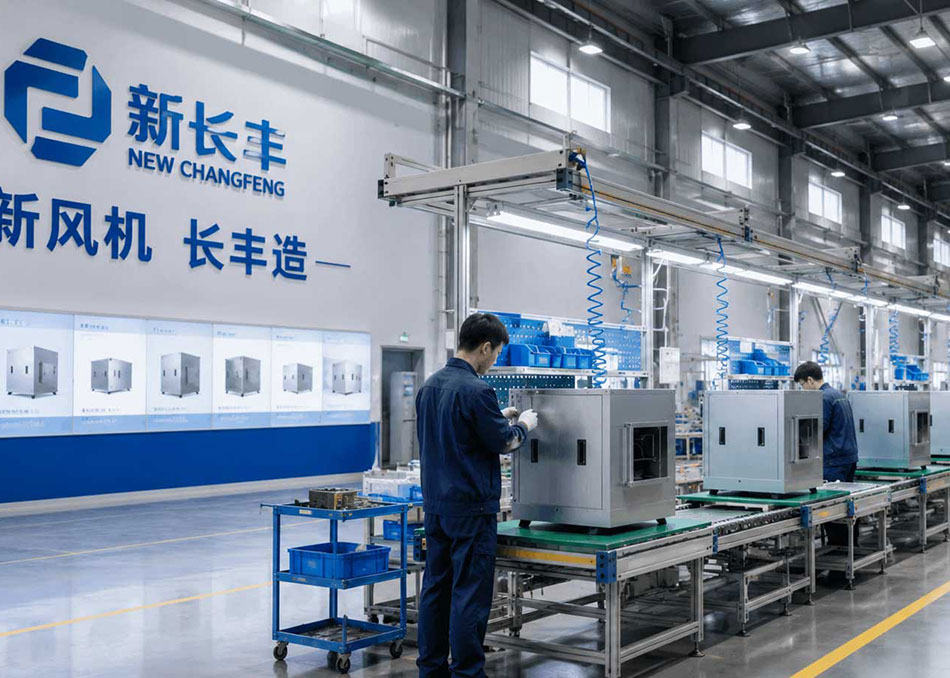
Operators of mahjong lounges abroad often run into a problem that seems contradictory at first: the private rooms have exhaust fans installed, yet the smoke never clears completely. The air conditioning runs at full tilt, but guests still complain about stuffiness. The root cause is rarely insufficient exhaust capacity—it is that make-up air has not kept pace. Mahjong lounges are classic high-occupancy, long-dwell, smoke-heavy spaces. When you exhaust without replacing the air, the room goes into negative pressure: exhaust effectiveness drops, door gaps whistle, conditioned air is pulled out of the space, and both comfort and energy performance deteriorate. This article focuses on how to select a water-cooled fresh air unit for mahjong lounge make-up and air exchange, taking into account the voltage, climate, and installation constraints common in overseas markets.
Start With the Ventilation Logic: Make-Up Air Is the Prerequisite for Effective Exhaust
In a mahjong lounge, contaminants are concentrated in two sources: tobacco smoke and the heat and moisture released by occupants. Sound ventilation design follows a simple principle—exhaust carries contaminants away, make-up air replenishes fresh air and maintains a balanced pressure relationship, either slightly positive or slightly negative as the layout requires. Per general ventilation engineering practice, make-up air volume should be matched to exhaust volume so that airflow direction stays stable and smoke does not migrate from private rooms into corridors, reception areas, or other public zones.
When make-up air is insufficient, the actual airflow of the exhaust fan decays as system resistance rises—the classic "the harder you exhaust, the stuffier it gets" cycle. Overseas mahjong lounges face additional building constraints: many are leased and retrofitted spaces with limited ceiling voids, restricted exterior wall openings, and neighbors sensitive to noise. The make-up air equipment therefore has to satisfy four requirements at once—matched airflow, cooling and dehumidification, controllable noise, and flexible installation. That combination is exactly why water-cooled fresh air units are widely adopted in this application.
Why a Water-Cooled Fresh Air Unit Fits the Mahjong Lounge Scenario
A water-cooled fresh air unit draws in outdoor air, conditions it through a water-cooled heat exchange coil, and supplies it to the occupied space. Unlike a conventional fresh air fan that simply injects hot, humid outdoor air, the water-cooled design reduces the supply air temperature and moisture content, so the make-up air does not fight the indoor air conditioning or add latent load. In a smoke-heavy lounge, this matters: the make-up air is both a dilution medium and a comfort contributor.
The water-cooled approach also decouples capacity from outdoor air temperature more effectively than simple evaporative cooling in humid climates, because the coil is served by chilled or cooling water rather than relying solely on evaporation. For operators in regions with high summer humidity, this is a meaningful advantage. At the same time, because the unit is a packaged fresh air solution, it can be ducted to multiple private rooms or a central supply plenum, keeping the installation footprint within the ceiling void.
- Pressure balance: matched supply and exhaust keeps smoke from spilling into public areas.
- Cooling and dehumidification: conditioned make-up air avoids adding heat and moisture to the lounge.
- Noise control: a packaged unit with acoustic treatment suits residential-adjacent sites.
- Installation flexibility: ducted supply fits retrofit ceilings and limited wall openings.
Selection Points for Overseas Installations
Voltage and frequency. Overseas markets vary widely—single-phase vs. three-phase, 50 Hz vs. 60 Hz, and different nominal voltages. Confirm the unit's motor and control configuration match the local supply before ordering, and specify protection and isolation appropriate to the site. Do not assume a unit built for one market will run correctly on another supply without verification.
Climate and water source. The water-cooled coil depends on a reliable cooling water circuit—chilled water from a chiller plant, or a dedicated cooling loop. Confirm water temperature, flow, and water quality, and plan for filtration and periodic coil cleaning. In hard-water areas, scale control protects heat transfer performance over time.
Airflow matching and duct design. Size the unit against the calculated exhaust volume, then verify the duct layout so that supply air reaches the private rooms rather than short-circuiting back to the return. Fan performance should be evaluated against the relevant test standard, such as GB/T 1236 for fan performance testing, and energy performance considered under GB 19761 where applicable to the fan assembly.
Smoke and fume strategy. Make-up air supports dilution, but it is not a substitute for source capture. For kitchen or food service areas within the venue, reference GB 18483 for kitchen fume emission limits and pair exhaust purification with the make-up air design. Where smoke exhaust systems are part of the building, coordination with GB 51251 principles for smoke and heat exhaust is advisable.
Common Mistakes That Undermine Performance
The most frequent error is treating the fresh air unit as an afterthought—installed after the exhaust system is already sized and commissioned. The result is a system that cannot be balanced: exhaust dampers are throttled to stop door whistling, and the lounge never reaches its design air exchange rate. Bring the make-up air unit into the design from the start and calculate supply and exhaust together.
A second mistake is undersizing the condensate and drainage provisions. A water-cooled coil produces condensate in humid conditions; if drainage is improvised, water damage and odors follow. A third is neglecting service access—coil cleaning and filter replacement require space, and a unit boxed into a ceiling void with no access panel will degrade quietly. Finally, noise complaints often trace back to rigid duct connections and inadequate vibration isolation rather than the fan itself; specify flexible connections and isolation mounts as part of the package.
Frequently Asked Questions
Q: Can I just add a bigger exhaust fan instead of a make-up air unit?
A: A larger exhaust fan without matching make-up air will deepen the negative pressure, increase door-gap noise, and pull conditioned air out of the lounge. The exhaust may move more air on paper, but the effective air exchange in the occupied rooms can still be poor. Balancing supply and exhaust is the more reliable path.
Q: Does a water-cooled fresh air unit work in both humid and dry climates?
A: The water-cooled coil conditions incoming air by heat exchange with the water circuit, so performance depends on water temperature and flow rather than outdoor humidity alone. In humid climates it also removes moisture, which helps comfort. Confirm the local cooling water source and water quality during selection.
Q: How do I handle voltage differences when sourcing equipment abroad?
A: Specify the local nominal voltage, phase, and frequency at the ordering stage, and confirm the motor and control configuration accordingly. Verify protection, isolation, and any local electrical code requirements with a qualified engineer before installation.
Q: How much maintenance does the unit need?
A: Plan for regular filter checks and coil cleaning, with frequency depending on outdoor air quality and water conditions. Provide access panels at installation so service can be performed without dismantling the ceiling. Scale control in hard-water areas extends coil life and preserves heat transfer performance.
Getting make-up air right is the difference between a lounge that smells fresh and one that guests quietly avoid. A water-cooled fresh air unit, sized against the exhaust volume and matched to local voltage, climate, and installation conditions, addresses negative pressure, smoke migration, and comfort in one package. XCFFJ manufactures water-cooled fresh air units and a full range of industrial and commercial ventilation equipment—cabinet centrifugal fans, negative pressure fans, kitchen exhaust purifiers, and more—and can help you match equipment to your venue's layout and local requirements. Visit www.xcffj.com to review options and discuss your project.