
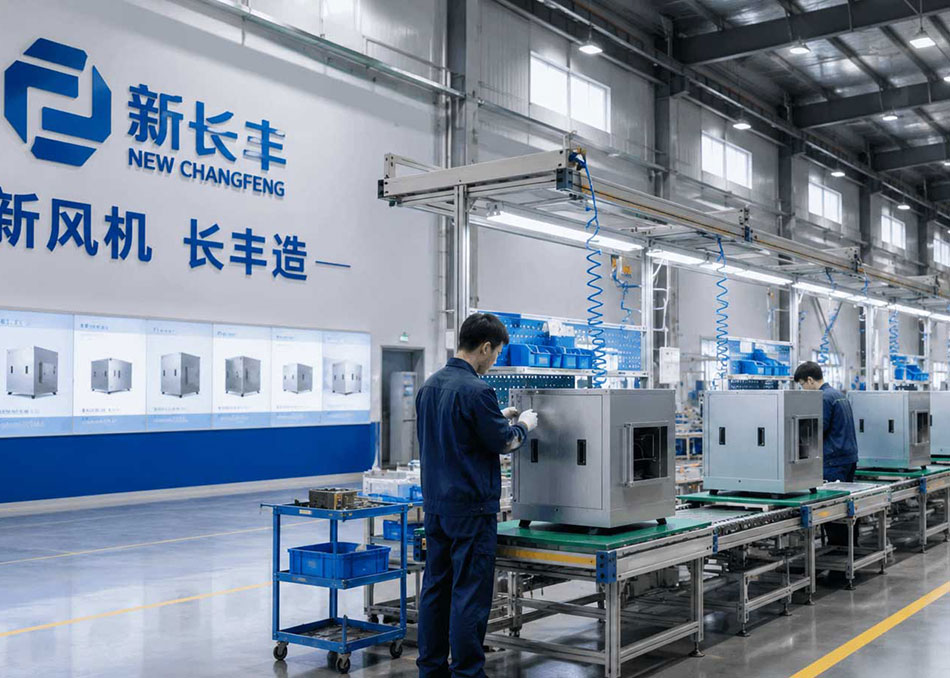
In most manufacturing plants, summer heat is not just an inconvenience—it is a management challenge that affects productivity, equipment reliability, and worker safety. Traditional floor fans only move air around without actually lowering the temperature, while split or central air conditioning, though effective at cooling, struggles in tall, open industrial spaces with concentrated heat sources. In these environments, cold air is lost quickly, electricity bills soar, and fresh air supply is often insufficient. Workshops for injection molding, metalworking, garment production, packaging, and logistics sorting face a common dilemma: equipment heat gain combined with high personnel density makes it difficult to balance cooling, ventilation, and energy consumption with a single type of equipment.
Evaporative air coolers—also known as swamp coolers or water-cooled air conditioners—have emerged as a ventilation and cooling solution tailored to these conditions. They work on the principle of water evaporation absorbing heat: hot outdoor air passes through a wet cooling pad, where its temperature drops before being delivered indoors, while a continuous fresh air exchange is maintained. Compared with conventional compressor-based air conditioning, evaporative coolers are more adaptable in open or semi-open factory buildings, making them a frequently compared option in factory cooling retrofits.
However, "evaporative air cooler" is not a single product but a category of solutions. Different air delivery methods, installation positions, and combination forms produce significantly different results and suit different conditions. This article provides a systematic comparison of common system designs based on the actual needs of factory cooling.
Main Types of Evaporative Cooling Systems for Factories
In factory cooling applications, evaporative air cooler systems generally fall into three categories: central ducted supply, spot cooling at workstations, and combined evaporative cooling with negative pressure exhaust fans. Each has its own strengths and limitations.
- Central ducted supply: Cooled air is distributed evenly through ducts or supply outlets. This suits workshops with widely distributed personnel and connected spaces. It provides uniform temperature and good air quality, but requires careful duct design to avoid excessive pressure loss and uneven distribution.
- Spot cooling at workstations: Cool air is directed to specific work areas where heat or personnel density is highest. This is ideal for large halls where only certain zones need cooling, reducing energy waste and installation costs. However, it may leave other areas unconditioned.
- Combined with negative pressure fans: Evaporative coolers supply cool fresh air while negative pressure fans exhaust hot, stale air from the opposite side of the building. This creates a directed airflow that improves overall ventilation and cooling efficiency. It works well in workshops with high heat generation and airborne contaminants.
When selecting a system, several key dimensions should be compared: cooling effectiveness, initial investment, operating cost, ventilation capability, noise level, and maintenance requirements. For instance, central ducted systems typically have higher upfront costs but offer better air distribution; spot cooling may have lower initial costs but can be less effective in extreme heat; combined systems excel in air exchange but require proper sizing of both supply and exhaust components.
How Evaporative Coolers Compare with Traditional Cooling Methods
To make an informed decision, it helps to understand how evaporative cooling stacks up against conventional approaches like fans and compressor-based air conditioning.
Traditional floor fans are inexpensive and easy to deploy, but they do not reduce air temperature. In fact, they can increase heat stress when the air is already hot. Compressor-based air conditioning, on the other hand, can achieve significant temperature drops, but in large, open factory spaces, cool air escapes quickly through open doors, windows, and loading bays. This leads to high energy consumption and insufficient fresh air, which can cause stuffiness and poor indoor air quality.
Evaporative air coolers offer a middle ground. They consume less electricity than compressor-based systems because they do not use a refrigerant cycle. They also introduce large volumes of fresh, filtered air, improving indoor air quality. However, their cooling effect depends on the ambient humidity—performance is best in hot, dry climates and decreases as humidity rises. In humid regions, they may provide less temperature reduction but still offer effective ventilation.
It is also important to consider the specific environment. For example, in workshops with high dust or oil mist, evaporative coolers can help dilute contaminants, but regular maintenance of cooling pads and water quality is essential to prevent odors and scaling. In facilities with strict temperature and humidity control requirements, such as cleanrooms or precision manufacturing, evaporative cooling alone may not be sufficient, and a hybrid approach with air conditioning might be necessary.
Key Considerations for Selecting a Factory Cooling Solution
Choosing the right evaporative cooling system requires a thorough assessment of the facility and its operations. Here are the main factors to evaluate:
- Building layout and height: Tall, open spaces with high ceilings are well-suited for evaporative coolers because they can deliver large air volumes. Ducted systems work better in spaces with obstacles or partitioned areas.
- Heat sources and personnel distribution: Identify where heat is generated (machines, processes) and where people work. This determines whether spot cooling or general ventilation is more effective.
- Climate conditions: Temperature and humidity levels affect cooling performance. In dry climates, evaporative coolers can achieve substantial temperature drops; in humid climates, their cooling capacity is reduced.
- Ventilation requirements: Factories often need to exhaust fumes, dust, or heat. Combining evaporative coolers with negative pressure fans can enhance air exchange and maintain a healthier environment.
- Energy efficiency and operating costs: While evaporative coolers use less electricity than air conditioning, they still require power for fans and pumps, plus water. Calculate the total cost of ownership over time.
- Maintenance and water quality: Regular cleaning of cooling pads and water tanks is necessary to prevent mold, bacteria, and mineral buildup. In areas with hard water, water treatment may be needed.
- Noise levels: Fan noise can be a concern in some workplaces. Choose models with low noise output or install them away from workstations.
Additionally, compliance with relevant standards can guide selection. For example, GB/T 1236 covers fan performance testing, GB 19761 specifies fan energy efficiency, and GB 51251 addresses smoke and heat exhaust systems. While these standards are Chinese, they reflect general engineering principles that can be applied internationally.
Installation and Maintenance Best Practices
Proper installation and regular maintenance are critical to achieving the desired cooling effect and ensuring long-term reliability.
For installation, location matters. Evaporative coolers should draw in outside air from a clean, shaded area, away from exhaust vents or heat sources. If ducted, the ducts should be sized correctly to minimize pressure loss and ensure even air distribution. For combined systems with negative pressure fans, the supply and exhaust capacities must be balanced to avoid pressurization issues. It is also important to provide adequate water supply and drainage, and to protect electrical components from moisture.
Maintenance should include periodic inspection and cleaning of cooling pads, water distribution systems, and filters. In dusty environments, pads may clog more quickly and require more frequent cleaning. Water quality should be monitored to prevent scale and biological growth. Fans and motors should be lubricated and checked for wear. During off-seasons, the system should be drained and covered to prevent contamination.
Training operators on basic troubleshooting and daily checks can prevent minor issues from becoming major failures. Keeping a maintenance log helps track performance and plan for replacement parts.
Frequently Asked Questions
Q: Can an evaporative air cooler really cool a large factory effectively?
A: Yes, when properly sized and installed. Evaporative coolers work best in hot, dry climates and can reduce air temperature by several degrees while providing large volumes of fresh air. In humid climates, the temperature drop is less, but they still improve ventilation. For very large or complex facilities, a combination with negative pressure fans or spot cooling may be needed.
Q: How does the energy consumption of evaporative coolers compare to traditional air conditioning?
A: Evaporative coolers typically use less electricity because they do not have a compressor. The main energy consumers are the fan and water pump. However, actual consumption depends on the size of the unit, airflow, and operating hours. In many factory settings, they can be a more energy-efficient alternative to air conditioning, especially where doors and windows are often open.
Q: What maintenance is required for evaporative air coolers?
A: Regular maintenance includes cleaning or replacing cooling pads, checking water distribution, descaling water tanks, and inspecting fans and pumps. In dusty environments, more frequent cleaning is necessary. Proper water treatment can reduce scale and microbial growth. It is also important to drain and dry the system before long periods of non-use.
Q: Can evaporative coolers be used in workshops with oil mist or dust?
A: Yes, but with caution. Evaporative coolers introduce fresh air and can help dilute contaminants, but they are not a substitute for dedicated fume or dust extraction systems. In oily or dusty environments, cooling pads may clog faster and require more frequent maintenance. It is advisable to combine them with exhaust ventilation to maintain air quality.
In summary, evaporative air coolers offer a practical and energy-efficient solution for factory cooling, particularly in open or semi-open industrial spaces. The key is to select the right system design—whether central ducted, spot cooling, or combined with negative pressure fans—based on the specific conditions of your facility. Proper installation, regular maintenance, and a clear understanding of the technology's strengths and limitations will ensure optimal performance.
For expert guidance on choosing the right evaporative cooling solution for your factory, contact XCFFJ. Our team specializes in industrial and commercial ventilation equipment and can help you design a system that meets your cooling, ventilation, and energy-efficiency goals.