
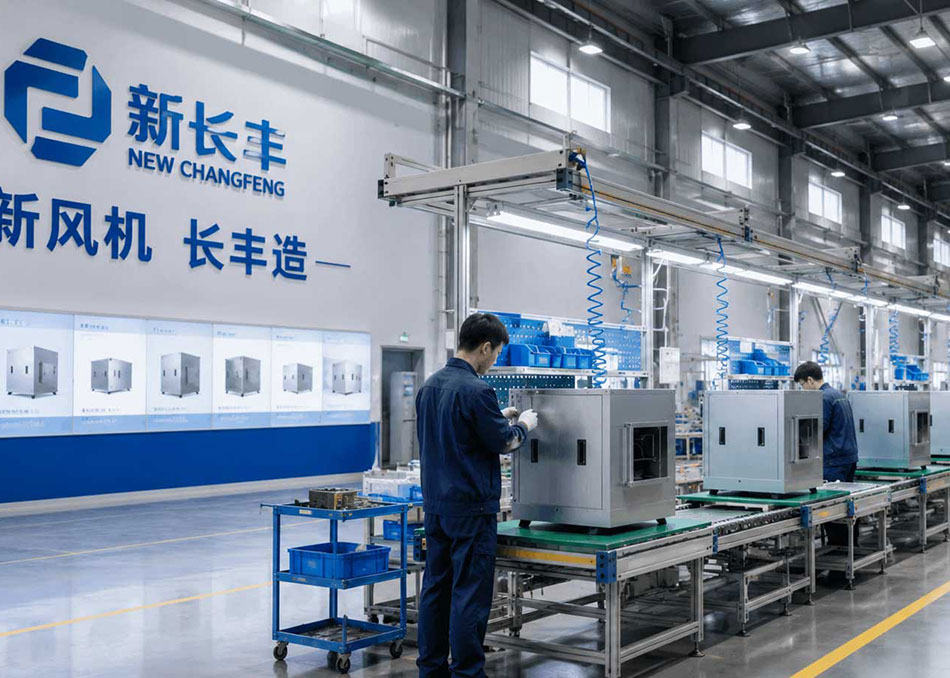
During hot summer months, industrial plants and large commercial kitchens often face the same two stubborn problems: heat builds up quickly and air movement is poor, while dense occupancy makes the space feel stuffy and uncomfortable. The instinctive response for many facility managers is to add air conditioning. But plants have high ceilings and large openings, and kitchens combine grease-laden fumes with heat and humidity. Relying on air conditioning alone drives up both capital investment and operating energy, and it often still leaves hot spots untreated. Negative pressure fans have become a widely adopted ventilation and cooling approach in this context. Their core logic is not to "manufacture cold air" but to force exhaust and create a slight negative pressure indoors, so that cooler outdoor air is drawn in in an orderly way and the overall air environment improves.
One boundary needs to be clear from the outset: in industrial plants, a negative pressure fan is a ventilation and heat-relief tool, not a fume purification device. Large kitchens can also apply the negative pressure ventilation concept for heat relief, but grease and fume removal must still be handled by dedicated equipment such as electrostatic fume purifiers or water-wash hoods. Getting this division right is the first step toward selecting the right equipment and using it well.
How Negative Pressure Fans Work and Why They Suit Plant Ventilation
A negative pressure fan is essentially a high-airflow, low-pressure axial ventilation device, typically mounted on an exterior wall or in a window opening. When running, it forces indoor air outdoors. When exhaust volume exceeds supply volume, a slight negative pressure forms inside, and outdoor air continuously enters through doors, windows, louvers and inlet gaps. The result is an organized exhaust with natural make-up air, forming a continuous airflow loop.
This logic fits industrial plants particularly well. Plants contain many heat sources and concentrated equipment heat dissipation, so hot air tends to stagnate in the upper zones and in corners. A negative pressure fan installed at height or on the leeward side can pull that hot, stale air out, while fresh air enters from the windward openings. Compared with sealed, air-conditioned spaces, this approach works with the building's existing openings rather than fighting them, which keeps both investment and running costs more controllable.
It is worth noting that performance should be verified against recognized standards. Fan airflow and pressure characteristics are commonly tested in line with GB/T 1236, fan energy efficiency is covered by GB 19761, and where smoke and heat exhaust is involved, GB 51251 applies. Specifying products with credible test data helps avoid the common problem of nominal airflow that does not hold up in real installations.
Applying the Negative Pressure Concept in Large Commercial Kitchens
Large kitchens, including school canteens and hotel kitchens, face a harsher environment than most plants: cooking generates heat, steam and grease simultaneously, and staff work in close proximity to the sources. The negative pressure idea can still help here, but only as part of a layered strategy. The first layer is capture at the source, using exhaust hoods and grease filters to contain fumes before they spread. The second layer is purification, typically electrostatic precipitation or water-wash systems, to meet emission requirements such as GB 18483. Only then does ventilation and heat relief come into play.
In practice, kitchen ventilation should maintain a controlled pressure relationship so that fumes do not leak into dining areas or adjacent rooms. Supply air should be introduced in a way that does not disturb hood capture, and make-up air should be tempered where comfort matters. This is where dedicated fresh air units and kitchen air conditioners complement the exhaust system, rather than replacing it.
- Treat fume capture and purification as a separate system from heat relief.
- Balance exhaust and make-up air to avoid fume leakage and door-draught problems.
- Use tempered make-up air in air-conditioned or comfort-sensitive zones.
- Verify grease filtration and purification performance against GB 18483 requirements.
Selection and Installation Points That Determine Real-World Results
Selection starts with the actual ventilation requirement, not with a single headline airflow number. The volume of the space, the number of air changes needed, the heat load from equipment and people, and the available inlet and outlet areas all shape the choice. A fan that is oversized for the available make-up air will simply stall against resistance; one that is undersized will not move enough air to make a difference. Matching fan capacity to the building's openings is the single most important design decision.
Installation details matter just as much. Mounting height, the distance from nearby obstacles, the condition of louvers and the sealing of unused openings all affect performance. Noise is another practical concern: direct-drive axial fans are generally simpler to maintain, while belt-driven units can offer different airflow characteristics. In noise-sensitive areas, selecting a suitable model and isolating vibration at the mounting point are more effective than adding sound insulation afterwards.
Maintenance should be planned from day one. Dust accumulation on blades and shutters reduces airflow over time, and belts, bearings and fasteners need periodic inspection. A simple scheduled cleaning and inspection routine keeps performance close to the original design and protects the investment.
Where Negative Pressure Fans Fit in a Complete Ventilation Strategy
Negative pressure fans are most effective as part of a coordinated system rather than a standalone fix. In a factory, they can work alongside roof turbo ventilators, axial fans and evaporative air coolers to create directed airflow: exhaust at the hot end, fresh or cooled air at the occupied zone. In warehouses and logistics facilities, the same principle improves air exchange in large-volume spaces where air conditioning would be impractical.
The key is to define the goal before choosing equipment. Is the priority heat relief for workers, removal of stale air, humidity control, or dust and fume containment? Each goal points to a different combination of exhaust, supply and purification equipment. A clear goal, verified performance data and careful installation will always outperform a collection of mismatched units.
FAQ
Q: Can a negative pressure fan replace air conditioning in a factory?
A: In most cases it complements rather than replaces air conditioning. It improves air exchange and reduces heat accumulation at low operating cost, but it does not actively cool the air. For spaces with strict temperature requirements, a combined approach using ventilation and targeted cooling is more realistic.
Q: Why does my negative pressure fan seem to move less air than expected?
A: The most common cause is insufficient make-up air. If doors, windows and louvers cannot supply enough air, the fan works against resistance and airflow drops. Check inlet areas, clean blades and shutters, and confirm that the installation matches the design.
Q: Can the same negative pressure approach handle kitchen fumes?
A: Negative pressure ventilation can help with heat relief, but it is not a substitute for fume capture and purification. Kitchen grease and fumes should be handled by hoods, filters and purification equipment meeting relevant emission requirements, with ventilation balanced around that system.
Q: How do I verify the performance claims of a fan?
A: Ask for performance data based on recognized test methods such as GB/T 1236 and energy efficiency information consistent with GB 19761. Compare data at the actual operating point rather than relying on a single maximum figure.
Summary
Negative pressure fans are a practical, cost-conscious way to improve ventilation and relieve heat in industrial plants, and the same principle can support comfort in large commercial kitchens when it is kept separate from fume purification. Success depends on matching fan capacity to make-up air, installing with care, and maintaining the system over time. To discuss the right configuration for your plant or kitchen project, contact XCFFJ for product information and application guidance.