
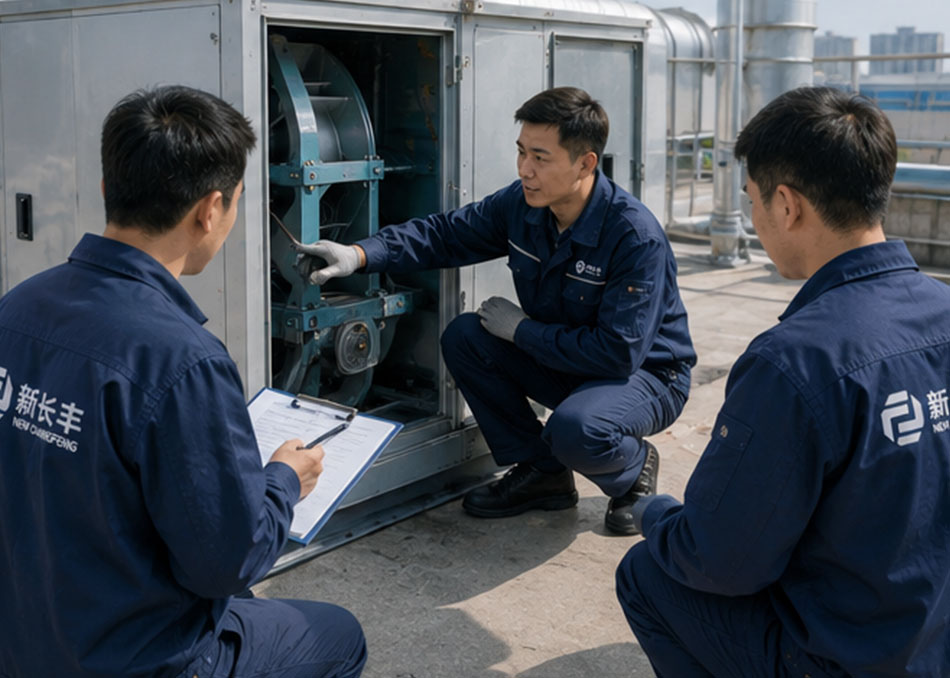
In Shenzhen, restaurant kitchen ventilation is a year-round challenge. With high summer heat and humidity, continuous heat radiation from cooking equipment, and exhaust hoods running at high load for extended hours, inadequate makeup air design quickly leads to a pronounced negative pressure environment: air rushing in through door gaps, poor exhaust performance, grease and odor leakage into dining areas, and staff struggling with stuffy, uncomfortable conditions. Many operators focus on exhaust equipment but overlook the critical role of makeup air. A water-cooled fresh air unit is one of the most effective solutions for addressing negative pressure and high temperatures in commercial kitchens. This article explains the selection logic and practical implementation points for water-cooled fresh air units based on real-world kitchen conditions in Shenzhen.
Why Makeup Air Is Essential for Shenzhen Restaurant Kitchens
When a kitchen exhaust system operates, the exhaust hood continuously extracts a large volume of air. If an equal amount of fresh air is not supplied to the space, the kitchen becomes negatively pressurized. The consequences are immediate: reduced hood capture velocity, ineffective grease and fume containment, odors migrating into dining areas, and in severe cases, backdrafts that affect burner combustion and cause smoke rollback. Shenzhen restaurants are often located in commercial complexes or street-front shops with compact layouts and limited door and window openings. Natural infiltration is rarely sufficient to balance exhaust volumes, making mechanical makeup air a practical necessity.
Makeup air is not simply about cutting a hole in the wall. The makeup air volume, supply temperature, air cleanliness, and airflow distribution all affect kitchen comfort and exhaust effectiveness. This is especially true in Shenzhen, where summers are long and humidity is high. Introducing untreated hot, humid outdoor air directly into the kitchen does not cool the space—it makes it feel even more oppressive and degrades staff comfort. Therefore, makeup air equipment must simultaneously address negative pressure, temperature, and humidity.
What a Water-Cooled Fresh Air Unit Does
A water-cooled fresh air unit combines ventilation with sensible cooling. It draws in outdoor air, passes it through a water-cooled heat exchange section, and supplies cooled fresh air into the kitchen. This achieves two goals at once: it balances the exhaust volume to eliminate negative pressure, and it reduces the supply air temperature to improve working conditions. Unlike simple axial fans that only move air, water-cooled fresh air units provide tempered makeup air, which is particularly important in hot and humid climates.
The cooling process typically uses chilled water from a central chiller, a dedicated air-cooled chiller, or an evaporative cooling section, depending on the project scale and budget. For restaurants without access to central chilled water, self-contained water-cooled fresh air units with integrated cooling sources are available. The key is to match the unit's cooling capacity and airflow to the kitchen's exhaust volume and internal heat load.
Key Selection Factors for Shenzhen Restaurant Kitchens
Choosing the right water-cooled fresh air unit requires a systematic approach. The following factors are critical:
Makeup air volume balance: The makeup air volume should typically be 80–90% of the exhaust volume to maintain a slight negative pressure relative to the dining area, preventing odors from escaping while ensuring proper exhaust capture. Undersized makeup air leads to negative pressure; oversized makeup air can disrupt hood capture and waste energy.
Cooling capacity: Shenzhen's design outdoor conditions are demanding. The unit must be sized to handle the sensible and latent heat load of the outdoor air. Oversizing wastes energy; undersizing fails to deliver comfort.
Air filtration: Kitchen environments are greasy and dusty. The fresh air unit should include at least a primary filter (G4) and preferably a medium-efficiency filter (F7–F8) to protect the heat exchanger and maintain indoor air quality.
Airflow organization: Supply air should be directed to low-occupancy zones or directly to the breathing zone of staff, avoiding short-circuiting into the exhaust hood. Proper diffuser selection and placement are essential.
Noise control: Kitchen staff work in close proximity to equipment. The unit should operate at acceptable noise levels, typically below 65–70 dB(A) at one meter. Consider acoustic insulation or remote mounting if needed.
Energy efficiency: Look for units that comply with GB 19761 fan energy efficiency standards. High-efficiency EC fans or properly matched centrifugal fans reduce operating costs.
Corrosion resistance: High humidity and grease-laden air demand corrosion-resistant materials for the heat exchanger, casing, and fan components.
Installation and Commissioning Best Practices
Even the best equipment can underperform if installation is flawed. The fresh air unit should be located to minimize duct runs and bends, which reduce airflow and increase energy consumption. Outdoor air intakes must be positioned away from exhaust discharges, grease bins, and vehicle traffic to avoid drawing in contaminants. Ductwork should be sealed and insulated to prevent condensation, especially in Shenzhen's humid climate.
Commissioning is equally important. Measure the actual makeup air volume and adjust dampers to achieve the design balance. Verify that the exhaust hood capture velocity meets requirements—typically 0.25–0.5 m/s at the hood face for cooking operations. Check that the kitchen maintains a slight negative pressure relative to adjacent spaces. Train staff to operate the system correctly and schedule regular maintenance, including filter cleaning and heat exchanger inspection.
FAQ
Q: Can I use a simple axial fan for makeup air instead of a water-cooled fresh air unit?
A: An axial fan can supply air, but it does not cool or dehumidify. In Shenzhen's hot and humid climate, untreated outdoor air will make the kitchen even more uncomfortable. A water-cooled fresh air unit provides both ventilation and cooling, which is essential for staff comfort and productivity.
Q: How do I determine the right makeup air volume for my kitchen?
A: Start with the exhaust volume of your hood system. As a rule of thumb, makeup air should be 80–90% of exhaust volume. However, the exact figure depends on kitchen layout, hood design, and local code requirements. A qualified HVAC engineer should perform a balance calculation.
Q: Does a water-cooled fresh air unit require a separate chiller?
A: Not necessarily. Some units are designed to connect to an existing central chiller, while others are self-contained with an integrated cooling source. The choice depends on your building's infrastructure and budget. For standalone restaurants, self-contained units are often more practical.
Q: How often should I maintain the water-cooled fresh air unit?
A: Filters should be checked and cleaned or replaced monthly, or more frequently in heavy cooking operations. The heat exchanger should be inspected and cleaned at least quarterly. Coil cleaning and water quality checks are also recommended to maintain efficiency.
Conclusion
For Shenzhen restaurant kitchens, makeup air is not optional—it is a fundamental requirement for effective exhaust, odor control, and staff comfort. A properly selected and installed water-cooled fresh air unit solves negative pressure and high-temperature problems simultaneously. By considering air volume balance, cooling capacity, filtration, airflow organization, noise, and energy efficiency, operators can create a safer, more comfortable, and more efficient kitchen environment. XCFFJ offers a range of water-cooled fresh air units designed for commercial kitchen applications. Contact us to discuss your project requirements and find the right solution for your kitchen.