
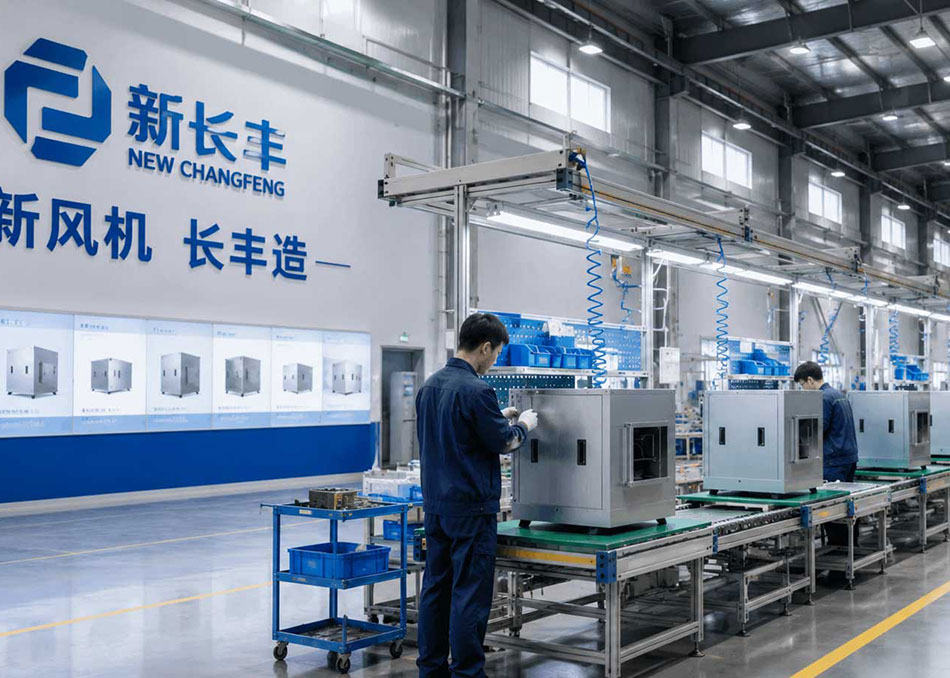
In commercial kitchens, poor ventilation is often not about failing to exhaust fumes—it's about failing to bring in enough fresh air. Many operators invest heavily in exhaust hoods, fume purifiers, and exhaust fans, only to find flames flickering, grease-laden air spilling into dining areas, doors that are hard to open, and unbearable heat in summer. These symptoms typically point to a single root cause: negative pressure imbalance. While the exhaust system removes cooking fumes, it also continuously extracts indoor air. Without a corresponding makeup air path, negative pressure builds up. Water-cooled fresh air units address this exact pain point by drawing in outdoor air, cooling it through a water-cooled process, and supplying it to the kitchen—balancing pressure and improving the working environment. XCFFJ's water-cooled fresh air units are engineered around this core principle: solving negative pressure through effective ventilation and makeup air.
Why Negative Pressure Occurs in Commercial Kitchens: The Exhaust-Makeup Air Imbalance
According to GB 18483, the Chinese emission standard for cooking fume, commercial kitchens must collect and purify fumes before discharge. This requires a sufficiently powerful exhaust system. The exhaust hood, ductwork, purifier, and exhaust fan form an exhaust chain. When its extraction capacity exceeds the kitchen's natural air intake, negative pressure develops. Negative pressure is not an abstract concept—it manifests in tangible ways: incomplete combustion with weak, yellow flames; grease-laden air escaping from hood edges into dining areas or corridors; whistling noises at makeup air doors and pass-through windows; and employees feeling stuffy or dizzy.
A more insidious problem is that negative pressure undermines the efficiency of the exhaust system itself. When a kitchen is under negative pressure, the exhaust fan must work harder to overcome resistance, leading to reduced airflow and higher energy consumption. In severe cases, backdrafts can occur, allowing odors to flow back into the kitchen. The solution is not to simply increase exhaust capacity, but to establish a balanced makeup air strategy—supplying filtered, cooled outdoor air to offset the extracted air volume and maintain a slight negative pressure (typically around -5 to -10 Pa) to prevent odors from escaping while ensuring proper combustion and comfort.
How Water-Cooled Fresh Air Units Solve Negative Pressure and Improve Kitchen Conditions
Water-cooled fresh air units are designed to introduce outdoor air, cool it via a water-cooled heat exchanger, and deliver it directly to the kitchen. Unlike conventional makeup air units that may bring in hot or humid air, water-cooled units reduce the incoming air temperature, which is especially beneficial in hot climates or during summer months. The cooling process also helps to condense moisture, delivering drier, more comfortable air. By supplying a controlled volume of fresh air, these units balance the exhaust system, stabilize combustion, prevent fume spillage, and improve staff comfort.
XCFFJ's water-cooled fresh air units are built with robust components and are suitable for continuous operation in demanding commercial kitchen environments. They can be integrated with existing exhaust systems and controlled via variable frequency drives to match makeup air volume to exhaust demand, ensuring energy efficiency and consistent performance. Key benefits include:
- Pressure balance: Neutralizes negative pressure, preventing backdrafts and fume leakage.
- Temperature reduction: Cools incoming air, lowering kitchen temperature and improving worker comfort.
- Improved combustion: Provides sufficient oxygen for gas burners, leading to stable flames and efficient cooking.
- Energy savings: Reduces the load on exhaust fans and minimizes conditioned air loss.
- Compliance: Helps meet ventilation requirements outlined in GB 18483 and GB 51251 (smoke and heat exhaust standards).
Key Design Considerations for Kitchen Makeup Air Systems
Properly sizing a makeup air system requires a careful assessment of the exhaust volume, the kitchen layout, and the number of cooking appliances. The makeup air volume should typically be 80–90% of the exhaust volume to maintain a slight negative pressure. The location of makeup air diffusers is also critical—they should be positioned away from exhaust hoods to avoid short-circuiting and should distribute air evenly across the kitchen. Water-cooled fresh air units should be selected based on the required airflow and cooling capacity, with consideration given to the available water source and drainage.
Noise control is another important factor. Water-cooled units can be equipped with acoustic insulation and low-noise fans to ensure a comfortable working environment. Regular maintenance, including cleaning the water-cooled coil and checking the water quality, is essential to maintain performance and prevent scaling. XCFFJ provides technical support and after-sales service to ensure optimal system operation.
Frequently Asked Questions (FAQ)
Q: What is the ideal negative pressure for a commercial kitchen?
A: A slight negative pressure of about -5 to -10 Pa is generally recommended. This prevents cooking odors from migrating to dining areas while ensuring adequate combustion and comfortable working conditions. Excessive negative pressure can cause backdrafts and reduce exhaust efficiency.
Q: Can a water-cooled fresh air unit be retrofitted into an existing kitchen?
A: Yes, water-cooled fresh air units can be integrated into most existing kitchens, provided there is sufficient space for the unit and access to a water supply and drain. A professional assessment of the exhaust system and ductwork is recommended to ensure proper balance.
Q: How does a water-cooled fresh air unit compare to a standard makeup air unit?
A: Standard makeup air units simply bring in outdoor air, which can be hot and humid. Water-cooled units cool the air via a water-cooled heat exchanger, delivering cooler, drier air that improves comfort and reduces the load on kitchen air conditioning. They are particularly beneficial in hot climates or during summer.
Q: What maintenance is required for water-cooled fresh air units?
A: Regular maintenance includes cleaning or replacing air filters, checking the water-cooled coil for scaling and cleaning as needed, inspecting the water supply and drainage, and verifying fan operation. Following the manufacturer's maintenance schedule ensures reliable performance and longevity.
In summary, negative pressure in commercial kitchens is a common but solvable problem. By implementing a properly designed makeup air system with water-cooled fresh air units, operators can achieve balanced ventilation, improved working conditions, and compliance with industry standards. XCFFJ offers a range of water-cooled fresh air units tailored to commercial kitchen applications. For expert advice on selecting the right model for your kitchen, please contact our team or visit our website at www.xcffj.com.