
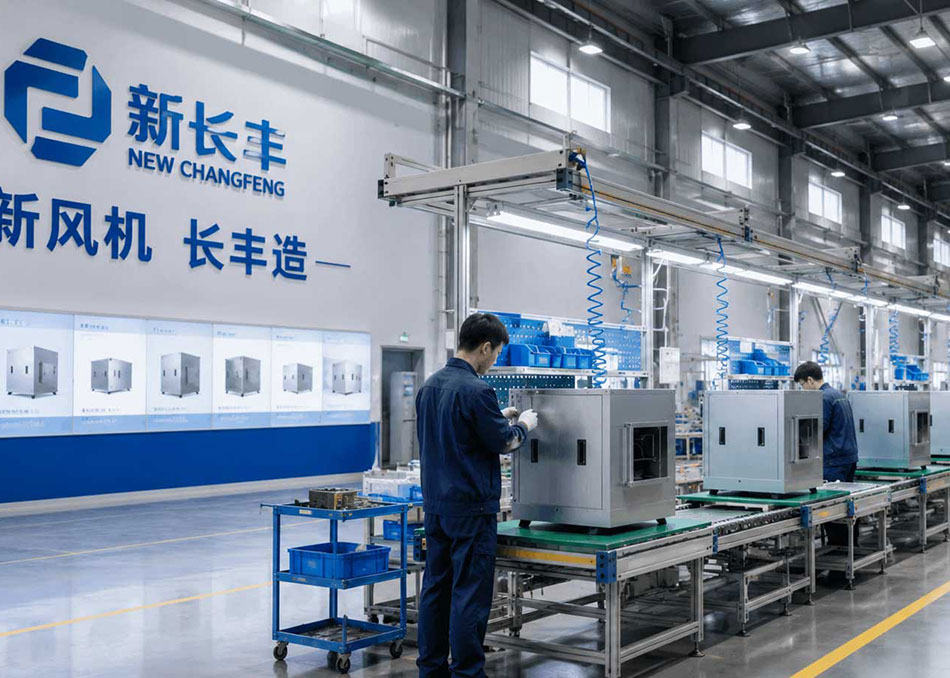
Guangzhou's subtropical climate—long summers, high humidity, and concentrated rainy seasons—places constant pressure on ventilation in factory workshops and commercial kitchens. When upgrading ventilation systems, managers often first consider axial fans: simple in structure, easy to install, high airflow, and moving air along the axis. They are a common choice for ventilation and makeup air. However, selecting solely by "high airflow" can lead to insufficient static pressure, noise complaints, high energy consumption, and even poor smoke exhaust or fume overflow. Proper selection requires analyzing the system's actual operating conditions.
1. Clarify the Application: Ventilation vs. Smoke Exhaust and Makeup Air
Axial fans move air along the blade axis, offering high airflow but relatively low static pressure, making them suitable for short ducts with low resistance. In Guangzhou factories, axial fans are often used for sidewall or roof exhaust to create organized ventilation. In commercial kitchens, they primarily provide makeup air and auxiliary exhaust, working with fume purifiers and exhaust fans to maintain a stable negative-pressure capture zone above cooking stations and prevent fume leakage.
The first step in selection is not checking equipment specifications but calculating system requirements: space volume, air changes per hour, exhaust path length, number of elbows and louvers, and resistance of purification equipment. Longer ducts, more elbows, and higher terminal resistance require higher static pressure. Simply increasing fan size may not help—and can even reduce actual airflow due to mismatched system resistance curves. For smoke exhaust and purification applications, include the resistance of the fume purifier in the fan selection calculation.
2. Key Selection Factors for Axial Fans
Once system requirements are clear, evaluate axial fans based on the following factors:
- Airflow and static pressure matching: Select a fan whose performance curve intersects the system resistance curve near the optimal efficiency point. Avoid oversizing, which increases energy use and noise.
- Energy efficiency: Choose fans compliant with GB 19761 fan energy efficiency standards. High-efficiency models reduce operating costs over the long term.
- Noise control: Axial fans can be noisy at high speeds. Consider low-noise designs, proper installation with vibration isolators, and duct silencers where needed.
- Material and construction: For humid or corrosive environments, choose corrosion-resistant materials and protection ratings suitable for the application.
- Compliance with ventilation and fire safety codes: For smoke exhaust systems, ensure fans meet GB 51251 smoke and heat exhaust requirements. For kitchen exhaust, consider GB 18483 emission standards.
Additionally, verify fan performance based on GB/T 1236 testing to ensure reliable operation. For kitchen applications, pair axial fans with electrostatic fume purifiers to achieve effective purification and odor control.
3. Common Pitfalls and Practical Solutions
Many ventilation upgrades fail due to avoidable mistakes. Here are typical issues and how to address them:
- Insufficient static pressure: Symptoms include weak exhaust and fume leakage. Solution: recalculate system resistance and select a fan with higher static pressure or reduce duct complexity.
- Excessive noise: Often caused by oversized fans or improper installation. Solution: choose a right-sized fan, install vibration isolators, and use flexible duct connections.
- High energy consumption: Inefficient fans or systems running at off-design points. Solution: select high-efficiency fans and consider variable speed drives for demand-based control.
- Poor makeup air balance: In kitchens, insufficient makeup air causes negative pressure, reducing exhaust effectiveness. Solution: use axial fans for dedicated makeup air, interlocked with exhaust fans.
For factory workshops, combine axial fans with evaporative air coolers or negative pressure fans to improve comfort and air quality. In kitchens, integrate axial fans with kitchen exhaust purifiers and water-cooled fresh air units for a complete solution.
4. Installation and Maintenance Best Practices
Proper installation and maintenance maximize fan performance and lifespan:
- Install fans in locations with unobstructed airflow and easy access for maintenance.
- Ensure duct connections are airtight to prevent leakage and performance loss.
- Regularly clean fan blades and check for balance to avoid vibration and noise.
- Lubricate bearings according to manufacturer recommendations.
- Inspect electrical connections and protection devices periodically.
For kitchen exhaust systems, schedule regular cleaning of purifiers and ducts to maintain airflow and reduce fire risk.
Frequently Asked Questions
Q: Can axial fans be used for kitchen exhaust?
A: Axial fans are generally not suitable as the primary kitchen exhaust fan due to low static pressure and grease-laden air. They are better used for makeup air or auxiliary exhaust. For main exhaust, use centrifugal fans designed for grease and high static pressure, paired with fume purifiers.
Q: How do I calculate the required airflow for my workshop?
A: Determine the space volume and required air changes per hour based on application (e.g., 6–10 ACH for general workshops). Multiply volume by ACH, then add 10–20% margin for duct leakage and resistance. Consult a ventilation engineer for precise calculation.
Q: What is the difference between axial and centrifugal fans?
A: Axial fans move air parallel to the fan axis, providing high airflow at low static pressure. Centrifugal fans draw air radially and can generate higher static pressure, making them suitable for longer ducts and higher resistance systems. Choose based on system requirements.
Q: How can I reduce noise from axial fans?
A: Select a fan with low noise ratings, install vibration isolators, use flexible duct connections, and ensure proper duct sizing to avoid turbulence. In sensitive areas, add duct silencers.
Selecting the right axial fan for ventilation and makeup air in Guangzhou's challenging climate requires a systematic approach—from calculating system resistance to choosing energy-efficient, compliant models. XCFFJ offers a range of axial fans and ventilation solutions tailored to industrial and commercial needs. Visit www.xcffj.com to explore our products and contact our team for expert guidance.