
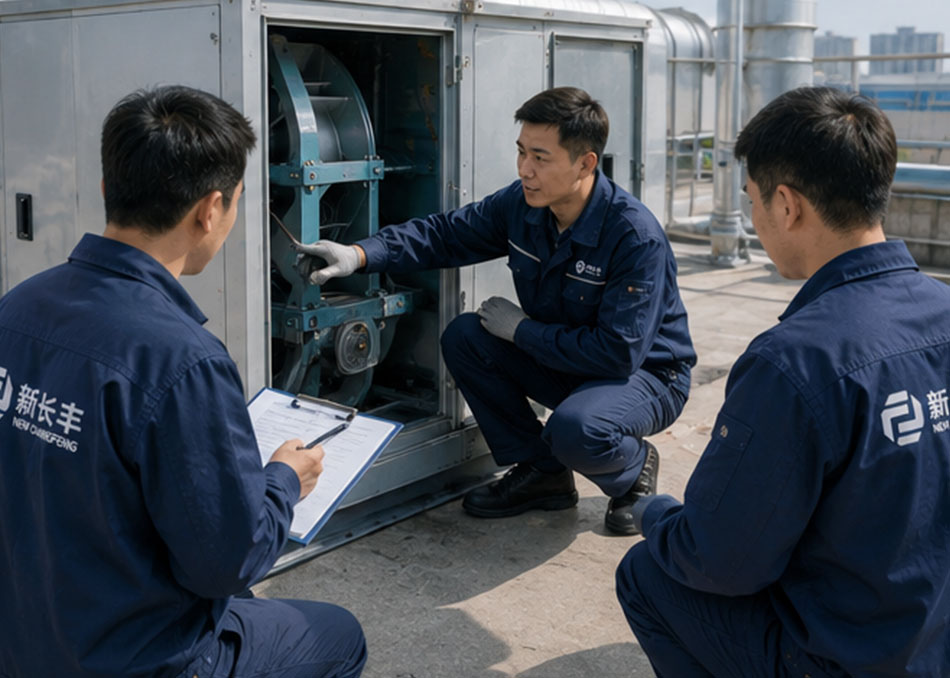
In commercial kitchen ventilation design, most attention goes to exhaust fans and hoods, but the critical counterpart—makeup air—is often overlooked. When exhaust airflow exceeds supply, the kitchen falls into negative pressure, causing doors to stick, fumes to backdraft, conditioned air to be pulled out, and gas burners to underperform. Traditional reliance on door and window gaps is inconsistent, especially in sealed kitchens or high-rise buildings. A water-cooled fresh air unit, combining cooling and supply air, is emerging as an ideal solution: it balances pressure and lowers ambient temperature in one system.
Understanding Negative Pressure in Commercial Kitchens
Kitchen exhaust systems, typically using centrifugal or axial fans, are sized based on the number of burners and cooking load. However, while exhaust runs continuously, makeup air is often missing or undersized, creating a significant pressure imbalance. The consequences are multi-faceted:
- Kitchen doors become hard to open due to pressure differentials, hindering workflow and posing safety risks.
- Fumes and odors cannot be fully captured, leaking back from hood gaps or floor drains.
- Air conditioning from the dining area is siphoned out, raising cooling costs and reducing comfort.
- Gas appliances may experience incomplete combustion in negative pressure, increasing carbon monoxide risks for staff.
The root solution lies in a properly designed makeup air system. But makeup air is not just about pushing air in—it must also address thermal comfort. In a hot kitchen, introducing unconditioned outdoor air can worsen heat stress. This is where water-cooled fresh air units add value.
Why Water-Cooled Fresh Air Units Are Ideal for Kitchen Makeup Air
Unlike standard fresh air units that only filter and supply outdoor air, water-cooled fresh air units incorporate a cooling coil that uses chilled water (from a chiller or cooling tower) to reduce the air temperature before delivery. This dual function—pressure balancing and cooling—makes them particularly suitable for commercial kitchens where heat loads are extreme.
Key benefits include:
- Pressure balance: Provides a controlled, filtered air supply that matches exhaust rates, preventing negative pressure and its issues.
- Temperature control: Cools incoming air, lowering kitchen ambient temperature and improving worker comfort and productivity.
- Energy efficiency: Compared to separate exhaust and cooling systems, integrated makeup air reduces overall HVAC load.
- Air quality: Filtration removes particulates, reducing the load on exhaust purification systems and improving indoor air.
When paired with existing exhaust purification (e.g., electrostatic precipitators per GB 18483), the unit supports compliance with local emission standards while maintaining a safe, comfortable workspace.
Selection and Sizing Considerations for Kitchen Makeup Air
Selecting the right water-cooled fresh air unit requires a systematic approach:
- Calculate exhaust rate: Based on hood size, cooking equipment, and applicable standards (e.g., GB 51251 for smoke control), determine the required exhaust volume.
- Set makeup air volume: Typically 80–90% of exhaust to maintain slight negative pressure, but verify with local codes.
- Assess cooling load: Consider kitchen heat generation, outdoor design temperatures, and desired indoor temperature to size the cooling coil.
- Duct design: Ensure supply air is distributed to capture hoods and workstations, avoiding drafts and short-circuiting.
- Control strategy: Use variable speed fans and sensors to modulate supply based on exhaust operation, saving energy during low-load periods.
It is essential to consult with a ventilation engineer to perform detailed calculations, as undersizing leads to persistent negative pressure, while oversizing wastes energy.
Implementation Best Practices
Successful integration goes beyond equipment selection:
- Placement: Locate supply diffusers near exhaust hoods but not directly under them, to avoid disrupting capture.
- Air balance: Commission the system with anemometers and manometers to verify pressure differentials.
- Maintenance: Clean filters and coils regularly; inspect water loops for fouling to maintain cooling performance.
- Compliance: Follow local mechanical codes and energy efficiency regulations, referencing standards like GB/T 1236 for fan testing and GB 19761 for fan efficiency.
By treating makeup air as a first-class citizen in kitchen ventilation design, facility managers can eliminate negative pressure, enhance safety, and create a more tolerable environment for staff.
FAQ
Q: How does a water-cooled fresh air unit differ from a standard makeup air unit?
A: A standard unit only supplies filtered outdoor air. A water-cooled unit adds a chilled water coil that actively cools the air, reducing kitchen heat gain. This is especially beneficial in hot climates or where kitchen heat loads are high.
Q: Can I retrofit a water-cooled fresh air unit into an existing kitchen?
A: Yes, but it requires assessing existing ductwork, water supply, and electrical capacity. A professional engineer should evaluate the space and recommend appropriate sizing and integration to avoid performance issues.
Q: What is the ideal makeup air volume relative to exhaust?
A: Generally, makeup air should be 80–90% of exhaust volume to maintain a slight negative pressure, preventing fumes from escaping while minimizing energy loss. However, local codes and specific cooking processes may dictate different ratios.
Q: Does a water-cooled fresh air unit help with kitchen exhaust purification?
A: Indirectly, yes. By ensuring proper air balance, it improves hood capture efficiency, reducing the load on exhaust purification systems and helping meet emission standards like GB 18483.
In summary, the water-cooled fresh air unit offers a practical, dual-purpose solution for commercial kitchen makeup air. By addressing negative pressure and thermal comfort simultaneously, it enhances safety, energy efficiency, and staff well-being. For a tailored design, consult with XCFFJ specialists who can recommend the right configuration for your kitchen's specific needs.