
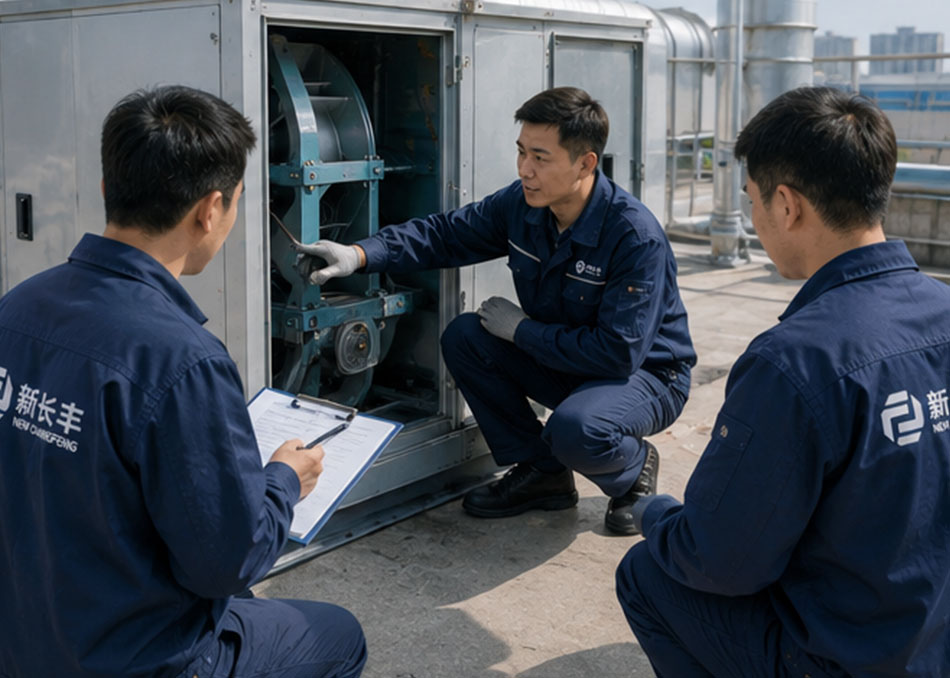
In the daily operations of a commercial kitchen, the efficiency of smoke and steam extraction directly impacts the working environment, food safety, and building fire safety. Many kitchen managers notice that even with exhaust hoods installed, the kitchen remains smoky, walls become greasy, and issues like backdraft in ducts or noisy fans arise. These problems often point to a core issue: improper selection or use of the cabinet centrifugal fan. As the backbone of commercial kitchen exhaust systems, cabinet centrifugal fans rely on their unique working principle to overcome duct resistance and transport grease-laden air over long distances. This article provides a comprehensive analysis of this critical equipment, focusing on its working principle and practical applications in kitchen exhaust scenarios.
Understanding the Structure and Working Principle of Cabinet Centrifugal Fans
Cabinet centrifugal fans are a type of centrifugal fan, featuring a scroll housing, impeller, inlet, outlet, and drive motor. Unlike axial fans that move air in a straight line, centrifugal fans draw air axially into the impeller. High-speed rotating blades impart kinetic energy to the air, which is then expelled radially outward. The scroll housing converts this kinetic energy into static pressure through diffusion. This 'axial inlet, radial outlet' airflow design enables cabinet centrifugal fans to generate high static pressure, essential for overcoming friction losses in ducts, resistance from elbows, and pressure drops across grease filters or purification units.
In a typical kitchen exhaust system, the cabinet centrifugal fan is installed at the end or midpoint of the exhaust ductwork. When the fan operates, it creates a negative pressure zone that draws smoke and vapors from cooking appliances into the hood, through the ducts, and ultimately discharges them outdoors. The fan's ability to maintain consistent airflow despite system resistance is crucial for effective capture and removal of contaminants.
Key Advantages in Kitchen Exhaust Applications
- High Static Pressure Capability: Ideal for long duct runs and multiple elbows, ensuring consistent exhaust performance.
- Durability: Designed to handle grease-laden air, with options for corrosion-resistant coatings or stainless steel construction.
- Noise Reduction: Cabinet-style enclosures provide sound attenuation, reducing operational noise compared to exposed fans.
- Versatility: Can be paired with variable frequency drives (VFDs) to adjust airflow based on demand, improving energy efficiency.
Proper Installation and Maintenance for Optimal Performance
Correct installation is paramount. The fan should be mounted on a solid foundation to minimize vibration, and flexible connections at inlet and outlet prevent transmission of vibration to ductwork. Ensure adequate clearance for maintenance access. Regular inspection of the impeller for grease buildup is essential, as accumulation can unbalance the rotor, leading to premature bearing failure and reduced performance. Belts (if applicable) should be checked for tension and wear. Cleaning schedules should align with kitchen usage intensity, typically every three to six months.
Common Issues and Troubleshooting
One frequent issue is reduced airflow, often caused by clogged filters or duct obstructions. Another is excessive noise, which may indicate bearing wear, impeller imbalance, or loose components. Backdraft can occur if the fan is undersized or if the exhaust outlet is poorly positioned relative to wind direction. Regular preventive maintenance and proper system design can mitigate these problems. If you encounter persistent issues, consulting a ventilation specialist is recommended.
Standards and Efficiency Considerations
When selecting a cabinet centrifugal fan, consider compliance with relevant standards such as GB/T 1236 for performance testing and GB 19761 for energy efficiency. In commercial kitchens, adherence to local building codes and fire safety regulations (e.g., GB 51251 for smoke and heat exhaust) is mandatory. High-efficiency motors and VFDs can significantly reduce energy consumption, aligning with sustainability goals.
FAQ
Q: What is the difference between a cabinet centrifugal fan and an axial fan for kitchen exhaust?
A: Cabinet centrifugal fans generate higher static pressure, making them suitable for systems with long duct runs and multiple bends. Axial fans move larger air volumes at lower pressure, which is often insufficient for overcoming duct resistance in commercial kitchens.
Q: How do I determine the correct fan size for my kitchen?
A: Sizing is based on the total exhaust volume required, which depends on the type and number of cooking appliances, hood dimensions, and duct length. Professional load calculations and reference to standards like GB/T 1236 are recommended to ensure adequate ventilation.
Q: Can a cabinet centrifugal fan be installed outdoors?
A: Yes, but it requires weatherproofing. Many manufacturers offer models with weather-resistant enclosures or recommend installing the fan in a protective housing to prevent corrosion from outdoor elements.
In summary, the cabinet centrifugal fan is an indispensable component of effective commercial kitchen exhaust systems. Its ability to maintain high static pressure ensures that smoke, heat, and odors are efficiently removed, contributing to a safer and more comfortable working environment. For new installations or retrofits, partnering with a reputable manufacturer like XCFFJ ensures access to reliable equipment and expert guidance. Visit our website at www.xcffj.com to explore our range of ventilation solutions tailored to commercial kitchens.