
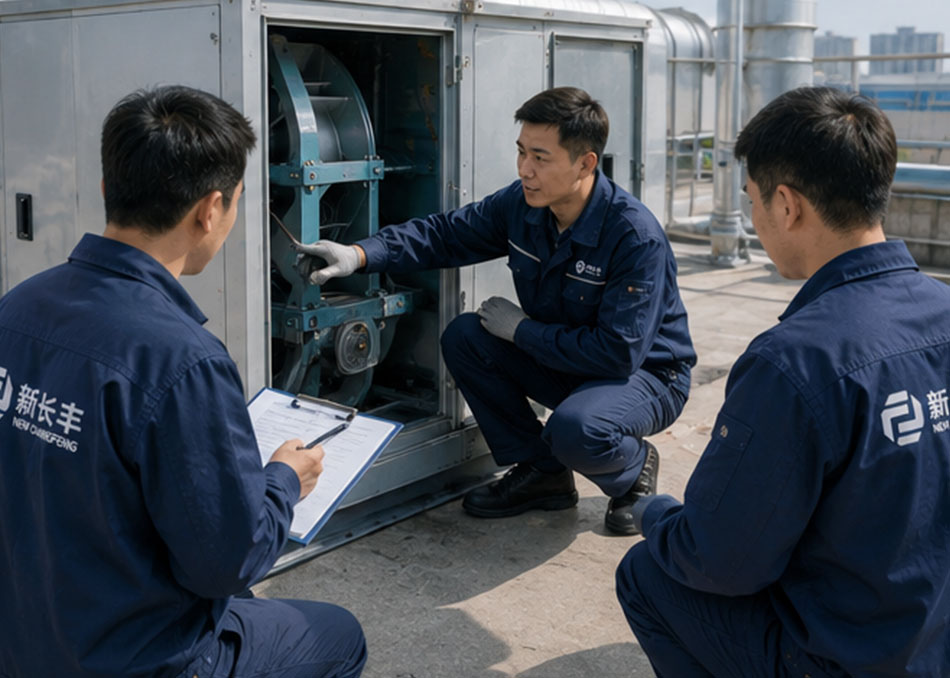
School canteens are deceptively demanding when it comes to kitchen exhaust. Unlike a restaurant that spreads cooking across a full day, a school kitchen concentrates its entire load into a one- to two-hour lunch window. Dozens of woks fire up at the same time, and the fume generation rate spikes almost instantly. When the exhaust system is undersized or the fan cannot hold enough static pressure, the symptoms appear fast: grease-laden air spills over the hood, the kitchen becomes stifling, and cooking odors drift into corridors and dining areas. For facility managers and HVAC contractors, the cabinet centrifugal fan is often the component that decides whether the whole system holds up.
Why School Canteen Exhaust Systems Fail Under Peak Load
The core challenge is simultaneity. A school canteen may operate only a few hours per day, but during those hours the exhaust system must handle the combined output of every cooking station at once. Systems sized around average daily load rather than peak load will inevitably underperform when it matters most. The result is not just discomfort — it is a compliance and safety issue, since kitchen fume emissions are regulated under standards such as GB 18483.
A typical canteen exhaust train consists of capture hoods, ductwork, a fume purification unit, the exhaust fan, and a make-up air path. Each element adds resistance. Long horizontal runs, multiple elbows, and the pressure drop across an electrostatic purifier all stack up against the fan. The fan must overcome this total system resistance while still delivering enough air volume at the hood face to capture fumes before they escape. This is why fan selection is not a secondary detail — it is the deciding factor in system performance.
Cabinet centrifugal fans are widely chosen for this role because their centrifugal impeller generates higher pressure coefficients than axial fans of comparable size. In a canteen with extended duct runs and a purifier in line, that extra pressure capability translates directly into reliable capture and discharge.
How a Cabinet Centrifugal Fan Fits Into a Canteen Exhaust and Make-Up Air Strategy
In a well-designed canteen system, the cabinet centrifugal fan typically sits downstream of the fume purification stage, completing a capture–purify–discharge chain. Air enters the hood, passes through ductwork to the purifier where grease and particulate are removed, and is then pulled through the fan by its centrifugal impeller before being discharged at the roof or wall. Because the fan handles air after purification, it is exposed to less grease loading — a meaningful advantage for maintenance intervals.
Equally important is make-up air. Every cubic meter of air exhausted must be replaced, or the kitchen will run under negative pressure. That negative pressure starves the hood of capture velocity, causes doors to resist opening, and can even back-draft combustion appliances. A balanced design pairs the exhaust fan with a dedicated make-up air unit — often a filtered fresh air cabinet or a water-cooled fresh air unit in warmer climates — so the kitchen remains slightly negative relative to the dining hall but not so negative that performance suffers.
Cabinet centrifugal fans support this balance because their performance curve can be matched to the actual system resistance. Rather than guessing, a competent supplier will review the duct layout, purifier pressure drop, and required hood capture velocity before recommending a model. This is a key differentiator between a box-mover and a genuine ventilation partner.
What to Evaluate When Choosing a Cabinet Centrifugal Fan Supplier
Not all cabinet centrifugal fans are built to the same standard, and the specification sheet alone rarely tells the full story. Buyers should look for verifiable conformity with recognized testing and efficiency standards, and should expect a supplier to explain how the fan will perform in their specific system — not just quote a model number.
- Standard compliance: Fan performance should be tested in accordance with GB/T 1236, and energy efficiency should align with GB 19761. For any system interfacing with fire safety design, GB 51251 requirements for smoke and heat exhaust must be respected.
- Scenario fit: Confirm the fan is rated for the actual static pressure required by the duct run plus purifier resistance — not just the airflow at free delivery.
- Noise control: Centrifugal fans are generally quieter than axial types at equivalent duty, but cabinet construction, impeller balance, and mounting details still determine real-world noise. Ask how the fan will perform at the nearest occupied space.
- System support: A supplier who can also provide make-up air units, purifiers, and duct accessories reduces compatibility risk and simplifies commissioning.
- Service and parts: Canteens cannot afford long downtime during the school term. Clarify lead times, spare part availability, and technical support responsiveness.
It is also worth asking about the fan's placement relative to the purifier. Some designs place the fan before purification, which exposes the impeller to grease and shortens service life. For canteen applications, a post-purification configuration is generally preferred.
Practical Design Notes for Canteen Exhaust and Make-Up Air
Even a well-chosen fan can underperform if the surrounding design is flawed. Hood geometry, duct velocity, and make-up air distribution all influence results. Grease ductwork should maintain sufficient velocity to keep grease entrained rather than depositing on duct walls, and access doors should be provided for cleaning. On the make-up side, air should be introduced away from the hood so it does not short-circuit directly into the exhaust.
Commissioning matters as much as selection. Airflow should be balanced after installation, with hood face velocities verified and the make-up air rate adjusted to maintain the intended pressure relationship. A fan that is throttled or over-speeded to compensate for a design error will run louder, consume more energy, and wear faster.
Finally, plan for seasonal variation. In hot climates or summer months, make-up air that is simply drawn from outdoors can make the kitchen unbearable. Integrating a cooling element into the make-up air path — while keeping exhaust and supply balanced — preserves both comfort and capture performance.
FAQ
Q: Why not just use an axial fan for a school canteen exhaust system?
A: Axial fans move air at lower pressure coefficients. In canteens where the duct run is long, includes several elbows, and passes through a fume purifier, the total system resistance is often too high for an axial fan to overcome while still delivering the airflow needed at the hood. A cabinet centrifugal fan's higher pressure capability makes it better suited to these conditions.
Q: Should the cabinet centrifugal fan be installed before or after the fume purifier?
A: In most canteen designs, the fan is placed after the purifier. This reduces grease loading on the impeller and motor, which extends maintenance intervals and helps preserve performance over time. Placing the fan before purification exposes it to heavy grease and is generally not recommended for cooking applications.
Q: How important is make-up air in a school canteen?
A: It is essential. Without adequate make-up air, the kitchen operates under excessive negative pressure, which reduces hood capture effectiveness, can cause door-opening difficulty, and may interfere with combustion appliance drafting. A balanced exhaust and make-up air design is what allows the exhaust fan to perform as intended.
Q: What standards should a cabinet centrifugal fan meet?
A: Look for performance testing consistent with GB/T 1236 and energy efficiency in line with GB 19761. Where the system interfaces with fire safety design, GB 51251 requirements for smoke and heat exhaust should also be considered. For kitchen fume emissions, GB 18483 sets the relevant discharge expectations.
Summary
School canteen exhaust is a peak-load problem, and the cabinet centrifugal fan is central to solving it. By selecting a fan that matches the real system resistance, pairing it with proper make-up air, and choosing a supplier who can support the full capture–purify–discharge chain, facility managers can avoid fume spillage, kitchen overheating, and odor migration. XCFFJ manufactures cabinet centrifugal fans and complete ventilation and cooling equipment for school canteens, factory floors, commercial kitchens, and warehouse logistics — with the technical documentation and system support to help you get the design right the first time.