
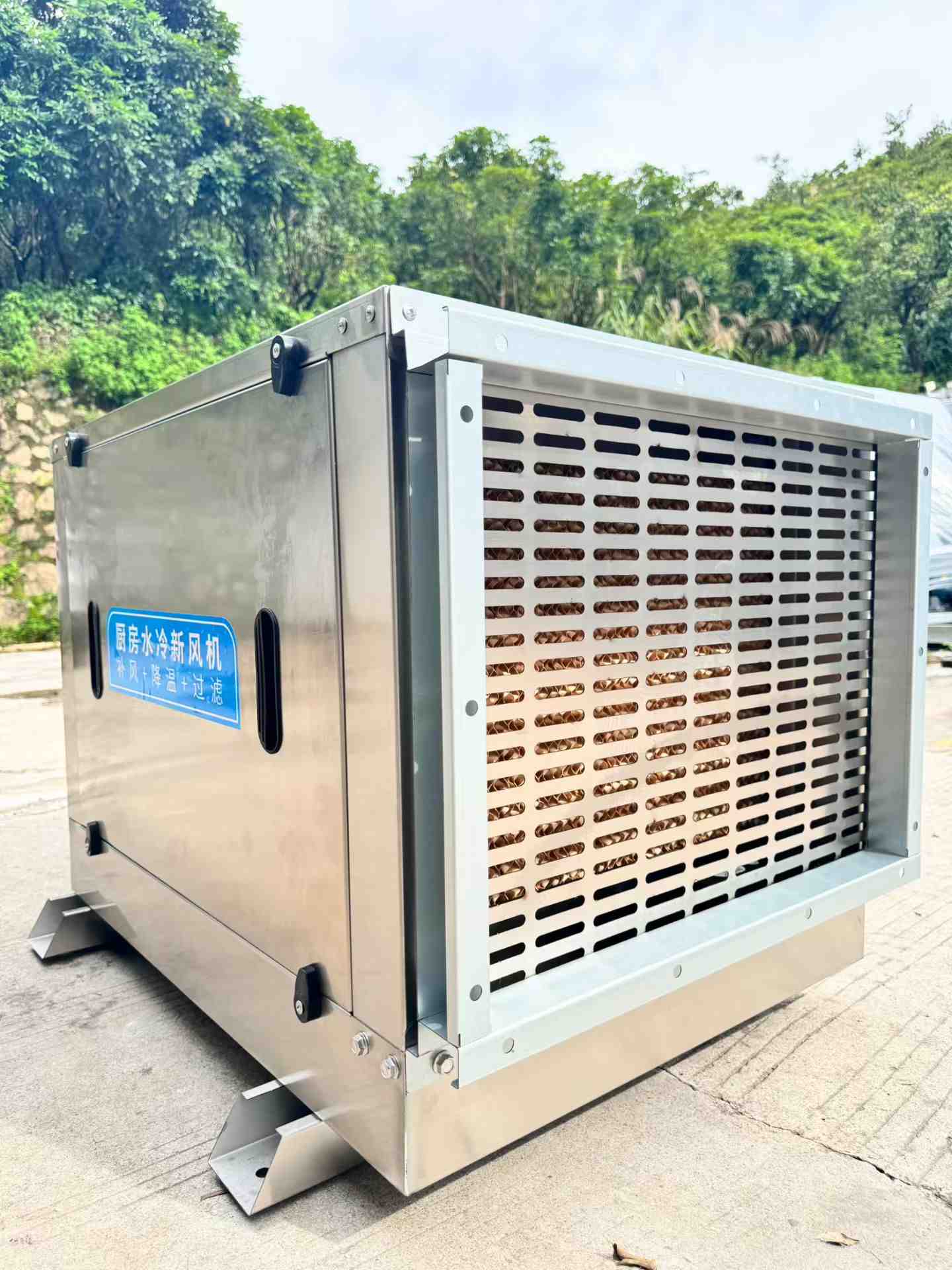
There is an unavoidable physical conflict in commercial kitchen cooling: the exhaust system continuously extracts air, creating negative pressure in the kitchen, while hot outdoor air rushes back in through door gaps and pass-through windows. The chef stands at the stove with hot air surging in from behind and radiant heat from the burners in front. Traditional air conditioning barely survives in this environment — grease clogs the fins, cold air is instantly sucked away by the exhaust hood, and compressors trip repeatedly under high-frequency cycling. Water-cooled fresh air units take a different path: rather than fighting the exhaust system, they cool outdoor fresh air and deliver it into the kitchen, simultaneously solving make-up air and cooling while improving the kitchen's airflow environment at its root.
Shenzhen Xin Changfeng Dust Removal and Cooling Equipment Co., Ltd. occupies a clear position in this niche: building industrial-grade durable equipment. Founded in 2016 and registered in Longhua, Shenzhen, with registered capital of 1 million RMB, the company is modest in team size but concentrates its technical积累 in industrial dust removal and cooling. It holds multiple patents covering centrifugal air cabinet and volute structures.
Stainless Steel Construction: Built for Hostile Environments
The most immediately visible feature of Xin Changfeng's water-cooled fresh air unit is its all-stainless-steel body. This choice carries practical significance in commercial kitchen scenarios. The kitchen environment attacks equipment from multiple directions: high humidity, grease particles, water vapor during cleaning, and occasional cleaning agent splashes. Under these conditions, ordinary galvanized sheet or powder-coated enclosures begin corroding from the inside within one to two years. The stainless steel body sacrifices some cost advantage in exchange for a unit that can withstand five to eight years of continuous operation.
The fan core adopts a centrifugal air cabinet structure, which is Xin Changfeng's technical foundation. The company holds a utility model patent for a "volute for a centrifugal cabinet fan," using an interlocking assembly design of first and second casing shells, angle steel, and flat cover plates to improve structural stability and ease of disassembly. Centrifugal fans are characterized by high static pressure and stable airflow, making them suitable for connecting longer duct runs and penetrating the negative pressure zone created by the exhaust system. For commercial kitchens with complex duct routing, numerous elbows, and the need to deliver cold air to remote workstations, centrifugal construction offers better adaptability than axial fans.
Parameter Range: Coverage from Small Kitchens to Large Cafeterias
Xin Changfeng's water-cooled fresh air units cover an airflow range from 4,100 m³/h to 40,000 m³/h, with maximum static pressure of 680 Pa, motor power from 0.32 kW to 11 kW, support for both 220V single-phase and 380V three-phase power, and electrical control options including three-speed, fixed-speed, or variable-frequency drives. This parameter system is broad enough to correspond to kitchen scenarios of different scales.
Take several typical models as examples. The XCF-SL75A is the entry-level model, with maximum airflow of 6,100 m³/h, static pressure of 480 Pa, power consumption of just 0.75 kW, 220V power supply, water consumption of 6 L/h, and weight of 60 kg. This specification suits small commercial kitchens or single-zone make-up air needs. At 480 Pa, the static pressure is solid for its airflow class, sufficient to handle conventional short-duct delivery resistance.
The XCF-SL150A steps up: airflow of 8,100 m³/h, static pressure of 580 Pa, power of 1.5 kW, switching to 380V three-phase power, with water consumption of 8 L/h. This model suits medium-sized kitchens and can serve as the primary make-up air and cooling unit.
Further up, the XCF-SL300A reaches 14,000 m³/h airflow and 680 Pa static pressure at 3 kW. A static pressure of 680 Pa means this unit can connect to longer supply ducts and deliver cooled fresh air to workstations far from the unit. For large central kitchens or group catering operations, this pressure margin is necessary — exhaust hoods typically generate 100-150 Pa of negative pressure, and adding duct friction loss and elbow local resistance, without sufficient static pressure reserve, cold air simply cannot reach the chef.
Xin Changfeng's product line also includes larger models with maximum airflow up to 40,000 m³/h for very large cafeterias or industrial kitchen scenarios. Shenzhen government procurement records have referenced the Xin Changfeng XCF-SL750A model with an airflow requirement of ≥30,000 m³/h for a school cafeteria renovation project. This indicates the products have passed qualification review and practical verification in government projects.
Water consumption control is another parameter worth attention. The operating cost of a water-cooled fresh air unit comes primarily from water and electricity. Xin Changfeng's models consume between 4 L and 50 L per hour, with the 6,100 m³/h model using only 6 L/h and the 8,100 m³/h model using 8 L/h. This water usage compares favorably with traditional evaporative cooling pads, as the water circulation heat exchange mode reduces unnecessary water consumption.
Engineering Validation: From School Cafeterias to Industrial Workshops
Xin Changfeng's public engineering cases concentrate in educational institutions and industrial scenarios, consistent with its "industrial-grade durability" positioning.
The Longpeng School ventilation and cooling project is a typical reference. The project involved ventilation system construction for teaching buildings and cafeterias, configuring water-cooled fresh air units with quiet air cabinets. The water-cooled fresh air units were installed on rooftops or equipment platforms, continuously delivering cooled fresh air; the cafeteria exhaust air cabinets connected to hoods and ducts, independently handling grease exhaust. Project feedback specifically noted that "the entire equipment set is moisture-proof and rust-proof, adapting to Shenzhen's humid climate, with simple maintenance and low operating costs." Shenzhen's high-humidity environment is a natural test for equipment rust resistance, and the value of the stainless steel body was validated in this scenario.
The Shenzhen Technology University Affiliated School project adopted a similar configuration logic: Xin Changfeng quiet air cabinets paired with water-cooled fresh air units to build a fresh air ventilation system, with the cafeteria area equipped with backward-curved air cabinets for grease and exhaust emission. The system balanced "fresh air supply, exhaust emission, and dust removal with cooling" as triple functions, with all equipment mounted on vibration-damping bases and zoned duct routing for convenient later maintenance.
The common thread in these engineering cases is that the water-cooled fresh air unit plays a composite role of "make-up air plus cooling," cooperating with rather than replacing the exhaust system. For commercial kitchen scenarios, this means the core value of the equipment is not turning the entire kitchen into an air-conditioned room, but solving the negative pressure and insufficient make-up air problems caused by exhaust, while cooling the incoming fresh air to an acceptable range.
Selection Advice: Calculate Make-Up Air First, Then Check Static Pressure Margin
If considering Xin Changfeng water-cooled fresh air units, the core selection logic is matching the kitchen's exhaust volume and duct resistance.
Step one: confirm make-up air volume. The exhaust hood's exhaust volume determines how much fresh air needs to be supplied. Insufficient make-up air means negative pressure cannot be resolved, exhaust hood suction decreases, and grease backflows; excessive make-up air may cause grease to spill into the front of house. Generally, make-up air volume should be designed as a reasonable proportion of exhaust volume to maintain slight negative pressure in the kitchen.
Step two: calculate static pressure requirements. Duct length from the unit to the farthest supply outlet, number of elbows, and outlet specifications all affect resistance. Exhaust system negative pressure is typically 100-150 Pa, and adding duct friction loss, it is advisable to select a model with sufficient static pressure margin. Xin Changfeng's 680 Pa maximum static pressure models suit long ducts or complex routing, while 480 Pa class models suit short-duct direct delivery.
Step three: confirm supply air position. Make-up air outlets should be arranged along the chef's back or to the side, avoiding direct blowing at stove flames. Xin Changfeng water-cooled fresh air units support multi-outlet connection, with different models capable of connecting 10 to 120 outlets, enabling multi-point centralized air supply, which provides flexibility for distributed air supply design in commercial kitchens.
For small to medium kitchens, the XCF-SL75A or XCF-SL150A are reasonable starting choices, with single-phase 220V power reducing electrical renovation barriers. For large cafeterias or central kitchens, the XCF-SL300A and above paired with variable-frequency control can adjust make-up air volume based on exhaust system operating status, balancing energy consumption and performance.
The essence of commercial kitchen cooling is not buying a piece of equipment, but designing a ventilation system that matches the exhaust logic. Xin Changfeng's technical approach emphasizes durability and static pressure reserve, suitable for scenarios requiring long continuous operation, strong environmental corrosion, and equipment lifespan requirements. Under this premise, the choice of stainless steel body and centrifugal air cabinet structure is reasonable — their cost buys a longer service life and lower failure rate.