
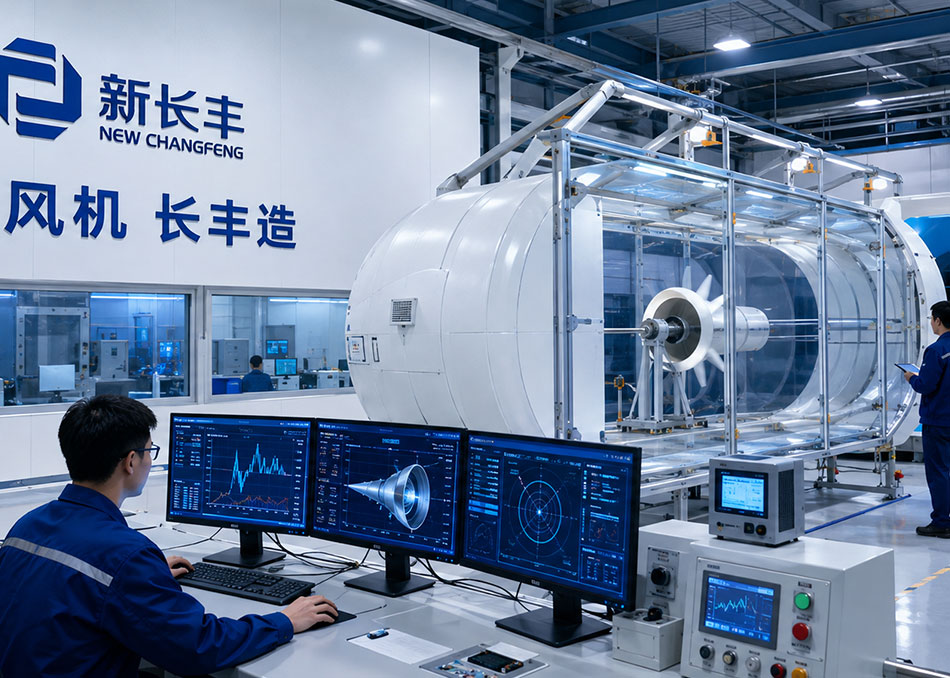
Hot workshops, fume-filled commercial kitchens, and stale, hazy work areas rarely trace back to a single failing machine. More often, the problem is that supply and exhaust air are not organized into a coherent ventilation scheme. Axial fans move large volumes of air for general ventilation and exhaust, while water-cooled fresh air units deliver cooled, filtered make-up air into the space. Together, they let a kitchen or factory floor actually breathe.
This article focuses on the ventilation and air-exchange scenario: how axial fans should be selected, where they belong in a fume extraction and purification chain, and what typically drives the price of a commercial kitchen water-cooled fresh air unit. It is written for procurement teams, facility managers, and ventilation contractors who want fewer costly missteps.
What Role Do Axial Fans Play in Ventilation and Air Exchange?
An axial fan moves air parallel to the fan shaft. That geometry gives it a compact, space-efficient footprint and straightforward installation in walls, window openings, or at the end of a duct run for direct exhaust or direct supply. In ventilation systems, axial fans are commonly used for whole-workshop air exchange, heat removal from equipment rooms, and odor exhaust from restrooms and warehouse areas. Their core value is high air volume at relatively low system resistance, which suits large open spaces.
It is equally important to be clear about what an axial fan is not. It is not a universal fume purification device. Kitchen exhaust carries substantial grease particles and odor compounds. If ordinary axial fans are used to discharge raw cooking fume, grease deposits on the impeller and casing, and over time this degrades dynamic balance and reduces efficiency. The correct arrangement is a chain: cooking fume passes through a purifier first, then a fan handles final discharge; the make-up air side is handled by axial fans or water-cooled fresh air units.
This division of labor aligns with the intent of GB 18483 (the emission standard for cooking fume in the catering industry), which separates purification from discharge, and with GB 51251 (the smoke and heat exhaust ventilation standard), which emphasizes organized airflow paths and pressure relationships rather than isolated equipment.
- General ventilation: axial fans for whole-space air exchange in workshops, warehouses, and equipment rooms.
- Fume exhaust: purification first, then discharge by axial or cabinet centrifugal fans.
- Make-up air: axial supply fans or water-cooled fresh air units to replace exhausted air with filtered, cooled air.
How Should You Select an Axial Fan for Air Exchange?
Selection starts with the air exchange rate, not the fan. Estimate the required volumetric flow from room volume and the number of air changes per hour appropriate to the space, then confirm the actual system resistance: louvers, rain hoods, duct length, bends, and discharge grilles all add static pressure loss. Axial fans perform best against low-to-moderate resistance; if the duct run is long or heavily fitted, a centrifugal fan may hold pressure more effectively.
Performance should be verified against GB/T 1236, the standard for fan performance testing, so that quoted airflow and pressure reflect a consistent test method. Energy performance is a separate consideration: GB 19761 sets fan energy efficiency grades, and choosing a higher-efficiency unit reduces operating cost over years of continuous running. Noise is the third axis. For kitchens and occupied work areas, check sound pressure levels at the actual mounting distance and consider lower-speed units, vibration isolation, or acoustic treatment at the wall penetration.
Finally, match materials and protection to the environment. Humid or grease-laden exhaust streams call for appropriate motor enclosure ratings and corrosion-resistant finishes, and any fan handling grease-laden air should be positioned downstream of purification, with accessible cleaning points.
- Calculate required airflow from room volume and air changes per hour.
- Sum static pressure losses across the full exhaust or supply path.
- Confirm performance data per GB/T 1236 and efficiency grade per GB 19761.
- Check noise at the receiver location, not just at the fan.
- Specify motor protection and materials suited to humidity and grease.
Why Make-Up Air Matters in Kitchen and Workshop Ventilation
Every cubic meter of air exhausted must be replaced. Without deliberate make-up air, a kitchen or workshop develops negative pressure: doors become hard to open, exhaust hoods lose capture efficiency, and fume can leak into dining or adjacent production areas. In hot climates or heat-generating processes, untreated make-up air simply reintroduces the discomfort the exhaust system was meant to remove.
A water-cooled fresh air unit addresses both problems at once. It draws in outdoor air, filters it, and cools it through an evaporative or water-cooled process before distributing it into the occupied space. The result is a balanced pressure relationship, a more comfortable working environment, and better capture performance at the exhaust hood. In commercial kitchens, this pairing of purified exhaust and cooled make-up air is what keeps fume from migrating into guest areas.
Balancing is not a set-and-forget task. Make-up air volume should be commissioned against measured exhaust volume, and the pressure relationship should be rechecked after any change in hood configuration, ductwork, or menu and equipment load.
What Drives the Price of a Commercial Kitchen Water-Cooled Fresh Air Unit?
Buyers often ask for a single number, but a water-cooled fresh air unit quotation reflects a configuration, not a commodity. The main cost drivers are the air handling capacity required by the space, the cooling method and its associated water system components, the filtration stages specified, the fan and motor efficiency grade, and the unit casing construction. Controls, condensate management, and installation accessories add further variables.
Because capacities and performance figures must be matched to the actual project, reputable suppliers quote against a load calculation and site conditions rather than publishing one-size-fits-all pricing. A quote should state the design airflow, the cooling approach, filtration class, electrical requirements, and the scope of supply, so that offers from different suppliers can be compared on equal terms.
- Design airflow and required cooling duty for the space.
- Cooling method and water system scope.
- Filtration stages and maintenance access.
- Fan and motor efficiency, plus control options.
- Casing materials, installation accessories, and commissioning support.
Frequently Asked Questions
Q: Can a standard axial fan be used to exhaust kitchen cooking fume directly?
A: It is not recommended. Grease in cooking fume will accumulate on the impeller and casing, upsetting balance and reducing efficiency over time. Fume should pass through a purifier first, with final discharge handled by a fan suited to the remaining airstream, consistent with the purification-then-discharge logic of GB 18483.
Q: How do I know whether an axial fan or a centrifugal fan is right for my exhaust run?
A: Compare the total static pressure of your system against the fan's performance curve. Axial fans are efficient against low-to-moderate resistance, such as short wall or window exhausts. Long duct runs with many fittings generally favor centrifugal fans, which hold pressure more effectively.
Q: Why does my kitchen feel stuffy even though the exhaust hood is running?
A: The exhaust is likely removing air faster than make-up air can enter, creating negative pressure that starves the hood and pulls fume from other paths. Adding properly sized make-up air, ideally cooled and filtered, restores balance and improves hood capture.
Q: What information do I need to provide to get an accurate water-cooled fresh air unit quotation?
A: Provide the space volume and intended use, required supply airflow, outdoor design conditions, available water and power services, filtration expectations, and installation constraints. With those inputs, a supplier can configure a unit and quote the actual scope rather than a generic figure.
Summary
Effective ventilation is a system, not a single product. Axial fans handle the bulk air exchange and exhaust duty, purification equipment removes grease and odor before discharge, and water-cooled fresh air units supply cooled, filtered make-up air to keep pressure balanced and spaces comfortable. Selecting each element against recognized standards such as GB/T 1236, GB 19761, GB 51251, and GB 18483 gives you a design that performs and stays maintainable.
If you are planning ventilation for a workshop, school canteen, hotel kitchen, or warehouse, share your room data and exhaust layout with our engineering team at XCFFJ. We can help you match axial fans, purification equipment, and water-cooled fresh air units into a coordinated system and provide a configuration-based quotation.