
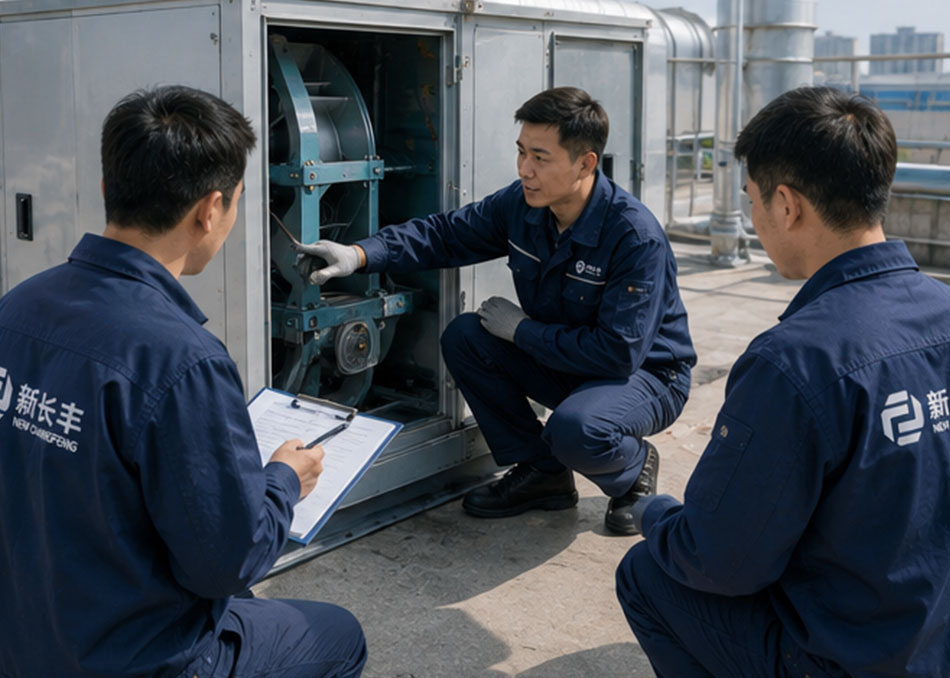
Internet cafes and commercial kitchens may seem like different worlds, but they often share the same ventilation challenges: enclosed spaces, concentrated heat sources, and poor air quality. In internet cafes, dense equipment and long-staying patrons lead to stuffy summers and rising CO2 levels. In kitchens, stoves radiate heat continuously while fumes and steam mix; if exhaust and makeup air are unbalanced, negative pressure causes grease spillover, doors that are hard to open, and unstable flames. Water-cooled fresh air units, which combine cooling with fresh air supply, can address both scenarios. This article explains the principles, selection, installation, and maintenance to help managers and engineers use these units effectively.
Internet Cafe Ventilation and Cooling: Why Water-Cooled Fresh Air Units Beat Simple Exhaust
Internet cafes are densely occupied with high heat loads from equipment, and doors and windows are often kept closed. Relying solely on air conditioning recirculation can lead to poor air quality, a stuffy feeling, and uneven temperatures. Adding exhaust fans alone may exchange air, but it draws in hot outdoor air, increasing the cooling load in summer. A water-cooled fresh air unit works differently: it introduces outdoor fresh air, cools it through a wet curtain (evaporative cooling), and supplies it indoors, while a well-designed exhaust path creates organized airflow to achieve simultaneous cooling and air exchange.
Technically, evaporative cooling relies on water evaporation to absorb heat, lowering the supply air temperature in an isenthalpic process. This is more effective in dry or semi-dry climates; in humid southern regions, evaluation should consider indoor load and air change rates to avoid excessive humidity. For internet cafes, water-cooled fresh air units provide cooled fresh air, diluting indoor pollutants and improving comfort without overburdening the air conditioning.
Kitchen Negative Pressure Solutions: Balancing Exhaust and Makeup Air
Commercial kitchens face severe negative pressure when exhaust hoods extract large volumes of air without adequate makeup. This leads to grease and smoke leaking into dining areas, doors that are difficult to open, and even backdrafts that affect combustion. Water-cooled fresh air units can supply cooled makeup air directly to the kitchen, maintaining a slight negative pressure relative to the dining area (typically around -5 Pa) to contain odors while ensuring sufficient air for exhaust.
The key is to balance exhaust and makeup air volumes. Exhaust hoods should be sized according to GB 18483 for kitchen fume emission, and makeup air should be about 80–90% of exhaust volume to avoid positive pressure in the kitchen. Water-cooled fresh air units should be positioned to deliver air near the cooking area without disrupting hood capture efficiency. In summer, the cooling effect also improves staff comfort and reduces the load on kitchen air conditioning.
Selection and Installation Tips for Water-Cooled Fresh Air Units
When selecting a water-cooled fresh air unit, consider the climate, required air change rate, and cooling load. In dry regions, evaporative cooling can provide significant temperature drops; in humid areas, a hybrid approach with dehumidification or sensible cooling may be needed. Installation should ensure proper duct design to minimize resistance, and the unit should be placed to allow easy access for maintenance. For internet cafes, distribute supply air evenly to avoid dead zones; for kitchens, coordinate with exhaust hood layout to prevent interference.
- Verify fan performance according to GB/T 1236 and energy efficiency per GB 19761.
- Ensure electrical safety and water supply quality for the wet curtain.
- Install filters and regular cleaning schedules to maintain air quality.
Maintenance and Operational Best Practices
Regular maintenance ensures optimal performance and longevity. Clean or replace wet curtains to prevent scale and mold, check water distribution, and inspect fans for balance and noise. In kitchens, grease filters should be cleaned frequently to avoid fire hazards. For internet cafes, monitor CO2 levels and adjust fresh air intake accordingly. During off-peak hours, reduce fan speed to save energy.
FAQ
Q: Can water-cooled fresh air units replace air conditioning in internet cafes?
A: Not entirely. They provide cooled fresh air and improve air quality, but in hot and humid climates, air conditioning may still be needed for sensible cooling. They work best as a supplement to reduce AC load and enhance ventilation.
Q: How do I determine the right size for a kitchen makeup air unit?
A: Calculate exhaust volume from hood specifications, then size the makeup air unit to supply about 80–90% of that volume. Consider the cooling load and climate; consult a professional for accurate sizing.
Q: What maintenance does a water-cooled fresh air unit require?
A: Regular cleaning of the wet curtain and water tank, checking water quality, lubricating fan bearings, and inspecting ducts for leaks. In kitchens, clean grease filters daily or weekly depending on usage.
Water-cooled fresh air units offer a practical solution for both internet cafes and commercial kitchens, improving comfort and air quality while addressing negative pressure issues. For tailored advice on selecting and installing the right unit for your space, contact XCFFJ's technical team.