
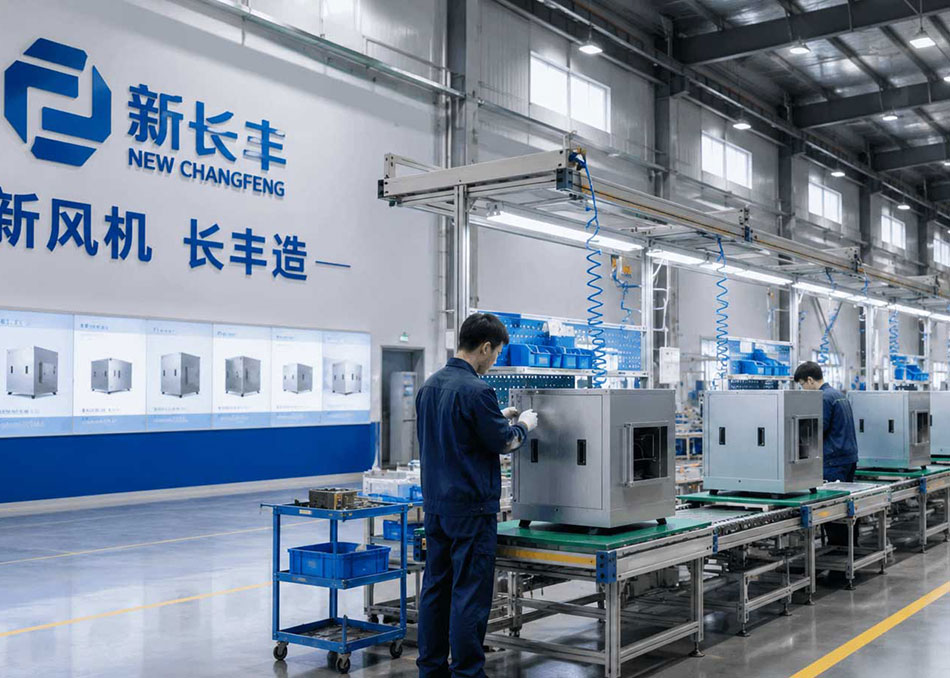
Guangdong's restaurant scene is famously dense — small eateries, open-air dai pai dong, and cha chaan tengs line every street and alley. Back-of-house kitchens are often tight, woks fire hard, and fume output is heavy. When the exhaust system is poorly matched, the consequences range from a sweltering, eye-stinging kitchen and grease-coated walls to fume spillover that disturbs neighbors and invites environmental complaints. Within the exhaust and makeup air system, axial fans are commonly deployed for duct boosting, terminal makeup air, and auxiliary extraction. This article focuses on the theme of fume purification · ventilation and makeup air, explaining how small restaurants should scientifically select and configure axial fans.
First, Clarify the Axial Fan's Role in a Restaurant Exhaust System
Many operators mistakenly believe one fan can solve all fume problems. In reality, kitchen exhaust is a system: the hood above the stove captures fume, ductwork transports it, the purifier treats it, the terminal fan extracts it, and the makeup air system balances indoor pressure. Axial fans — thanks to their compact structure, easy installation, high airflow, and direct-drive transmission — are frequently used for mid-duct boosting, long-run duct relay, and kitchen makeup or supply air.
It is important to be clear: axial fans have relatively limited pressure characteristics. If the duct run is long, elbows are numerous, or the purifier has significant resistance, an axial fan alone often cannot overcome total system resistance. In such cases, a cabinet centrifugal fan or centrifugal exhaust fan is typically required as the primary exhaust device, with the axial fan serving for auxiliary boosting or makeup air. Estimating system resistance before selecting fan type and installation position is the key step to avoiding the "bought it but it can't pull" trap.
In Guangdong, high-temperature and high-humidity conditions demand special consideration. Kitchen exhaust carries grease vapor and moisture; ordinary axial fans not designed for grease-laden airstreams may suffer motor overheating, blade imbalance, or shortened service life. Selecting models with moisture-proof motors, corrosion-resistant coatings, and grease-resistant impeller designs is strongly advised.
Matching Axial Fan Selection to the Exhaust and Makeup Air System
Axial fan selection for small restaurant exhaust should follow a systematic approach rather than guesswork. The first step is to determine the required exhaust volume based on the number and type of cooking stations, hood dimensions, and local emission requirements. GB 18483, the national standard for cooking fume emission, sets limits that indirectly influence required airflow and purification efficiency. Over- or under-sizing both create problems: too small and fume escapes; too large and you waste energy, increase noise, and destabilize the makeup air balance.
Next, assess system resistance. This includes hood pressure loss, duct friction, elbow and transition losses, purifier resistance, and terminal discharge conditions. Axial fans are best suited to low-resistance segments — for example, short makeup air runs or booster positions where system resistance is modest. For the main exhaust path through a long duct and purifier, a centrifugal fan is usually the better choice. Using an axial fan in a high-resistance main exhaust line often results in insufficient extraction and motor overload.
Makeup air is the other half of the equation. If a kitchen exhausts large volumes of air without corresponding makeup air, negative pressure builds, doors become hard to open, and exhaust efficiency drops. Axial fans are well-suited for makeup air supply because they move large air volumes at low pressure. In Guangdong's humid climate, bringing in untreated outdoor air can add heat and moisture load; consider whether a dedicated fresh air unit or dehumidification is needed for comfort and mold prevention.
- Estimate exhaust volume first — base it on cooking intensity and hood capture velocity.
- Calculate system resistance — long ducts, many elbows, and purifiers raise resistance sharply.
- Match fan type to duty — axial for low-resistance boosting and makeup air; centrifugal for high-resistance main exhaust.
- Plan makeup air deliberately — balance supply and exhaust to maintain pressure and comfort.
- Check motor protection — specify moisture-proof, grease-resistant designs for kitchen environments.
Installation and Maintenance Practices That Extend Axial Fan Life
Correct installation significantly affects axial fan performance and longevity. In kitchen exhaust applications, the fan should be mounted on a stable, vibration-isolated base. Flexible connections at duct joints reduce vibration transmission and noise. For makeup air fans, ensure the intake is located away from exhaust discharge and grease-laden zones to avoid drawing contaminated air back into the kitchen. Access doors or panels should be provided for cleaning and inspection.
Maintenance in a restaurant environment is non-negotiable. Grease accumulation on impeller blades causes imbalance, vibration, and eventual bearing failure. A practical maintenance schedule includes periodic inspection of blades, motor cooling passages, and electrical connections. In humid Guangdong conditions, checking for corrosion and moisture ingress in the motor and terminal box is especially important. Records of cleaning and service help identify recurring issues before they cause downtime.
Noise is another practical concern. Axial fans generally produce higher noise at equivalent airflow compared to centrifugal fans, particularly at high speeds. For small restaurants in dense urban areas, selecting lower-speed models, adding silencers, or isolating the fan from structural surfaces can help meet local noise limits and maintain good neighbor relations. Balancing noise control with adequate extraction is part of responsible system design.
Key Takeaways for Small Restaurant Operators
Selecting an axial fan for a small restaurant exhaust system is not about buying the biggest or cheapest unit — it is about matching the fan to its specific role in the system. Axial fans excel at moving large air volumes at low pressure, making them ideal for makeup air and auxiliary boosting. They are not a universal substitute for centrifugal fans in high-resistance main exhaust lines.
For Guangdong's small restaurants, the combination of high heat, high humidity, and dense neighboring buildings makes system design and maintenance especially critical. A well-balanced system — correct exhaust volume, appropriate fan types, sufficient makeup air, and regular cleaning — protects kitchen staff, satisfies environmental requirements, and avoids complaints. When in doubt, consult a ventilation professional who can perform resistance calculations and recommend a matched fan configuration.
FAQ
Q: Can I use just one axial fan for my small restaurant's entire kitchen exhaust?
A: It depends on your system resistance. If your duct run is short and there is no high-resistance purifier, an axial fan may handle the duty. However, for longer ducts, multiple elbows, or systems with electrostatic purifiers, an axial fan alone often cannot overcome total resistance. In those cases, a cabinet centrifugal fan is typically needed as the main exhaust fan, with axial fans used for boosting or makeup air.
Q: Why is makeup air important for my kitchen exhaust system?
A: Without makeup air, a kitchen exhausting large air volumes creates negative pressure. This makes doors hard to open, reduces exhaust effectiveness, and can cause fume to spill back into the dining area. Axial fans are commonly used for makeup air because they move high air volumes at low pressure. In Guangdong's humid climate, consider whether the incoming air needs cooling or dehumidification for comfort.
Q: How often should I clean and maintain my axial fan in a kitchen environment?
A: Grease and moisture are the main enemies of axial fans in kitchens. Inspection frequency depends on cooking volume, but a practical approach is to check blades, motor, and connections monthly, with thorough cleaning as needed. In humid conditions, check for corrosion and moisture ingress more often. Keeping maintenance records helps spot recurring problems early and extends fan life.
For more information on selecting the right axial fans and ventilation equipment for your commercial kitchen, visit www.xcffj.com or contact our team for application guidance.