
Walk into many commercial kitchens and the exhaust system appears to be moving plenty of air, yet smoke still lingers over the range, the line cooks work in stifling heat, greasy air drifts into the dining room, and staff have to shoulder the door open. In most of these cases the exhaust fan is not the culprit — the make-up air is. When a kitchen extracts air without supplying a comparable volume back in, the space goes into strong negative pressure, the capture efficiency of the exhaust hood collapses, and fumes back-draft through every gap, doorway, and service window. A water-cooled fresh air unit addresses both halves of the problem at once: it delivers outdoor air to balance the negative pressure while using evaporative water cooling to lower the supply air temperature, so make-up air does not simply make the kitchen hotter. This article explains the selection logic and maintenance essentials for water-cooled fresh air units in kitchen negative-pressure and ventilation make-up applications.
How Negative Pressure Forms in a Kitchen — and Why Make-Up Air Is the Only Fix
Exhaust hoods and exhaust fans run continuously, pulling air out of the kitchen. If an equal or near-equal volume of fresh air is not introduced, indoor air is steadily depleted and the space drops below outdoor atmospheric pressure. The consequences follow a predictable chain: hood suction weakens and fumes spread above the cooking line; doors become difficult to open; smoke migrates through pass-through windows, floor drains, and door gaps toward the front of house; and gas-fired equipment may suffer incomplete combustion. The basic principle of ventilation engineering is that exhaust and supply must be balanced — make-up air volume should typically approach the exhaust volume at a defined ratio so the hood can maintain a stable capture airflow pattern.
A common mistake is to simply install a larger exhaust fan. Increasing exhaust without increasing supply only deepens the negative pressure, and fume spillage gets worse rather than better. The correct sequence is to calculate exhaust first, then size the make-up air: base the exhaust figure on the number of burners, hood dimensions, and cooking style, then select a supply unit that closes most of the gap while leaving the kitchen slightly negative relative to the dining area — enough to contain odors, not enough to starve the hood.
This is where the water-cooled fresh air unit earns its place. A conventional supply fan would push hot outdoor air into an already hot kitchen, and operators often respond by shutting the unit down — which recreates the negative pressure. Evaporative cooling lowers the supply air temperature before it enters the space, so the unit can run continuously without turning the kitchen into an oven. The result is a balanced, cooler, and more comfortable working environment with hood capture restored.
Why Water-Cooled Fresh Air Units Suit Kitchen Make-Up Air
Kitchens combine three requirements that are hard to satisfy with ordinary equipment: high air-change rates, a supply air temperature that will not add heat load, and reliable operation in a greasy, humid atmosphere. A water-cooled fresh air unit is built around an evaporative cooling module, drawing outdoor air through a wetted cooling medium and delivering it at a lower dry-bulb temperature than the ambient air. Because the cooling effect comes from evaporation rather than a refrigerant circuit, the unit avoids the condenser heat rejection and higher electrical demand of conventional air conditioning, which matters in kitchens where every kilowatt competes with cooking equipment.
Selection should follow the same discipline applied to any fan system. Fan performance should be verified against GB/T 1236 test methods, and fan energy efficiency should be checked against GB 19761 so the unit is not oversized or inefficient at its actual duty point. Duct routing, filter resistance, and the cooling module's pressure drop all consume static pressure, so the unit must be selected on total system resistance rather than free-air delivery. Supply air should be distributed to avoid blowing directly onto the cooking line, which can disturb hood capture, and to prioritize the hottest zones and the make-up air paths that feed the hood.
In projects where smoke and heat exhaust is also part of the design, coordination with GB 51251 requirements is essential — make-up air for smoke control and make-up air for daily kitchen ventilation serve different purposes and should not be conflated. Where the kitchen discharges to a sensitive neighborhood, the exhaust side should be paired with fume purification meeting GB 18483 emission limits, so the ventilation strategy is complete from supply to discharge.
Maintenance Essentials for Water-Cooled Fresh Air Units
An evaporative unit is only as good as its water and air paths. Scale, biofilm, and dust loading degrade cooling performance and can turn the unit into an odor source, so a scheduled maintenance routine is not optional. The following checkpoints cover the majority of field problems:
- Cooling medium and water distribution: inspect the evaporative pad or cooling module for scale, algae, and physical damage; confirm the water distribution tray and nozzles deliver even coverage across the media face.
- Water quality and bleed-off: manage circulation water hardness and dissolved solids through controlled bleed-off and periodic drain-down; stagnant or over-concentrated water accelerates scaling and biological growth.
- Filters: clean or replace intake filters on the schedule set by local dust conditions; a loaded filter raises system resistance and reduces delivered airflow.
- Fan and drive: check belt tension on belt-driven units, bearing condition, and vibration; verify impeller balance and clean deposits from blades, which cause imbalance and noise.
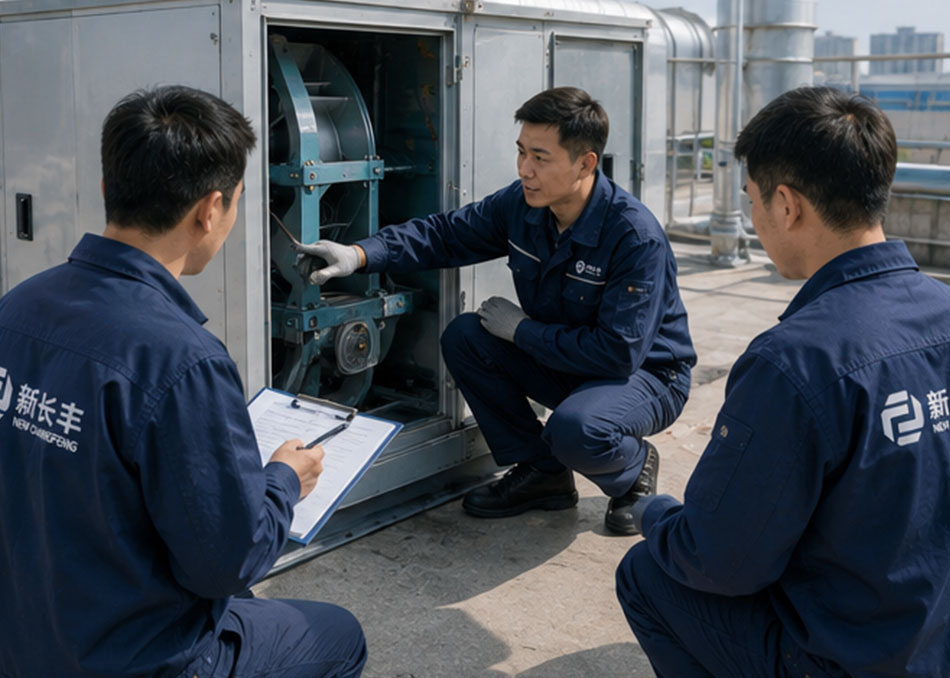
- Drain pan and cabinet: confirm drains flow freely, pans are sloped correctly, and cabinet seals are intact to prevent water carryover and corrosion.
- Controls and sensors: verify that temperature and humidity sensors read correctly and that fan and pump interlocks sequence properly on start-up and shutdown.
Maintenance frequency should reflect the environment. Kitchens with heavy grease loading, hard water, or continuous operation need shorter intervals than light-duty installations. Keeping a log of water quality, filter changes, and vibration readings allows faults to be caught before they affect kitchen pressure balance — a unit that quietly loses airflow will quietly reintroduce negative pressure.
Common Design and Operating Mistakes
Negative-pressure problems often persist after a supply unit is installed because of integration errors rather than equipment faults. Supply air discharged into a ceiling plenum instead of the occupied zone, make-up air short-circuiting directly back to the hood without crossing the cooking line, and units switched off during peak service all defeat the purpose. Commissioning should include a pressure check with the kitchen at full operation, and the unit should be treated as part of the cooking process — not as an optional comfort appliance.
Another frequent issue is treating the water-cooled fresh air unit as a substitute for the exhaust system's own design. The unit balances pressure and moderates supply temperature; it does not compensate for an undersized hood, poor hood mounting height, or cross-drafts from open doors and windows. A coordinated design covering hood capture, exhaust volume, make-up air volume, and supply air distribution is what delivers a smoke-free, workable kitchen.
FAQ
Q: Can I solve kitchen negative pressure just by opening a window or installing a wall fan?
A: Uncontrolled openings provide make-up air, but they deliver it hot, dirty, and unevenly, and they cannot be balanced against exhaust volume. A dedicated water-cooled fresh air unit gives a measured, filtered, and temperature-moderated supply that can be tuned to the exhaust rate, which is what restores stable hood capture.
Q: Does a water-cooled fresh air unit replace kitchen air conditioning?
A: No. It reduces supply air temperature through evaporative cooling and is intended primarily for ventilation and pressure balance. In very hot, humid climates the achievable temperature drop is limited by the ambient wet-bulb condition, so it should be specified as a ventilation and heat-relief measure rather than a full comfort-cooling system.
Q: How often should the cooling medium and water system be serviced?
A: There is no universal interval — it depends on water hardness, dust loading, and operating hours. Inspect the media and water distribution at least monthly during commissioning and the first season, then set a schedule based on observed scaling and biological growth, with filter checks aligned to the same routine.
Q: Will adding make-up air increase my energy bill significantly?
A: The supply fan and pump do consume energy, but the unit relieves the negative pressure that forces exhaust fans to work against a starved space, and evaporative cooling typically uses less electricity than refrigerant-based cooling for the same air volume. Selecting a unit verified to GB 19761 efficiency grades and sized to the actual system resistance keeps operating cost in check.
Kitchen negative pressure is rarely solved by a bigger exhaust fan — it is solved by a balanced, well-designed make-up air strategy. A water-cooled fresh air unit delivers that balance while keeping supply air temperatures manageable, provided it is correctly sized and maintained. If you are planning a kitchen ventilation upgrade or troubleshooting persistent fume spillage, the XCFFJ team can help you match unit selection to your exhaust volume, hood configuration, and site conditions.