
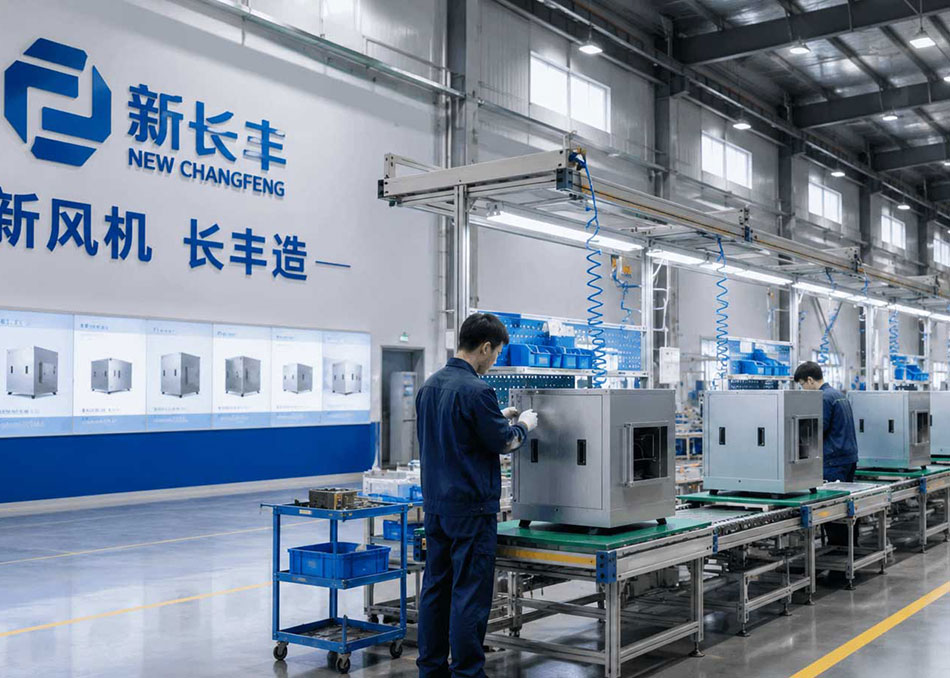
During the sweltering summer months, temperatures inside factory workshops can approach 40°C, with heat from machinery compounding the outdoor heatwave. This not only reduces worker productivity but also increases the risk of heatstroke and causes fluctuations in production line quality. Faced with this oppressive heat, many factory managers are turning to evaporative air coolers—a cooling solution that relies on the principle of water evaporation to absorb heat. Known for its moderate investment, low operating costs, and high air delivery, this equipment is becoming increasingly popular for industrial facility cooling. However, the market is flooded with numerous brands and models, each with varying specifications. How do you choose the right one? This article provides practical guidance to help you navigate the selection process.
Understanding Why Evaporative Air Coolers Work
The core principle behind an evaporative air cooler is “evaporative cooling.” When hot air passes through a moistened cooling pad (made of special fibers or honeycomb paper), water evaporation absorbs significant latent heat, causing the air temperature to drop noticeably. A high-volume axial fan then delivers this cooled air into the workshop. This is a natural, physical cooling process that does not rely on a compressor, so electricity consumption is far lower than that of traditional central air conditioning. Based on industry experience, in dry climates, the outlet air temperature can be 5–10°C lower than the outdoor temperature. In more humid regions, the temperature drop may be less pronounced, but the system still creates a continuous airflow that improves perceived comfort.
It is important to note that an evaporative air cooler is not an “air conditioner” in the conventional sense. It does not dehumidify or operate in a sealed recirculation mode. Instead, it uses a “high-volume, positive-pressure” approach to continuously replace hot indoor air with cooler, fresh air. Therefore, it is best suited for open or semi-open spaces such as injection molding workshops, welding shops, garment factories, and warehouse logistics centers.
Key Factors to Consider When Selecting an Evaporative Cooler
Before making a purchase, evaluate your specific needs based on the following criteria:
- Workshop layout and size: Measure the floor area and ceiling height to estimate the required air changes per hour. A common rule of thumb is to aim for 25–40 air changes per hour in industrial settings.
- Heat load: Consider the heat generated by machinery, lighting, and human occupancy. Higher heat loads may require more units or a higher cooling capacity.
- Humidity levels: In humid climates, the cooling effect is reduced. You may need to combine evaporative cooling with other ventilation methods or increase the number of units.
- Air quality and filtration: If your workshop has dust, fumes, or airborne particles, choose a model with appropriate filtration to maintain air cleanliness.
- Noise levels: For areas where workers need to concentrate or communicate, select a unit with lower noise ratings.
Additionally, consider the quality of the cooling pad material, the durability of the fan motor, and the ease of maintenance. Look for units that comply with relevant industry standards, such as GB/T 1236 for fan performance testing and GB 19761 for fan energy efficiency, to ensure reliable and efficient operation.
Installation and Maintenance Best Practices
Proper installation is crucial for maximizing the performance of your evaporative cooler. Position the unit to allow unobstructed airflow and ensure that the water supply and drainage systems are correctly connected. For large workshops, a centralized system with ducted air distribution may be more effective than multiple standalone units. Regular maintenance—such as cleaning or replacing the cooling pads, checking the water pump, and inspecting the fan blades—will prolong the equipment's lifespan and maintain optimal cooling efficiency.
It is also advisable to integrate the evaporative cooler with existing ventilation systems to create a balanced airflow. For example, installing exhaust fans on the opposite side of the workshop can help remove hot, stale air and enhance the overall cooling effect.
Cost-Benefit Analysis
One of the main advantages of evaporative coolers is their low operating cost. Compared to traditional air conditioning, they can reduce energy consumption by up to 80% in suitable climates. The initial investment is also significantly lower, making them an attractive option for budget-conscious factory managers. However, it is essential to factor in water consumption and the periodic replacement of cooling pads. In regions with water scarcity, this could be a concern.
When calculating the return on investment, consider the potential gains from improved worker comfort, higher productivity, and reduced heat-related downtime. In many cases, the payback period is less than two years.
Frequently Asked Questions
Q: Can an evaporative air cooler work in humid climates?
A: Yes, but the cooling effect will be less pronounced. In high-humidity conditions, the air is already saturated with moisture, so evaporation is slower. However, the cooler still provides beneficial airflow and can improve comfort, especially when combined with exhaust ventilation.
Q: How many evaporative coolers do I need for my workshop?
A: The number depends on the workshop's size, heat load, and desired air changes per hour. A rough estimate is one unit per 100–150 square meters, but it's best to consult with a professional to perform a detailed load calculation.
Q: Are evaporative coolers noisy?
A: Noise levels vary by model and fan speed. High-quality units are designed to operate at acceptable noise levels, typically around 60–70 dB(A). Check the product specifications and choose a model that meets your noise requirements.
Q: What maintenance is required?
A: Regular maintenance includes cleaning or replacing the cooling pads every 1–3 months, checking the water pump and float valve, and ensuring the fan and motor are clean and lubricated. Some units have self-cleaning features to reduce maintenance frequency.
Conclusion
Choosing the right evaporative air cooler for your factory workshop is a strategic decision that can significantly impact worker comfort, productivity, and operational costs. By understanding the principles of evaporative cooling, evaluating your specific needs, and following best practices for installation and maintenance, you can create a cooler, more comfortable working environment. For expert advice and high-quality evaporative cooling solutions, consider consulting with XCFFJ, a trusted brand in industrial ventilation and cooling equipment.