
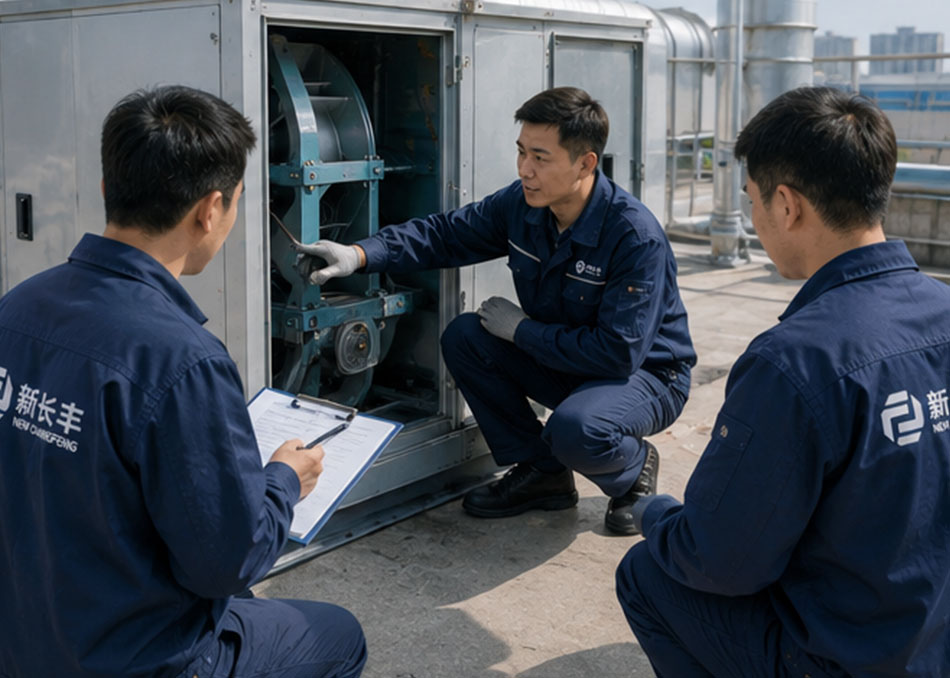
Summer in a commercial kitchen is a problem many operators can't avoid. Open flames radiate heat continuously, steamers and stock pots generate steam, and exhaust hoods extract large volumes of air without enough make-up air coming in. The result: station temperatures stay high, staff tire quickly, and turnover climbs. Traditional central AC or standard cabinet units often struggle in this environment — supply air outlets get coated with grease, condensate trays collect oil, filters clog within days, and cooling capacity drops noticeably. Solving station-level cooling in a commercial kitchen requires understanding the technical parameter logic of a commercial kitchen air conditioner, not simply copying the selection approach used for a living room unit. XCFFJ has accumulated extensive kitchen-scenario experience in industrial and commercial ventilation and cooling. This article explains station cooling across three levels: technical parameters, selection method, and installation points.
Why Kitchen Cooling Can't Copy Ordinary AC Selection
The difference between a kitchen environment and an ordinary room comes down to three things: concentrated heat sources, high grease concentration, and large air exchange volumes. Ranges, steam cabinets, and fryers are strong heat sources, releasing heat through both radiation and convection. Exhaust hoods must maintain sufficient exhaust volume per code, meaning indoor air is continuously extracted. If make-up air is insufficient, the kitchen forms a negative pressure, and cool air is pulled away before it ever reaches the workstations. Therefore, the design goal of a commercial kitchen air conditioner is not to cool the entire kitchen to a single comfort temperature, but to prioritize station cooling — providing stable cold air coverage to fixed positions such as the range front, plating, and prep stations. This is fundamentally different from whole-room cooling and directly determines the subsequent equipment selection and airflow organization.
Key Technical Parameters to Evaluate
When evaluating a commercial kitchen air conditioner, several parameters matter more than the nominal cooling capacity on a spec sheet. First is the cooling capacity under actual kitchen conditions. Because ambient temperature near the range is high and the unit's return air may be warmer than a normal room, the effective cooling output can decline. Look for performance data that reflects high-ambient operation rather than standard rating conditions.
Second is airflow organization and throw distance. The unit must deliver cool air to the workstation without being immediately captured by the exhaust hood. Adjustable louvers or directional nozzles help aim air at the person rather than the ceiling. Third is filtration and grease resistance. Kitchen air carries grease particles that clog standard filters quickly. A unit designed for kitchen use should have easily accessible, cleanable filtration and components that resist grease buildup on the evaporator and fan.
Fourth is condensate management. High humidity from steamers and boiling pots means more condensate. A reliable drainage path and corrosion-resistant drain pan are essential. Fifth is energy efficiency and noise. Fan energy efficiency standards such as GB 19761 provide a benchmark for motor and fan selection, while noise levels affect communication and comfort at the station. Finally, consider the power supply and voltage available, and whether the unit is designed for the ambient temperature range of a working kitchen.
Selection Method for Station Cooling
Start by identifying the specific workstations that need cooling. In most kitchens, the range front, wok station, and plating area are the critical positions. Measure or estimate the heat load at each station, including radiant heat from flames and hot surfaces, convective heat from steam, and heat from personnel. Then determine the air volume and temperature difference needed to offset that load at the station, not for the whole room.
Next, evaluate the interaction with the exhaust and make-up air system. If the exhaust hood is pulling more air than the make-up air supplies, the negative pressure will interfere with the air conditioner's delivery. In many cases, balancing the make-up air or adding dedicated make-up air near the unit improves performance more than simply choosing a larger AC. XCFFJ's experience in kitchen ventilation shows that station cooling works best when the air conditioner and the exhaust system are designed as one system.
Finally, choose a unit type that matches the installation constraints. Ceiling-mounted or floor-standing commercial kitchen air conditioners may be appropriate depending on ceiling height, available floor space, and the routing of refrigerant and drain lines. Avoid placing the unit where its return air will be directly in the grease-laden plume from the hood.
Installation and Maintenance Points
Installation quality determines whether the designed performance is actually delivered. Position the supply air outlet so the cool air reaches the worker's torso without blowing directly on open flames or food preparation surfaces. Keep the return air away from the exhaust hood's capture zone to avoid short-circuiting. Ensure the drain line has a continuous slope and is routed to a grease trap or appropriate discharge point, because kitchen condensate may contain trace grease.
Maintenance should be planned from day one. Establish a cleaning schedule for filters and evaporator coils based on actual grease loading, not a fixed calendar. Check the drain pan and line for blockages regularly. Inspect fan blades and motors for grease accumulation that can cause imbalance or overheating. Keep records of cleaning and service so that performance trends can be identified.
FAQ
Q: Can I just use a residential split AC for my restaurant kitchen?
A: A residential split AC is not designed for the grease, humidity, and high ambient temperatures of a commercial kitchen. Its filters clog quickly, the evaporator coil can become coated with grease, and condensate management may be inadequate. A commercial kitchen air conditioner is built with more accessible filtration, grease-resistant components, and airflow patterns suited to station cooling.
Q: What is more important — cooling capacity or airflow direction?
A: Both matter, but airflow direction often decides whether the cooling is felt at the station. If cool air is immediately captured by the exhaust hood or short-circuits back to the return, even a large capacity unit will not keep the worker comfortable. Adjustable directional supply and proper placement relative to the hood are critical.
Q: How does the exhaust hood affect air conditioner performance?
A: The exhaust hood removes air from the kitchen, creating negative pressure if make-up air is insufficient. This negative pressure can pull cool air away from the station and reduce the unit's effective throw. Balancing exhaust and make-up air is often necessary to get the expected performance from a commercial kitchen air conditioner.
Q: What maintenance does a commercial kitchen air conditioner need?
A: Expect to clean filters and coils more frequently than in a normal room, inspect and clear the condensate drain, and check the fan and motor for grease buildup. The exact frequency depends on cooking volume and grease production, so monitor and adjust the schedule rather than relying on a fixed interval.
Station cooling in a commercial kitchen is a system problem, not just an equipment purchase. By focusing on the actual technical parameters that affect performance, selecting for station-level cooling rather than whole-room cooling, and installing with the exhaust and make-up air in mind, operators can create a more comfortable and productive kitchen environment. XCFFJ supplies commercial kitchen air conditioners and ventilation equipment designed for these demanding conditions. To discuss your kitchen layout and cooling needs, visit www.xcffj.com or contact our team.