
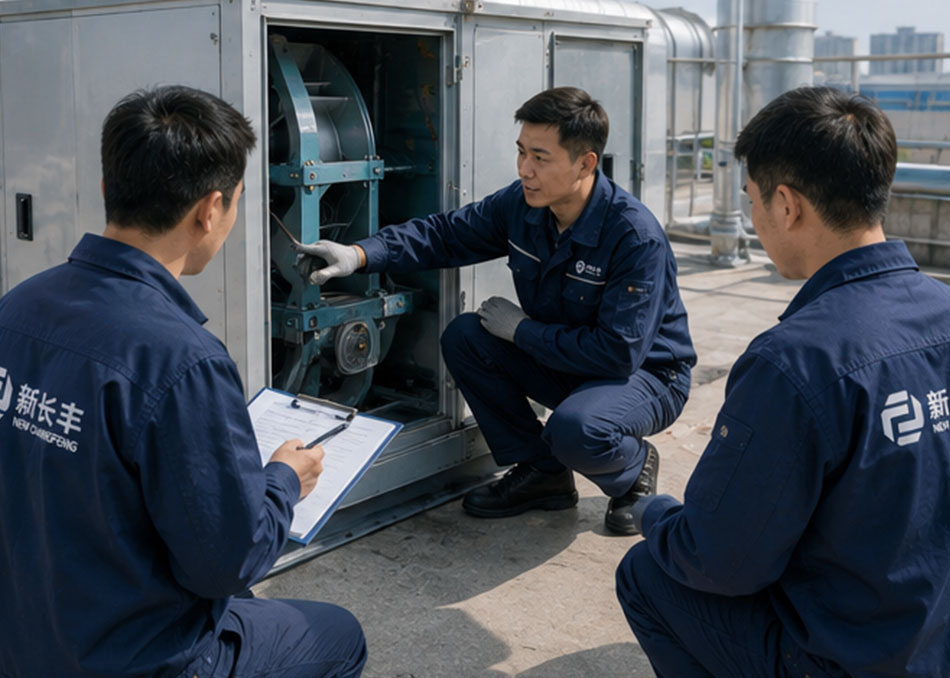
In mixed-use commercial spaces where restaurant kitchens and mahjong parlors coexist, ventilation is often treated as separate problems. The kitchen installs exhaust hoods and fans but still struggles with lingering fumes and unbearable heat, while the adjacent mahjong parlor feels stuffy and smoke-filled, leaving guests dizzy and uncomfortable. These issues share a common root: negative pressure imbalance caused by insufficient makeup air. A water-cooled fresh air unit, as part of a kitchen cooling system, provides the critical makeup air and ventilation that closes this loop.
Kitchen Negative Pressure: Exhaust Without Makeup Air
Kitchen exhaust systems are typically sized based on the number of burners, with hoods, grease filters, and centrifugal fans forming a complete exhaust chain. However, many kitchens focus solely on exhaust and neglect makeup air. When exhaust volume exceeds natural infiltration, a significant negative pressure develops inside the kitchen, triggering a series of problems.
Common symptoms include reduced hood capture efficiency, grease and smoke spilling into the dining area, incomplete gas combustion with yellow flames, doors that are hard to open, floor drain odors, and trapped heat during summer that raises the perceived temperature for staff. From a fluid dynamics perspective, an exhaust system needs a controlled makeup air path; otherwise, the fan works against excessive resistance, wasting energy without achieving the desired effect. Smoke escaping from the hood edge indicates insufficient capture velocity, while doors that slam shut or require force to open are classic signs of excessive negative pressure.
Mahjong Parlors: Air Quality and Comfort Challenges
Mahjong parlors present a different but related challenge. Enclosed rooms with multiple players and continuous smoking quickly become filled with stale air, smoke, and odors. Without adequate ventilation, guests may experience headaches, dizziness, and discomfort, which can drive them away and harm the establishment's reputation. Simply adding exhaust fans can create negative pressure that draws in odors from adjacent spaces, including the kitchen.
The key is to introduce filtered, cooled fresh air while maintaining a slight positive pressure relative to the kitchen, preventing cross-contamination. A water-cooled fresh air unit can deliver tempered fresh air, improving indoor air quality without causing drafts or temperature swings.
The Role of Water-Cooled Fresh Air Units
A water-cooled fresh air unit draws in outdoor air, filters it, and cools it using a water-cooled heat exchanger before supplying it to the space. This approach is particularly suitable for commercial environments where ductwork runs are long or where outdoor air temperatures are high. By providing a dedicated makeup air path, the unit helps balance exhaust systems, reduce negative pressure, and improve overall ventilation efficiency.
In a combined kitchen and mahjong parlor setting, the unit can be integrated into the building's ventilation strategy. For example, makeup air can be supplied to the kitchen to offset exhaust, while a separate branch supplies the mahjong parlor with cooled fresh air. This dual-purpose approach ensures that both spaces receive adequate air without compromising comfort or energy efficiency.
Design and Installation Considerations
- Balance exhaust and supply: Calculate exhaust volumes for the kitchen and required fresh air for the mahjong parlor, then size the water-cooled fresh air unit accordingly. Aim for a slight positive pressure in the parlor relative to the kitchen to prevent odor migration.
- Duct design: Route supply ducts to minimize resistance and avoid short-circuiting. Use proper insulation to prevent condensation.
- Filtration: Select filters that capture fine particles and smoke, and ensure regular maintenance.
- Controls: Implement variable-speed fans and demand-based ventilation to save energy and adapt to changing occupancy.
- Compliance: Ensure the system meets local standards for indoor air quality and fire safety, such as GB 51251 for smoke control and GB 18483 for kitchen fume emission.
Frequently Asked Questions
Q: Can a water-cooled fresh air unit replace a kitchen exhaust hood?
A: No. The unit provides makeup air and ventilation; it does not capture cooking fumes at the source. A properly designed exhaust hood and grease filter system are still required. The fresh air unit complements the exhaust system by balancing pressure and improving air quality.
Q: How do I know if my mahjong parlor has a negative pressure problem?
A: Signs include doors that are hard to open, drafts from gaps, lingering smoke and odors, and discomfort among guests. A simple test is to observe whether smoke drifts toward the door or remains stagnant. A professional ventilation assessment can confirm and quantify the issue.
Q: What maintenance does a water-cooled fresh air unit require?
A: Regular maintenance includes cleaning or replacing filters, checking the water cooling circuit for scale or leaks, inspecting the fan and motor, and ensuring condensate drains are clear. The frequency depends on usage and outdoor air quality; typically, filters need attention every few months.
By addressing both kitchen exhaust and mahjong parlor ventilation with a balanced approach, water-cooled fresh air units help create a comfortable, healthy environment for staff and guests alike. For tailored solutions that meet your specific layout and compliance needs, consult with a ventilation specialist to design a system that integrates seamlessly with your operation.