
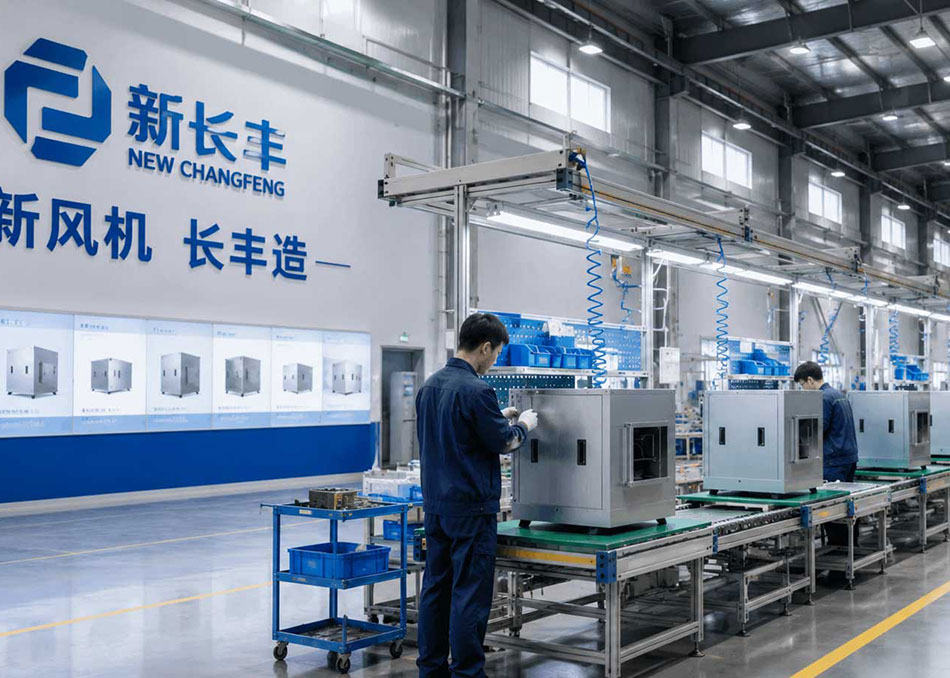
Industrial plant ventilation and cooling is a challenge that varies significantly by region and application. In southern China, hot and humid summers make workshops stifling and sweat difficult to dissipate; in eastern China, prolonged rainy seasons keep humidity high and promote equipment corrosion; in the north, spring dust storms and cold winters require a balance between ventilation and insulation; and in southwestern mountainous areas, factories often follow the terrain, leading to complex airflow patterns. The same negative pressure fan may not be suitable for a plastics injection molding workshop in Guangdong and a machining workshop in Northeast China. Therefore, selecting the right fan for different regions is not a cliché—it requires a systematic check of four fundamental aspects: airflow matching, airflow path, installation conditions, and energy efficiency. With years of experience in industrial and commercial ventilation, XCFFJ has served numerous cross-regional plant projects. Below, we outline the key points for selecting negative pressure fans for plant cooling and ventilation based on practical selection procedures.
1. First Calculate the Required Airflow, Then Choose the Fan
The core function of a negative pressure fan is to create exhaust on one side of the plant and intake on the opposite or adjacent areas, using pressure differential to expel hot air, dust, and odors while introducing cooler outdoor fresh air. The first step in selection is not to look at fan models but to estimate the required air exchange rate for the workshop.
In engineering practice, the total exhaust airflow is commonly estimated based on the workshop volume and the required air changes per hour: volume = length × width × height, and then the air change rate is selected according to the nature of the workshop—general production workshops, workshops with high heat sources, and workshops with dust or odors require progressively higher air change rates. Once the total exhaust airflow is determined, you can match it with the airflow performance of negative pressure fans.
It is important to note that fan airflow should be selected based on actual operating conditions, not just the maximum free-air delivery. Factors such as duct resistance, louvers, and installation location can affect actual airflow. Referring to standards like GB/T 1236 for fan performance testing helps ensure the fan can deliver the required airflow under real system resistance.
2. Design the Airflow Path to Avoid Short-Circuiting
Negative pressure ventilation relies on organized airflow: fresh air enters from clean, cool areas and hot, polluted air is exhausted from the opposite side. If intake and exhaust are too close, short-circuiting occurs, and the cooling effect is greatly reduced. Therefore, before installation, analyze the plant layout, equipment placement, and heat sources to determine the best locations for fans and intake openings.
In large workshops, it is advisable to use multiple negative pressure fans distributed along the exhaust side, with corresponding intake louvers or openings on the opposite wall. For workshops with complex geometry or partitions, consider using axial fans or centrifugal fans to assist airflow distribution. The goal is to create a uniform flow across the workshop, avoiding dead zones and local hot spots.
Additionally, in areas with strong winds or dust, intake openings should be equipped with filters or louvers to prevent debris from entering. In cold regions, it is essential to consider insulation and the risk of cold air drafts during winter; adjustable louvers or closing dampers can help balance ventilation and heating.
3. Consider Installation Conditions and Structural Constraints
The installation location and method directly affect fan performance and service life. Negative pressure fans are typically wall-mounted or roof-mounted. Wall installation is simpler but requires sufficient structural strength and space; roof installation saves wall space but demands good waterproofing and structural support.
In regions with frequent typhoons or strong winds, the fan and its mounting frame must be designed to withstand wind loads. In dusty environments, choose fans with easy-to-clean blades and guards. Also, consider maintenance access: fans should be easily reachable for inspection and cleaning.
For workshops with limited wall space, consider using roof turbo ventilators or axial fans as supplementary ventilation. In any case, follow local building codes and safety regulations, especially for fire safety; reference GB 51251 for smoke and heat exhaust requirements if applicable.
4. Evaluate Energy Efficiency and Noise Levels
Energy efficiency is a critical factor in fan selection, especially for continuous operation. GB 19761 specifies energy efficiency grades for fans; choosing a higher-efficiency fan can reduce electricity costs over time. The initial cost may be higher, but the return on investment is often worthwhile for factories running long hours.
Noise is another consideration, particularly for plants near residential areas or with strict occupational health requirements. Negative pressure fans with well-designed blades and proper mounting can reduce noise. It is advisable to check the sound pressure level at the installation distance and ensure it meets local noise regulations.
Regular maintenance, such as cleaning blades and checking belt tension (for belt-driven models), helps maintain efficiency and extend service life. Selecting a fan with accessible maintenance points and available spare parts is also prudent.
5. Match Fan Type to Application and Regional Climate
Negative pressure fans come in various types, including belt-driven and direct-driven, with different blade designs. For high-temperature workshops, choose fans with heat-resistant materials and motors. For humid environments, consider corrosion-resistant coatings or stainless steel components.
In northern regions with cold winters, fans with adjustable louvers or those that can be sealed during extreme cold are beneficial. In southern humid areas, emphasis should be on moisture protection and anti-corrosion measures. For dusty environments, filters or easy-clean designs are recommended.
XCFFJ offers a range of negative pressure fans suitable for different climates and applications. Our team can help you select the right model based on your specific workshop conditions and regional characteristics.
Frequently Asked Questions
Q: How do I determine the required air change rate for my workshop?
A: The air change rate depends on the workshop's function and heat load. General workshops may require 5-10 air changes per hour, while high-heat or dusty workshops may need 10-15 or more. It's best to consult a ventilation engineer or refer to industry guidelines for your specific process.
Q: Can negative pressure fans be used in areas with high humidity?
A: Yes, but you should choose fans with corrosion-resistant materials and motors with adequate IP protection. Regular maintenance and inspection are also important to prevent rust and electrical issues.
Q: What is the typical lifespan of a negative pressure fan?
A: With proper installation and regular maintenance, a quality negative pressure fan can last 10-15 years or more, depending on operating conditions and environment.
Q: How can I reduce noise from negative pressure fans?
A: Choose fans with low-noise blade designs, mount them on vibration isolators, and ensure proper alignment. Enclosing the fan or using duct silencers can also help. Regular maintenance to keep blades clean and balanced reduces noise over time.
Selecting the right negative pressure fan for industrial plant ventilation and cooling requires a systematic approach that considers airflow requirements, airflow path, installation conditions, energy efficiency, and regional climate. By following these guidelines, you can create a comfortable and safe working environment while optimizing energy use. For personalized assistance, contact XCFFJ's ventilation experts to discuss your project.