
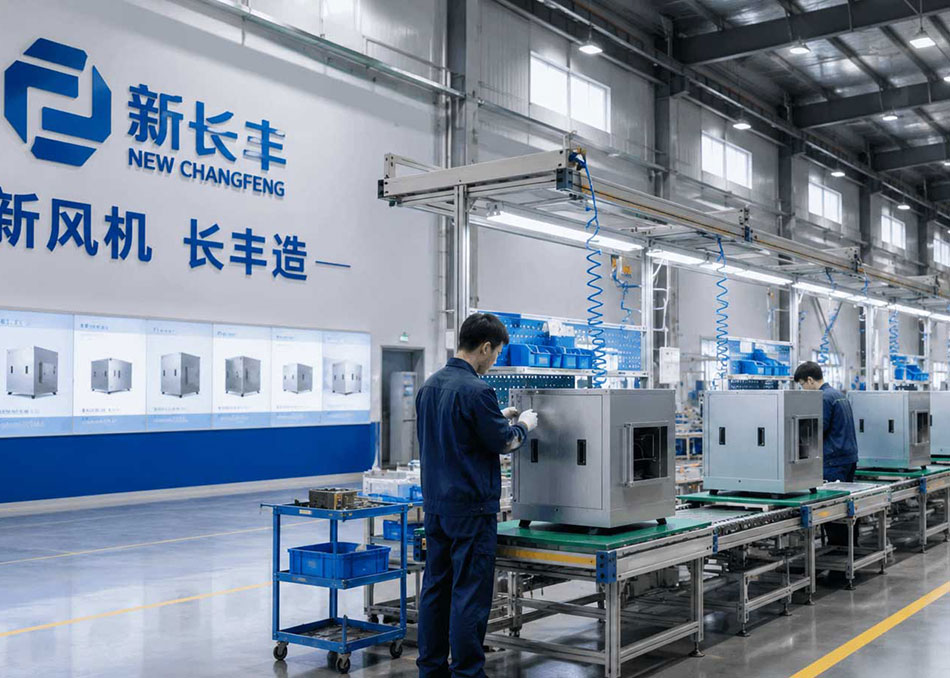
Walk into any busy commercial kitchen — a hotel restaurant, a school canteen, a food court — and you can often feel the problem before you see it. The exhaust hood is running, yet smoke lingers. The door is hard to push open. A high-pitched whistle comes from the gap around the frame, and cooking odors drift into the dining area. In most cases, the root cause is not a weak exhaust fan. It is an unbalanced makeup air system that has pushed the kitchen into excessive negative pressure.
Why Commercial Kitchens Develop Negative Pressure
Negative pressure itself is not a fault. Ventilation engineering principles require an exhaust hood to maintain a certain capture velocity so that smoke, steam, and heat are drawn away effectively. Problems begin when the exhaust volume significantly exceeds the makeup air volume. The kitchen then operates under a strong negative pressure differential, and outdoor air is forced in through door gaps, floor drains, and flue openings — uncontrolled and unfiltered.
This imbalance creates a cascade of operational issues. The exhaust fan's actual working point shifts because it is fighting against a starved air supply, so its effective exhaust capacity drops. The harder the system tries to exhaust, the less air it actually moves. Meanwhile, staff deal with door resistance, drafts, and temperature swings, while odors migrate into adjacent spaces.
The solution is not simply to add more exhaust power. It is to establish a dynamic balance between exhaust and makeup air. A water-cooled fresh air unit is one of the key devices for this task: it delivers outdoor air into the kitchen while cooling it in the process, addressing both air volume and thermal comfort at the same time.
How a Water-Cooled Fresh Air Unit Works in Kitchen Makeup Air
The technical approach of a water-cooled fresh air unit combines evaporative cooling with mechanical supply ventilation. Outdoor air passes through a wet pad or spray packing layer, where it contacts a water film. As water evaporates, it absorbs sensible heat from the air, lowering the supply air temperature. The cooled air is then delivered into the kitchen by a fan, creating a controlled and comfortable makeup air stream.
This makes the unit especially suitable for hot climates and for kitchens where the makeup air would otherwise be uncomfortably warm. By supplying cooled fresh air rather than raw outdoor air, it reduces the thermal load on the kitchen and improves working conditions without relying solely on expensive refrigerated air conditioning.
At the same time, the unit helps stabilize the pressure relationship between the kitchen and surrounding areas. When makeup air is supplied at a rate that closely matches exhaust demand, the negative pressure differential is kept within a reasonable range. The exhaust hood can then capture fumes at its designed performance, and the kitchen no longer pulls uncontrolled air through every gap.
Key Selection Factors for Water-Cooled Fresh Air Units
Choosing the right unit requires more than picking a model number. The goal is to match the unit to the actual exhaust and makeup air requirements of the kitchen, while accounting for climate, space, and operational patterns.
Airflow balance: Determine the total exhaust volume of the kitchen hood system, then design the makeup air volume to maintain a slight negative pressure — not an extreme one. The water-cooled fresh air unit should be sized to cover a substantial portion of this makeup air demand.
Cooling capacity and climate: Evaporative cooling performance depends on local wet-bulb temperature. In hot, dry regions the temperature drop is greater; in humid regions the effect is more modest. Select the unit based on realistic climate data rather than ideal conditions.
Air distribution: Supply air should be directed to occupied zones and toward the hood area without creating drafts that disturb the thermal plume. Poorly placed supply outlets can reduce capture efficiency even when the airflow volume is correct.
Filtration and air quality: Makeup air should be filtered to prevent dust and outdoor pollutants from entering the kitchen. Consider the filter class appropriate for the environment and the maintenance schedule.
Noise level: Kitchen staff work long shifts in close proximity to ventilation equipment. Fan selection, duct design, and mounting should keep noise within acceptable limits for the space.
Energy efficiency: Fan energy efficiency standards such as GB 19761 provide a reference for comparing equipment. Higher efficiency reduces operating costs over the life of the unit.
Integration with exhaust controls: The makeup air system should be able to track exhaust operation. Variable-speed control or interlocked operation helps maintain balance as cooking loads change through the day.
Design and Installation Practices That Make a Difference
Even a well-chosen water-cooled fresh air unit can underperform if the surrounding system is poorly designed. Ductwork should be sized to minimize pressure loss, and supply air paths should avoid short-circuiting directly into the exhaust hood. The unit should be located where outdoor air is reasonably clean and where service access is practical.
Commissioning is equally important. After installation, airflow measurements should confirm that exhaust and makeup air volumes are within the intended range. Adjustments to fan speed, damper positions, and control settings should be documented so that future maintenance can preserve the balance.
Regular maintenance of the wet pad or spray system is essential. Scale buildup, algae, or clogged packing will reduce cooling effectiveness and airflow. A maintenance schedule that includes cleaning, water quality checks, and fan inspection will keep the unit performing as designed.
Frequently Asked Questions
Q: Can a water-cooled fresh air unit completely solve kitchen negative pressure on its own?
A: No single device solves negative pressure in isolation. The unit provides controlled makeup air, but the exhaust system must be properly sized and balanced against it. The goal is a coordinated exhaust and supply design that maintains a slight negative pressure rather than an extreme one.
Q: Is evaporative cooling effective in humid climates?
A: Evaporative cooling performance depends on the difference between dry-bulb and wet-bulb temperature. In humid climates, the achievable temperature drop is smaller. The unit still provides necessary makeup air and some cooling, but expectations should be set based on local climate data.
Q: How does makeup air affect kitchen fume purification compliance?
A: Proper makeup air helps the exhaust hood capture fumes at the designed rate, which supports effective operation of fume purification equipment. Standards such as GB 18483 set emission requirements for kitchen fume, and a balanced ventilation system is part of meeting those requirements consistently.
Q: Should the makeup air be cooled in all seasons?
A: Not necessarily. In cooler weather, the evaporative cooling function can often be reduced or bypassed while the unit continues to supply air. Controls that allow seasonal adjustment help maintain comfort and avoid unnecessary cooling.
Conclusion
Excessive negative pressure in commercial kitchens is a system balance problem, not just an exhaust problem. A water-cooled fresh air unit addresses the makeup air side of the equation, delivering controlled, cooled outdoor air that supports hood capture, improves staff comfort, and helps the exhaust system perform as intended. Selection should be based on airflow requirements, local climate, air distribution, noise, and energy efficiency — followed by careful commissioning and maintenance.
For projects involving factory ventilation, commercial kitchen exhaust purification, school canteens, hotels, or warehouse logistics, working with an experienced ventilation equipment supplier can help ensure the system is designed as a whole. XCFFJ manufactures a range of industrial and commercial ventilation and cooling equipment, including water-cooled fresh air units, and can support selection and integration for kitchen negative pressure solutions.