
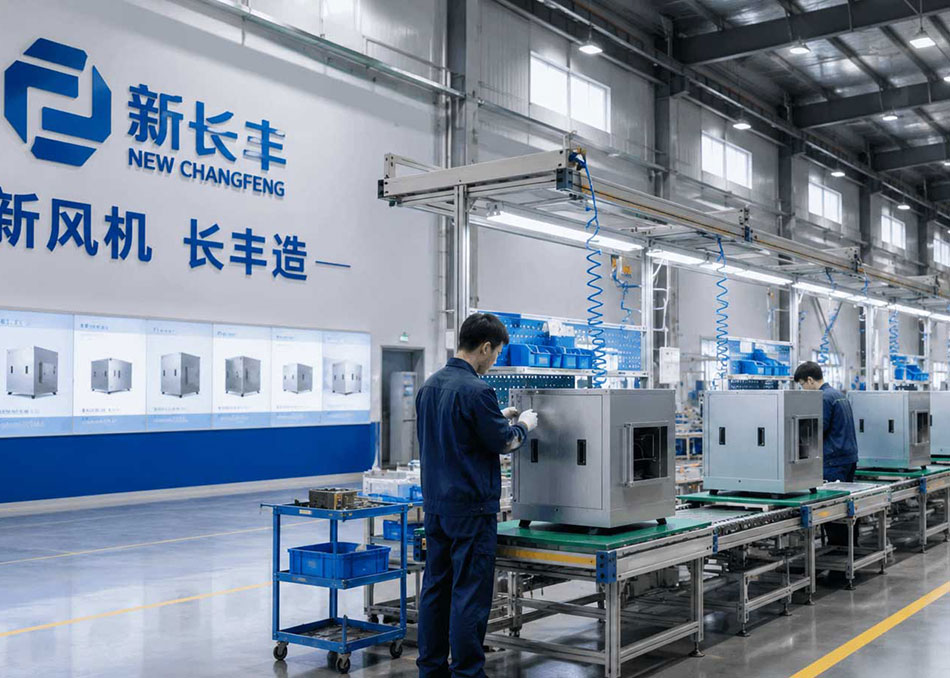
Commercial kitchens are among the most demanding environments in any foodservice operation. Continuous heat from cooking appliances, steam from boilers and soup kettles, and heavy-duty exhaust hoods running for hours create a challenging indoor climate. Many operators instinctively increase exhaust capacity to remove fumes and heat, but overlook the critical role of make-up air. The result: exhaust systems grow larger, yet the kitchen feels stuffier, doors become hard to open, odors leak into dining areas, and staff turnover rises. This article focuses on water-cooled fresh air units as a strategic solution for make-up air in commercial kitchens, addressing negative pressure while improving thermal comfort.
Why Make-Up Air Is Essential: The Roots of Negative Pressure
Ventilation in a commercial kitchen is fundamentally a balance between exhaust and supply. Exhaust hoods and fans remove cooking fumes, heat, and moisture—but they also remove indoor air. When make-up air volume consistently falls short of exhaust volume, the kitchen develops significant negative pressure. According to China's Emission Standard of Cooking Fume (GB 18483) and local commercial kitchen emission regulations, exhaust systems must maintain stable capture efficiency, which depends heavily on proper airflow organization.
The immediate consequence of negative pressure is reduced capture efficiency at the exhaust hood. When indoor air is insufficient to replenish exhaust, air is drawn in through door gaps, service windows, and drain pipes. These uncontrolled air streams are disorganized and weak, unable to effectively lift and transport cooking fumes. As a result, fumes escape from hood edges, spreading odors and grease into the kitchen and dining areas.
The Role of Water-Cooled Fresh Air Units in Kitchen Make-Up Air
Water-cooled fresh air units are designed to supply filtered, tempered outdoor air directly into the kitchen. Unlike simple axial fans that merely push air, these units incorporate a water-cooled coil to reduce incoming air temperature, delivering cooler, denser air that improves comfort and helps counteract radiant heat from cooking equipment.
By introducing a dedicated make-up air path, water-cooled fresh air units restore pressure balance. They reduce the volume of unconditioned air infiltrating through gaps and ensure that exhaust hoods receive a steady, directed supply of air to maintain capture velocity. This not only enhances fume extraction but also minimizes the risk of grease-laden air migrating into other spaces.
Key Benefits of Water-Cooled Fresh Air Units for Commercial Kitchens
Negative pressure relief: Balanced supply and exhaust prevent door-drafting, improve hood capture, and stop odor migration.
Temperature reduction: Water-cooled coils lower supply air temperature, creating a more comfortable working environment without overburdening the kitchen HVAC system.
Improved air quality: Filtered outdoor air dilutes airborne grease, smoke, and steam, enhancing indoor air quality and complying with GB 18483 requirements.
Energy efficiency: By reducing the load on separate cooling systems and ensuring exhaust fans operate at design conditions, overall energy use can be optimized.
Compact installation: Units can be roof-mounted or wall-mounted, saving valuable kitchen floor space.
Design and Application Considerations
Proper sizing is critical. Make-up air volume should typically be 80–90% of exhaust volume to maintain a slight negative pressure (around -5 Pa to -10 Pa) relative to adjacent spaces, preventing odor escape while avoiding excessive negative pressure. The exact balance depends on kitchen layout, hood type, and cooking intensity.
Water-cooled fresh air units should be integrated with the exhaust system controls to modulate supply air based on exhaust demand. Variable frequency drives (VFDs) on both supply and exhaust fans allow dynamic adjustment, saving energy during partial-load conditions. Regular maintenance—including coil cleaning, filter replacement, and drain pan inspection—ensures consistent performance and hygiene.
Frequently Asked Questions
Q: Can a water-cooled fresh air unit replace a traditional air conditioning system in the kitchen?
A: No. Water-cooled fresh air units are designed for ventilation and make-up air, not for full-space cooling. They reduce supply air temperature but are not a substitute for dedicated kitchen air conditioning, which may still be needed in extreme heat conditions. They work best as part of an integrated ventilation strategy.
Q: How does negative pressure affect kitchen exhaust efficiency?
A: Negative pressure reduces the volume of air available for exhaust hoods to capture fumes. When make-up air is insufficient, exhaust fans struggle to overcome the pressure imbalance, leading to smoke spillage, odor complaints, and increased energy consumption. Proper make-up air restores capture efficiency and stabilizes exhaust performance.
Q: What maintenance does a water-cooled fresh air unit require?
A: Regular maintenance includes cleaning or replacing air filters, inspecting and cleaning the water-cooled coil, checking the condensate drain pan and lines, and verifying fan belt tension and motor operation. Quarterly inspections are recommended, with more frequent filter checks in dusty environments.
Q: Is a water-cooled fresh air unit suitable for all kitchen sizes?
A: These units are scalable and can be configured for small cafeterias to large hotel kitchens. The key is proper sizing based on exhaust volume, kitchen layout, and local climate. A qualified ventilation engineer can determine the optimal model and installation position.
Conclusion
Managing heat and fumes in commercial kitchens requires more than just powerful exhaust—it demands a balanced approach to make-up air. Water-cooled fresh air units provide an effective solution by delivering filtered, tempered outdoor air to relieve negative pressure, improve hood capture, and enhance worker comfort. By integrating these units into a well-designed ventilation system, kitchen operators can achieve a safer, more efficient, and more comfortable working environment.
For expert guidance on selecting the right water-cooled fresh air unit for your kitchen, contact XCFFJ today. Our team specializes in industrial and commercial ventilation solutions tailored to your specific needs.