
Commercial kitchen exhaust is often the most underestimated part of a kitchen project—and the one most likely to cause problems. Once the burners are on, fumes rise. If exhaust power is insufficient or the fan is poorly selected, the kitchen becomes hot and suffocating, walls get coated with grease, or worse, fumes spill into the dining area and even affect nearby residents, leading to complaints and required remediation. Among the many types of exhaust fans, the DT cabinet centrifugal fan has become a common choice for kitchen exhaust purification systems thanks to its compact structure, stable pressure output, and ease of integration with purification equipment. This article offers practical guidance for kitchen operators and project buyers, covering selection logic, structural features, purification matching, and manufacturer selection.
Why DT Cabinet Centrifugal Fans Suit Commercial Kitchen Exhaust
Commercial kitchen exhaust differs fundamentally from general workshop ventilation. Fumes from cooking stations are hot, grease-laden, and often travel through long duct runs that include purifiers, fire dampers, elbows, and transitions. System resistance is significantly higher than in ordinary supply or exhaust scenarios. The fan must not only handle grease-laden air but also generate enough pressure to overcome duct resistance; otherwise, actual airflow drops sharply, and you end up with the awkward situation of a running fan that fails to remove smoke.
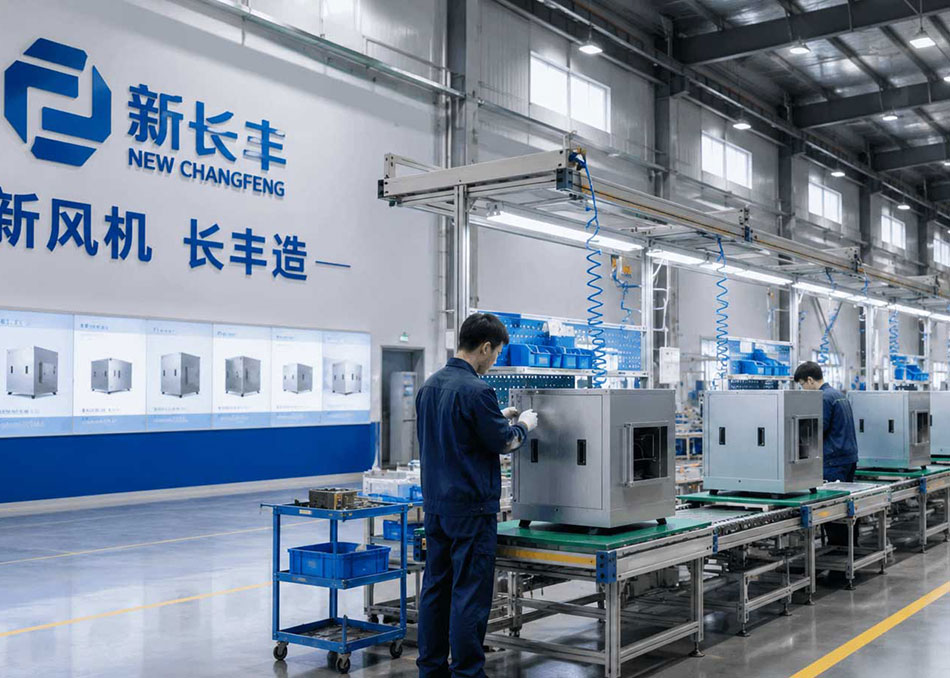
Compared with axial fans, centrifugal fans are inherently better suited to medium-to-high pressure, longer duct runs. The DT cabinet centrifugal fan uses a box-type cabinet with a multi-blade centrifugal impeller inside. Air is energized by the impeller and discharged through the volute, building relatively high pressure within a compact housing. This makes it a strong fit for kitchen exhaust systems where space is tight and resistance is high. The cabinet also helps contain noise and allows flexible duct connections, which is important in commercial buildings where the fan may be installed near occupied spaces.
Key Selection Factors for Kitchen Exhaust Applications
Selecting the right DT cabinet centrifugal fan is not simply a matter of matching airflow to kitchen size. Several interrelated factors determine whether the system will perform reliably over time.
- System resistance calculation: Estimate total pressure loss from hood, duct length, elbows, fire damper, purifier, and discharge point. The fan must provide enough static pressure at the required airflow.
- Grease and temperature handling: Kitchen exhaust contains grease and moisture. The fan should be compatible with grease-laden air, and the motor should be protected from heat and grease accumulation.
- Airflow requirements: Base airflow on the number and type of cooking stations, hood dimensions, and local code requirements. Undersizing leads to smoke spillage; oversizing wastes energy and can cause noise.
- Noise control: The cabinet structure helps, but proper selection, vibration isolation, and duct design are also needed to meet noise limits, especially when the fan is near dining or residential areas.
- Purification compatibility: The fan must work in harmony with the fume purifier. If the purifier has significant resistance, the fan must be selected with that in mind.
In practice, many kitchen exhaust problems stem from selecting a fan based on nominal airflow without accounting for actual system resistance. A DT cabinet centrifugal fan with a steep pressure curve can maintain airflow better as filters load, but it still must be sized correctly. Referring to fan performance testing standards such as GB/T 1236 and energy efficiency standards like GB 19761 helps ensure the selected model has verifiable performance data.
Matching DT Cabinet Centrifugal Fans with Fume Purification
Kitchen exhaust purification typically involves a fume purifier—often electrostatic—installed upstream of the fan. The purifier captures grease and smoke particles, but it also adds resistance. The fan must be placed to draw air through the purifier, creating negative pressure that prevents fumes from escaping into the kitchen. This negative-pressure approach is central to effective kitchen ventilation.
When integrating a DT cabinet centrifugal fan with a purifier, consider the following:
- Installation position: The fan is usually installed after the purifier (draw-through) so that purified air passes through it. This reduces grease buildup on the impeller, but some grease may still carry over. Regular cleaning remains essential.
- Fire safety: Kitchen exhaust ducts must comply with fire codes. Fire dampers and proper duct construction are required, and the fan should be selected to handle the additional resistance of these components.
- Maintenance access: The cabinet design should allow access for cleaning the impeller and cabinet interior. Grease accumulation can unbalance the impeller and reduce performance.
- Code compliance: In many regions, kitchen fume emission must meet standards such as GB 18483, which sets limits on oil fume concentration. The purification system, including the fan, must be designed to achieve these limits consistently.
For school canteens, hotel kitchens, and central kitchens, the combination of a DT cabinet centrifugal fan and a high-efficiency electrostatic purifier is a proven approach. The fan's stable pressure output helps maintain airflow as the purifier collects grease, extending cleaning intervals and maintaining performance.
Choosing a Manufacturer: What to Look For
The fan is a long-term investment, and manufacturer selection affects reliability, service life, and after-sales support. When evaluating suppliers for DT cabinet centrifugal fans, consider these points:
- Engineering support: A good manufacturer helps with selection calculations, duct design, and system layout—not just selling a box.
- Certifications and testing: Look for performance data based on recognized standards (e.g., GB/T 1236) and energy efficiency compliance (GB 19761). For fire safety, relevant certifications for smoke exhaust fans (GB 51251) may apply in some installations.
- Build quality: Check cabinet thickness, impeller balance, motor protection, and bearing quality. These details determine how well the fan handles grease and heat over time.
- Customization: Kitchen layouts vary. A manufacturer that can adapt fan configurations, motor positions, and connection sizes will make installation smoother.
- After-sales service: Prompt support for spare parts, technical questions, and maintenance guidance is critical for commercial kitchens that cannot afford long downtime.
XCFFJ (Shenzhen Xinchangfeng Dust Removal & Cooling Equipment Co., Ltd.) manufactures DT cabinet centrifugal fans and a range of ventilation equipment for commercial kitchens and industrial applications. With a focus on practical engineering and reliable performance, XCFFJ supports projects from selection through installation.
Frequently Asked Questions
Q: Can a DT cabinet centrifugal fan be used with an electrostatic fume purifier?
A: Yes. In fact, this is a common configuration. The fan is typically installed downstream of the purifier to draw air through it, creating negative pressure in the hood and duct. This helps prevent fume leakage into the kitchen. The fan must be selected to overcome the purifier's resistance, and regular cleaning is needed to prevent grease buildup on the impeller.
Q: How do I know what size DT cabinet centrifugal fan my kitchen needs?
A: Sizing depends on the number and type of cooking stations, hood dimensions, duct length and layout, and the resistance of the purifier and other components. A professional selection calculation based on required airflow and total static pressure is essential. Undersizing causes smoke spillage; oversizing wastes energy and increases noise. Consult a manufacturer or engineer for a system-specific recommendation.
Q: What maintenance does a DT cabinet centrifugal fan require in kitchen exhaust service?
A: Regular inspection and cleaning are important because kitchen exhaust contains grease. Check the impeller for grease buildup and clean it as needed to maintain balance. Inspect the motor, bearings, and belt (if applicable) for wear. Ensure the cabinet interior and drain points are free of grease and debris. Follow the manufacturer's maintenance schedule and local fire safety regulations.
Q: Is a DT cabinet centrifugal fan suitable for long duct runs?
A: Yes. Centrifugal fans are generally better at overcoming higher system resistance than axial fans. The DT cabinet design provides stable pressure output, making it suitable for longer duct runs with multiple fittings. However, the fan must still be selected with the actual system resistance in mind. Very long runs may require a higher-pressure model or a different fan type.
Conclusion
For commercial kitchen exhaust, the DT cabinet centrifugal fan offers a practical balance of pressure, compactness, and compatibility with purification equipment. Proper selection—based on real system resistance, airflow requirements, and code compliance—is the key to a system that keeps the kitchen comfortable and the neighbors happy. Whether you are upgrading an existing kitchen or designing a new one, working with a manufacturer that understands kitchen exhaust will help you get it right the first time.
To learn more about DT cabinet centrifugal fans and other ventilation solutions for commercial kitchens, visit XCFFJ at www.xcffj.com.