
Mahjong parlors and card rooms share a familiar problem: crowds, doors that stay shut, heavy smoke, and stale air. To keep the air conditioning from escaping, many operators seal every window and door — and the result is rising CO₂ levels, lingering smoke odor, and customers who cut their sessions short. Meanwhile, school and institutional canteen kitchens face a different but related challenge: the harder the exhaust hoods run, the deeper the negative pressure, and when makeup air cannot keep up, burner flames get pulled off-center, grease-laden fumes spill into the dining area, and cooks work in stifling heat. These two scenarios point to the same engineering principle: organized exhaust must be matched by organized makeup air. A water-cooled fresh air unit addresses exactly this — combining makeup air supply with cooling in a single package, serving both mahjong parlor ventilation and canteen kitchen cooling.
Why an exhaust fan alone cannot fix a mahjong parlor's air
Mahjong parlors have three main pollution sources: carbon dioxide and moisture from breathing, particulate matter and odor molecules from tobacco combustion, and general stale-air buildup in a sealed space. The instinctive fix is to install exhaust fans and pull air out — but in practice the improvement is limited. Exhaust only removes air; without a deliberate supply path, the room goes negative, and outdoor air leaks in chaotically through door and window gaps. The result is low exchange efficiency, disordered airflow, and smoke that still hangs in the corners.
The better approach is a directed "in-and-out" airflow. Per basic ventilation engineering practice, supply and exhaust openings should be laid out to produce a sensible age-of-air distribution, so fresh air sweeps the occupied zone before it is extracted. In a mahjong parlor, that means supplying treated fresh air low or at the perimeter and extracting stale, smoke-laden air near the ceiling and smoking areas. A water-cooled fresh air unit fits this role because it delivers filtered outdoor air at a comfortable temperature rather than dumping hot, humid outdoor air into a cooled room — the most common reason operators resist opening their makeup air dampers at all.
- Sealed rooms need a supply path: without one, exhaust fans starve and exchange rates collapse.
- Temperature matters: unconditioned makeup air in summer feels like a setback, so operators block it — a cooled supply solves the behavioral problem.
- Airflow direction beats airflow volume: a directed sweep from supply to exhaust removes smoke more effectively than a bigger fan in the same location.
The canteen kitchen problem: negative pressure, flame drift, and fume spill
Commercial kitchen exhaust systems are sized to capture fume at the hood face. When the exhaust fan runs and the makeup air path is undersized or absent, the kitchen becomes a negative-pressure zone. Symptoms are easy to recognize: flames pulled toward the hood, doors that are hard to open, grease and odor escaping around hood edges into the dining hall, and replacement air rushing in through the nearest gap — often the dishwashing area or the dining room itself — dragging odors along with it.
This is where the same water-cooled fresh air unit earns its place in a canteen. Instead of letting hot outdoor air leak in uncontrolled, the unit supplies a defined volume of filtered, cooled fresh air directly to the kitchen, balancing the exhaust and relieving negative pressure. Because the supply air is cooled, the kitchen stays more comfortable during peak cooking hours, and because the supply is filtered, grease and dust are not carried back into the hood. The principle aligns with the intent of GB 18483 for kitchen fume emission control: capture and containment at the source only work when the airflow balance around the hood is maintained.
For school and institutional canteens, the stakes go beyond comfort. Kitchens serving hundreds of meals per day run long, hot shifts, and staff heat stress is a real operational issue. A balanced supply of cooled fresh air supports both fume containment and a safer working environment, while also helping maintain the dining hall's air quality during service.
How a water-cooled fresh air unit works and where it fits
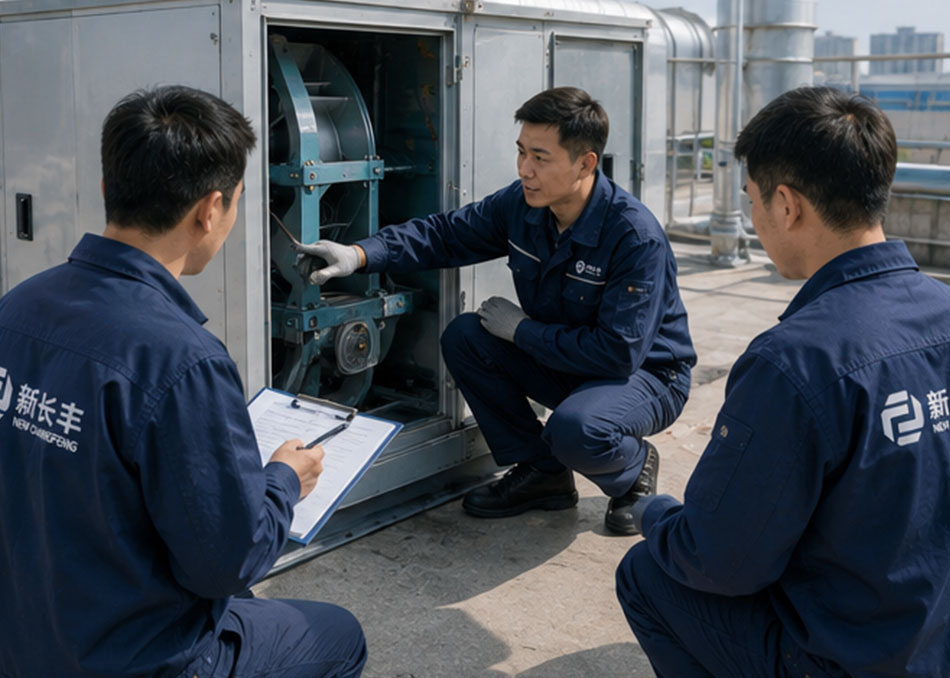
A water-cooled fresh air unit draws in outdoor air, filters it, and passes it through a cooling section that uses water-based evaporative or sensible cooling to reduce supply air temperature before delivering it to the space. The unit is designed for ducted supply, so it can be positioned on a roof, in a plant room, or on a service balcony, with ductwork routing treated air to mahjong parlor seating zones or canteen kitchen supply registers.
Selection should follow the same discipline as any fan-driven air system. Airflow and external static pressure must be matched to the duct network and the required supply volume; performance should be verified against GB/T 1236 fan performance testing methods, and fan energy efficiency considered under GB 19761. For smoke control provisions in larger buildings, coordination with GB 51251 requirements ensures that normal ventilation and emergency smoke exhaust do not conflict. In practice, the unit is sized to the makeup air demand created by the exhaust system — not the other way around.
- Mahjong parlors: supply cooled fresh air to seating areas while exhaust removes smoke and stale air near the ceiling.
- School and institutional canteens: supply cooled makeup air to the kitchen to balance hood exhaust and reduce negative pressure.
- Hotels and staff dining areas: improve air quality and comfort in enclosed, high-occupancy spaces.
Practical design and operating points
Getting results from a water-cooled fresh air unit is less about the equipment alone and more about the system around it. First, establish the exhaust-to-supply balance: exhaust volume should be set by hood capture requirements or by the air change target for the parlor, and the supply should be designed to cover a substantial share of that exhaust so the space stays close to neutral pressure. Second, lay out supply and exhaust locations to create a directed sweep rather than short-circuiting — supply air should not be pulled straight into the exhaust before it has crossed the occupied zone.
Third, pay attention to filtration and maintenance access. In smoking environments and kitchens, filters load faster, so specify units with accessible filter sections and a maintenance schedule that reflects actual operating hours. Fourth, consider controls: interlocking the fresh air unit with the exhaust system prevents the kitchen or parlor from running at deep negative pressure when one side is off. Finally, address noise — duct velocity, silencers, and unit placement all affect perceived noise in a mahjong parlor, where low background sound is part of the customer experience.
FAQ
Q: Can a mahjong parlor just use a bigger exhaust fan instead of a fresh air unit?
A: A larger exhaust fan without a supply path increases negative pressure and draws uncontrolled air through gaps, which does little for smoke removal in the occupied zone. A balanced supply, ideally cooled and filtered, gives the exhaust a defined path and improves air exchange where people actually sit.
Q: Why is makeup air important for a canteen kitchen hood?
A: Hood capture depends on airflow balance. When exhaust outpaces supply, negative pressure pulls flames and fumes off course and causes spill into adjacent areas. Supplying cooled, filtered makeup air stabilizes the hood's capture performance and improves kitchen comfort.
Q: Does a water-cooled fresh air unit replace air conditioning?
A: No. It treats and delivers outdoor ventilation air, reducing the temperature of that supply so it does not impose a heat load on the space. It complements, rather than replaces, a dedicated air conditioning system.
Q: What standards should be referenced when specifying one?
A: Fan performance can be referenced to GB/T 1236, fan energy efficiency to GB 19761, kitchen fume control to GB 18483, and smoke control coordination to GB 51251 where applicable. Local codes should always be confirmed for the specific project.
Whether the goal is clearing smoke from a sealed mahjong parlor or relieving negative pressure in a school canteen kitchen, the underlying fix is the same: pair organized exhaust with organized, conditioned makeup air. A water-cooled fresh air unit delivers that balance in one package. To discuss airflow, duct layout, or selection for your project, contact XCFFJ at www.xcffj.com.