
In the daily operation of restaurant kitchens, smoke exhaust and cooling are often conflicting challenges: to quickly remove cooking fumes, exhaust fans need sufficient suction, but this easily creates strong negative pressure in the kitchen, leading to incomplete combustion, oil smoke leaking into the front hall, and even affecting staff comfort. Meanwhile, enclosed spaces with dense crowds such as mahjong clubs and chess rooms suffer from stale air and accumulated odors after long hours of operation; exhaust alone cannot solve the need for make-up air and cooling. How can one piece of equipment address both 'kitchen negative pressure' and 'make-up air and ventilation in enclosed spaces'? Water-cooled fresh air units, with their ability to supply cooled air and balance make-up air, are becoming a preferred solution in cross-scenario ventilation design. This article starts from the causes of kitchen negative pressure and focuses on the correct application logic of water-cooled fresh air units in mahjong club make-up air and ventilation, providing actionable technical references for restaurant operators and HVAC engineers.
1. Pain Points of Restaurant Kitchen Smoke Exhaust and Cooling: Negative Pressure Imbalance and Deteriorating Thermal Environment
Restaurant kitchens typically have large exhaust hoods and fans. According to GB 18483, the Emission Standard of Cooking Fume, oil fumes must be purified before discharge. However, in actual operation, exhaust air volume often exceeds make-up air volume, creating significant negative pressure inside the kitchen. The direct consequences include: burner flames being drawn toward the exhaust hood, reducing combustion efficiency; untreated hot outdoor air or corridor odors being sucked in through gaps; and cold air from the front hall being drawn back into the kitchen, increasing overall energy consumption. These problems are not failures of the exhaust equipment itself, but rather the result of missing or inadequate make-up air systems.
To make up for the negative pressure, some kitchens simply open doors and windows, but this brings in dust and insects and fails to control temperature. Others install ordinary fresh air fans, but in summer the hot air increases the cooling load. The key is to introduce make-up air that is both filtered and cooled, and to maintain a slight negative pressure in the kitchen (relative to the front hall) to prevent oil smoke from escaping. This is where water-cooled fresh air units come into play.
2. Working Principle and Advantages of Water-Cooled Fresh Air Units
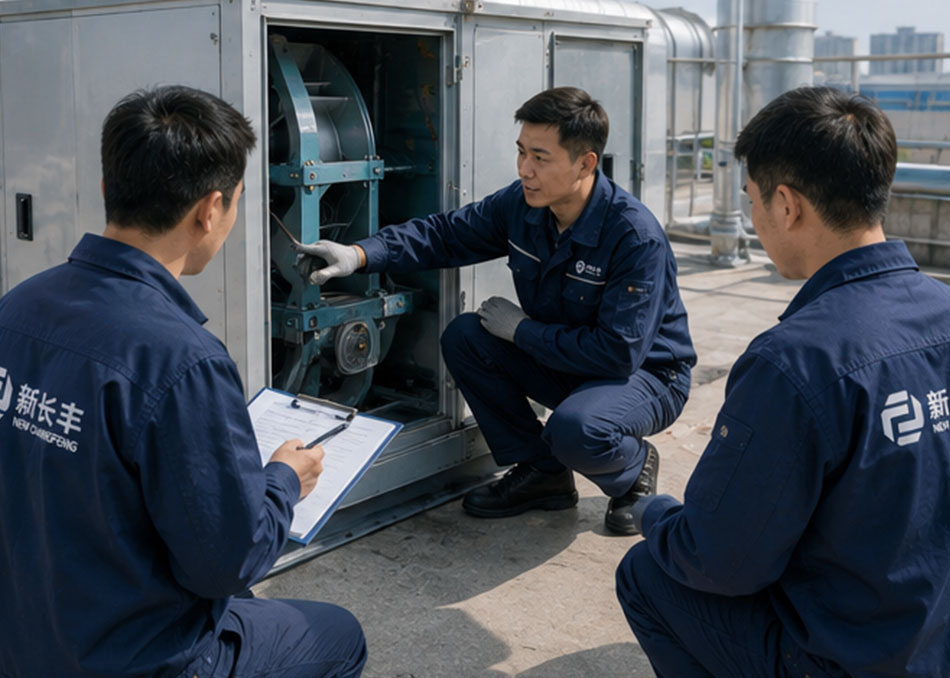
A water-cooled fresh air unit draws in outdoor air, filters it, and then cools it through a water-cooled coil (using chilled water or evaporative cooling) before supplying it indoors. Compared with traditional air-conditioning systems, water-cooled fresh air units are more energy-efficient and can handle large air volumes, making them suitable for industrial and commercial spaces. In kitchen make-up air applications, they can effectively offset negative pressure while reducing the supply air temperature, improving the kitchen thermal environment.
In mahjong clubs and similar enclosed spaces, water-cooled fresh air units can continuously introduce fresh air, dilute odors and CO2, and provide cooling to enhance comfort. The units can be configured with different filtration grades (e.g., primary and medium efficiency) to remove dust and some gaseous pollutants. Because they use water as the cooling medium, they avoid the high energy consumption of direct-expansion air conditioning and are more cost-effective for spaces requiring continuous ventilation.
- Balanced ventilation: Supplies filtered, cooled air to maintain slight negative pressure in kitchens and positive pressure in mahjong clubs.
- Energy saving: Water-cooled cooling reduces compressor energy use compared to conventional AC.
- Improved air quality: Dilutes odors and CO2, improving staff and customer comfort.
- Flexible installation: Can be ducted or wall-mounted, adapting to different space layouts.
3. Application of Water-Cooled Fresh Air Units in Mahjong Club Make-Up Air and Ventilation
Mahjong clubs are typical enclosed spaces with high occupancy density, long operating hours, and poor natural ventilation. Without proper make-up air, exhaust fans (if any) cannot effectively remove odors, and air conditioners only recirculate indoor air, leading to stuffiness and health complaints. Water-cooled fresh air units should be designed to supply at least the required fresh air volume per person (e.g., 30 m³/h per person as per GB 50736), and to maintain a slight positive pressure to prevent odors from adjacent spaces.
In practice, the fresh air unit can be integrated with the exhaust system: exhaust fans remove stale air from smoking areas or restrooms, while the fresh air unit supplies cooled fresh air to the gaming area. This creates a directed airflow from clean areas to polluted areas, improving overall air quality. The cooling function is particularly appreciated in summer, as it compensates for the heat generated by people and equipment. For mahjong clubs located in basements or with limited windows, water-cooled fresh air units are often the only viable solution to meet ventilation standards.
It is important to note that the unit should be sized based on actual occupancy and space volume, and ductwork should be designed to avoid short-circuiting of supply and exhaust air. Regular maintenance of filters and water systems is also essential to ensure long-term performance.
4. Integrated Design: Solving Both Kitchen Negative Pressure and Club Ventilation
In buildings that house both a restaurant kitchen and a mahjong club, a single water-cooled fresh air unit can sometimes serve both areas if they are adjacent, but careful design is needed to avoid cross-contamination. Typically, separate units are recommended for hygiene reasons. For the kitchen, the fresh air unit provides make-up air to balance exhaust, while for the mahjong club, it provides cooled fresh air. By using water-cooled fresh air units, building owners can achieve consistent indoor air quality and energy savings across different functional zones.
Engineers should refer to standards such as GB 50019 for heating, ventilation, and air conditioning design, and GB 51251 for smoke control and exhaust. Proper commissioning and balancing of air volumes are critical to realize the intended pressure relationships.
Frequently Asked Questions (FAQ)
Q: Can a water-cooled fresh air unit really solve kitchen negative pressure?
A: Yes, when properly sized and integrated with the exhaust system. The unit supplies make-up air to match a portion of the exhaust volume, reducing negative pressure to a slight level (e.g., -5 Pa to -10 Pa relative to the front hall). This prevents oil smoke leakage and improves combustion efficiency.
Q: Is a water-cooled fresh air unit suitable for mahjong clubs with no windows?
A: Absolutely. It is ideal for enclosed spaces because it introduces fresh air mechanically and can cool it. It helps meet ventilation requirements and improves comfort without relying on natural ventilation.
Q: How much maintenance does a water-cooled fresh air unit require?
A: Regular maintenance includes cleaning or replacing filters (monthly to quarterly depending on dust load), checking the water system for leaks and scaling, and inspecting fans and coils. Annual servicing by a professional is recommended.
Q: Can the unit be used in winter for heating?
A: Some models can be equipped with a heating coil or electric heater to provide warm fresh air in winter, but this depends on the specific product configuration. Consult the manufacturer for cold-climate options.
In summary, water-cooled fresh air units offer a practical and energy-efficient solution for both kitchen negative pressure control and mahjong club ventilation. By understanding the principles and following proper design guidelines, you can create healthier and more comfortable environments. For tailored advice on selecting the right water-cooled fresh air unit for your project, contact XCFFJ's technical team today.