
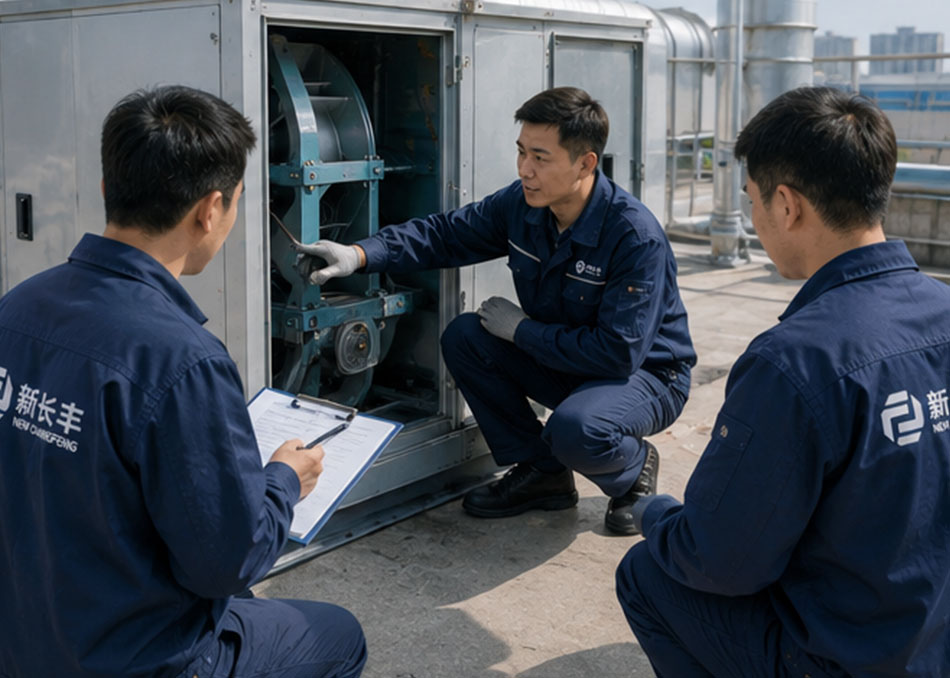
Hotel kitchens are among the most demanding thermal environments in any commercial building. Open flames, steamers, ovens, and dishwashers release heat continuously, while frying adds both oil mist and water vapor to the air. The result is a space that stays significantly hotter than the rest of the hotel—often by a wide margin. Many hotels first try standard comfort air conditioning, only to find that filters clog with grease within weeks, cooling capacity drops sharply, and the equipment fails far earlier than expected. The real challenge is not cooling the entire kitchen to a comfortable temperature, but delivering clean, cool air to the people who need it most: the staff working at the wok range, the prep station, the noodle station, and the dishwashing area.
Why Standard Air Conditioning Fails in Hotel Kitchens
Standard comfort air conditioners are designed for clean, low-humidity spaces. In a hotel kitchen, they face three simultaneous problems: airborne grease, high humidity, and continuous high heat load. Grease coats the evaporator coil and filters, insulating the heat exchange surfaces and forcing the compressor to work harder. Moisture promotes corrosion and microbial growth. The high ambient temperature means the unit runs at maximum capacity for hours, accelerating wear on fans, motors, and compressors.
The common outcome is a cycle of declining performance: airflow drops, supply air temperature rises, and the unit becomes a maintenance burden rather than a cooling solution. This is why the industry has moved toward equipment specifically engineered for kitchen environments—commercial kitchen air conditioners and water-cooled fresh air units that incorporate oil-resistant, moisture-tolerant, and easily serviceable designs.
The Right Approach: Localized Supply Air + General Exhaust
From an HVAC engineering perspective, kitchen cooling is rarely about conditioning the entire room. The more effective strategy is a combination of localized supply air and general exhaust. The exhaust side is handled by hoods and exhaust fans, which capture smoke, grease, and heat at the source. The supply side is handled by commercial kitchen air conditioners or water-cooled fresh air units, which deliver treated air directly to the work positions.
This balance matters. If supply air is insufficient, the kitchen becomes stuffy and workers suffer. If exhaust is too strong relative to supply, the space goes into excessive negative pressure, which can cause doors to be hard to open, disrupt hood capture efficiency, and even draw odors from adjacent areas. Proper design matches supply and exhaust airflow so that the kitchen remains comfortable without compromising smoke capture.
Commercial Kitchen Air Conditioners vs. Water-Cooled Fresh Air Units
Commercial kitchen air conditioners are designed specifically for station-level cooling. They may use compressor-based refrigeration or evaporative (water-cooled) cooling. Their key advantage is controllable supply air temperature and long throw distance—cool air can be ducted or directed via jet nozzles straight to the wok station, creating a "cool air zone" exactly where the employee stands.
Water-cooled fresh air units belong to the evaporative cooling family. They draw in outside air, pass it through a wetted media, and deliver cooled fresh air into the kitchen. Because they continuously introduce outdoor air, they also help with ventilation and pressurization. They are particularly effective in hot, dry climates, and when used in humid regions, they are often paired with dehumidification or hybrid designs.
Both approaches share the same goal: keep the worker comfortable at the station without attempting to cool the entire kitchen volume. The choice between them depends on climate, budget, kitchen layout, and whether the priority is temperature control (compressor-based) or ventilation with moderate cooling (evaporative).
Key Design and Selection Considerations
When specifying equipment for hotel kitchen cooling, several factors determine success:
Grease resistance: Filters, coils, and fans should be accessible and easy to clean. Stainless steel or coated surfaces resist corrosion.
Supply air temperature and throw: The unit must deliver cool air to the station, not just to the ceiling. Adjustable louvers or ducted outlets help.
Humidity management: In humid climates, evaporative cooling alone may raise indoor humidity. Consider hybrid or compressor-based options.
Exhaust coordination: The supply air volume should be balanced with the kitchen exhaust to avoid negative pressure problems.
Energy efficiency: Look for units that meet relevant efficiency standards and offer variable-speed or multi-stage operation.
Maintenance access: In a busy hotel, equipment that is difficult to service will be neglected. Design for easy filter removal and coil cleaning.
Frequently Asked Questions
Q: Can I just use a portable air conditioner for my hotel kitchen?
A: Portable units can provide temporary relief but are not a long-term solution. They typically have small filters that clog quickly with grease, and they exhaust hot air into the kitchen, which can worsen the overall heat load. A dedicated commercial kitchen air conditioner or water-cooled fresh air unit is designed for continuous duty in grease-laden environments.
Q: What is the difference between a commercial kitchen air conditioner and a water-cooled fresh air unit?
A: A commercial kitchen air conditioner uses either a compressor or evaporative cooling to produce cool air, with the ability to control supply temperature and direct it to specific stations. A water-cooled fresh air unit uses evaporative cooling to cool incoming outdoor air and continuously ventilate the space. The former is better for targeted temperature control; the latter excels at ventilation and moderate cooling, especially in dry climates.
Q: How do I prevent negative pressure in my kitchen?
A: Negative pressure occurs when exhaust airflow exceeds supply airflow. The solution is to balance the two. Calculate the exhaust volume required for your hoods and then provide make-up air through a commercial kitchen air conditioner, water-cooled fresh air unit, or dedicated make-up air unit. A slight negative pressure (around 5–10%) is often desirable to contain odors, but excessive negative pressure will impair hood performance and door operation.
Q: Are there energy efficiency standards for this equipment?
A: Yes. In many regions, commercial kitchen ventilation and cooling equipment must meet efficiency requirements such as GB 19761 for fan energy efficiency or local equivalents. When selecting equipment, ask for performance data tested according to recognized standards like GB/T 1236 for fan airflow and pressure. High-efficiency motors and variable-speed controls can significantly reduce operating costs in a hotel kitchen that runs many hours per day.
Conclusion
Cooling a hotel kitchen is not about lowering the entire room to 24°C—it is about protecting the people at the stations where heat is most intense. Commercial kitchen air conditioners and water-cooled fresh air units offer a practical, targeted solution that balances temperature control, ventilation, and grease resistance. By matching supply and exhaust, selecting equipment suited to the climate and kitchen layout, and planning for maintenance from the start, hotels can create a safer and more productive back-of-house environment.
For more information on selecting the right commercial kitchen air conditioner or water-cooled fresh air unit for your hotel, visit www.xcffj.com or contact our team for a consultation.