
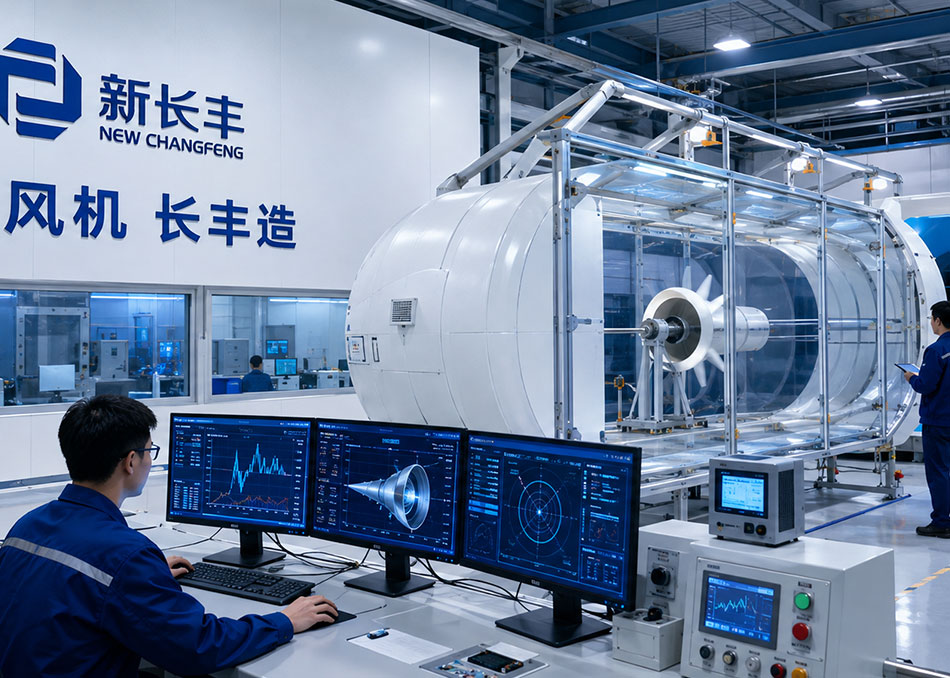
In factory workshops, underground garages, warehouse and logistics hubs, and commercial kitchen exhaust systems, axial fans handle the unglamorous but essential work of supply, exhaust, and make-up air. Their design is comparatively simple and installation is flexible, but that very simplicity can breed complacency. Long service in humid, dusty, or grease-laden conditions gradually produces blade fouling, bearing wear, and loosened fasteners — conditions that show up as reduced airflow, rising noise, motor overheating, and eventually breakdown. When ventilation stops, the consequences arrive quickly: stifling workshop heat, fume spillover into dining areas, and odour backflow through the ductwork. A practical, scheduled maintenance regime built around the axial fan is therefore the foundation of stable ventilation performance.
The Role of Axial Fans in Ventilation and the Logic of Maintenance
An axial fan moves air parallel to the impeller axis. That geometry gives it high volume flow and low resistance, which suits large-space ventilation where duct runs are short and system resistance is modest. In combined extract-and-make-up systems, the exhaust side removes cooking fumes, hot air, and airborne contaminants while the supply side draws in outdoor air to maintain pressure balance. Only when the two work together does the system avoid the familiar failure mode of air that cannot get out and fresh air that cannot get in. This is why maintenance should not focus on a single unit in isolation — the extract and make-up paths need to be inspected as one system.
From a technical standpoint, fan performance follows the fan laws, which define a clear relationship among rotational speed, volume flow, and shaft power. When blade fouling or a clogged duct filter raises system resistance, the fan's operating point shifts. Actual air changes per hour fall even as motor load climbs, because the fan is pushing against a higher pressure curve. Left unaddressed, this mismatch accelerates bearing wear and shortens motor life. Understanding the fan laws helps maintenance teams interpret symptoms correctly instead of simply replacing parts.
Where the application involves commercial kitchen exhaust, maintenance also intersects with compliance. GB 18483 sets limits on cooking fume emissions, and a fouled axial fan or saturated purification stage can compromise both capture efficiency and discharge quality. Similarly, where smoke and heat exhaust is part of the design, GB 51251 requirements mean that fans serving those functions must remain reliable under demanding conditions — regular inspection is not optional.
Building a Practical Maintenance Cycle
Effective maintenance is less about complexity than consistency. A tiered schedule — routine checks, periodic cleaning, and annual overhaul — keeps small issues from becoming system failures. The right intervals depend on the operating environment: a kitchen exhaust fan handling grease-laden air will need attention far more often than a supply fan moving filtered outdoor air in a warehouse.
- Routine checks (weekly to monthly): Listen for abnormal noise or vibration, confirm smooth rotation, check for unusual motor temperature, and verify that airflow at grilles and diffusers feels consistent with normal operation.
- Periodic cleaning (quarterly or environment-dependent): Clean impeller blades and housings to remove dust and grease buildup. Fouled blades disturb balance and reduce efficiency. Inspect and clean or replace duct filters at the same time.
- Fastener and mounting inspection: Check anchor bolts, mounting brackets, and flexible connections for looseness. Vibration loosens hardware over time, and a loose fan is a noisy, inefficient fan.
- Bearing and lubrication: Follow the manufacturer's lubrication guidance for the bearing type fitted. Over-lubrication is as harmful as under-lubrication. Replace sealed bearings according to service life rather than waiting for failure.
- Electrical checks: Verify terminal connections, inspect contactors and overload protection settings, and confirm that motor current is within nameplate limits under normal operating conditions.
- Annual overhaul: Include impeller balance assessment, insulation resistance testing, and a review of the whole extract and make-up system, including dampers, controls, and pressure balance between zones.
Diagnosing Common Problems Before They Escalate
Most axial fan failures announce themselves well in advance. Reduced airflow with a clean impeller often points to increased system resistance — blocked filters, closed dampers, or crushed flexible ducts. Rising noise accompanied by vibration usually indicates blade imbalance, debris on the impeller, or worn bearings. Motor overheating can stem from overload caused by resistance, inadequate ventilation around the motor, or failing capacitors in single-phase units. Recording these observations in a simple log allows patterns to emerge and supports predictive rather than reactive maintenance.
For systems that combine exhaust and make-up air, pressure balance deserves particular attention. If make-up air is insufficient, the exhaust fan works against negative pressure, reducing its effective capacity and drawing unfiltered air through unintended paths. If make-up air is excessive, conditioned air is wasted and odours may migrate to neighbouring spaces. Balancing dampers and verifying airflow at commissioning and after any ductwork change keeps the system in its intended operating range. Where fan performance needs verification, reference testing methods in GB/T 1236 provide a consistent basis for measurement, and energy efficiency considerations under GB 19761 help inform replacement decisions when an old unit is no longer economical to run.
Selection and Replacement Considerations
Maintenance extends to knowing when repair is no longer the right answer. An axial fan that has been rebuilt repeatedly, runs well below its rated efficiency, or no longer matches the system's resistance profile may be a candidate for replacement. When specifying a new unit, match the fan to the actual system curve rather than selecting on volume flow alone. Consider the operating environment — corrosion-resistant finishes for humid locations, grease-tolerant designs for kitchen exhaust, and appropriate ingress protection for outdoor installations.
For commercial kitchen applications, the axial fan is only one part of the exhaust purification chain. Electrostatic precipitators, baffle filters, and odour control stages all affect resistance and therefore fan selection. A holistic view of the system — capture, transport, purification, and discharge — produces better outcomes than optimizing any single component. The same principle applies to evaporative cooling and fresh air systems, where supply fans and exhaust fans must be sized to work together.
Frequently Asked Questions
Q: How often should axial fans in a commercial kitchen exhaust system be cleaned?
A: Grease-laden exhaust air accelerates fouling, so kitchen exhaust fans typically need cleaning far more frequently than general ventilation fans. Inspect monthly and clean based on observed buildup rather than a fixed calendar. Heavily used kitchens may require cleaning every few weeks, while lighter operations can extend intervals. Always isolate power before cleaning and follow the manufacturer's instructions.
Q: Why does my axial fan seem noisier than when it was installed?
A: Increased noise usually has a physical cause: dust or grease on the impeller creating imbalance, worn or dry bearings, loose mounting hardware, or increased system resistance shifting the fan to an unstable operating point. Start with a visual inspection and cleaning, check fasteners, and assess bearing condition. If noise persists after these steps, have the impeller balance and motor checked by a qualified technician.
Q: Can I replace an axial fan with a centrifugal fan for better performance?
A: It depends on the system's resistance. Axial fans suit low-resistance, high-volume applications, while centrifugal fans generate higher static pressure and are better suited to longer duct runs or systems with purification stages that add resistance. Rather than swapping fan types arbitrarily, measure the system resistance and select a fan whose performance curve matches it. In many cases, correcting duct restrictions or filter maintenance restores performance without replacement.
Q: What records should be kept for a ventilation maintenance programme?
A: Keep a log for each fan covering inspection dates, cleaning performed, bearing and lubrication service, electrical checks, measured motor current, and any noted abnormalities. For kitchen exhaust systems, records also support compliance with emission requirements. Over time, these records reveal deterioration trends and justify planned replacement rather than emergency repair.
Summary
Axial fans are dependable workhorses, but dependable does not mean maintenance-free. In ventilation systems serving factories, warehouses, garages, and commercial kitchens, a scheduled programme of cleaning, inspection, bearing care, and electrical checks keeps airflow where it should be and prevents the fume spillover and heat buildup that follow ventilation failure. Treating extract and make-up air as one balanced system, and knowing when to repair versus replace, extends equipment life and protects indoor conditions. XCFFJ supplies axial fans, roof turbo ventilators, cabinet centrifugal fans, and complete kitchen exhaust purification and fresh air solutions — our team can help you match equipment to your system's actual resistance and operating environment. Visit www.xcffj.com to discuss your ventilation project.