
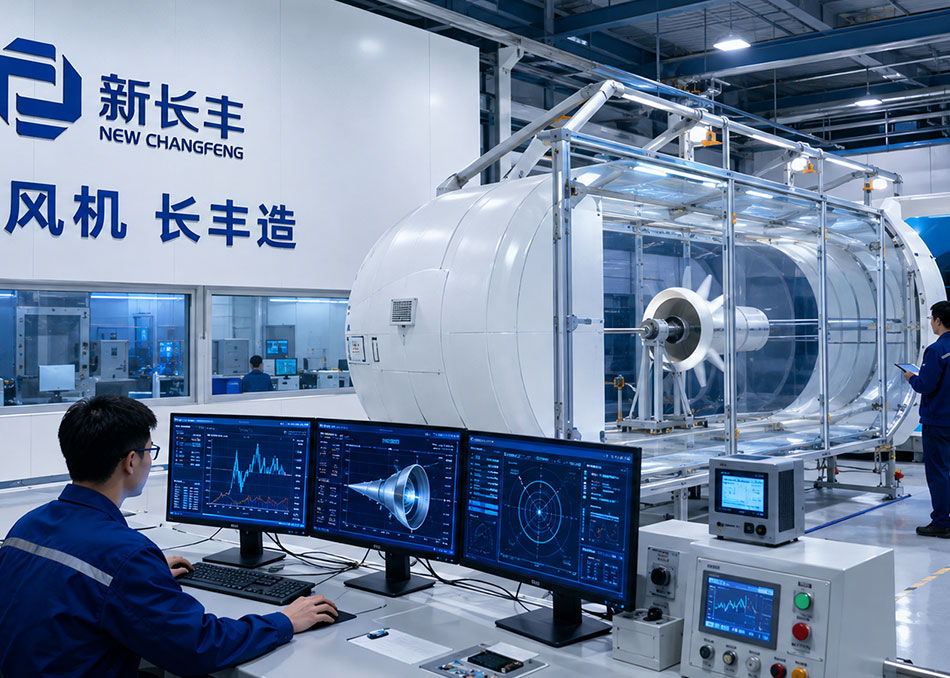
Summer heat and stagnant air in workshops are challenges that many factory managers face. High temperatures not only affect workers' comfort and productivity but can also pose safety risks. Traditional air conditioning is often energy-intensive in large industrial spaces and fails to address air circulation. Enter the negative pressure fan—a highly efficient solution for workshop cooling and ventilation that is gaining attention among facility managers. To select and position these fans correctly, it's essential to understand their core operating principle.
The Core Principle: Creating Negative Pressure and Organized Airflow
The working principle of a negative pressure fan is straightforward: it leverages the pressure differential of air to achieve forced ventilation. Installed on one wall of the workshop, the fan's large blades rotate at high speed, extracting indoor air to the outside. This continuous extraction lowers the indoor air pressure below the atmospheric pressure outside, creating a stable negative pressure differential. Driven by this pressure difference, fresh outdoor air is naturally drawn into the workshop through doors, windows, air inlets, or louvers on the opposite side. This establishes a complete, organized airflow path: outdoor fresh air → workshop interior (passing through work zones) → negative pressure fan exhaust. This process, known as negative pressure ventilation or forced exhaust, is one of the most cost-effective methods for industrial ventilation and cooling.
From Principle to Application: How Negative Pressure Fans Deliver Workshop Ventilation and Cooling
Understanding the pressure differential principle reveals two core functions of negative pressure fans in real-world workshop settings:
- Effective Air Replacement: By continuously pulling fresh air from outside and expelling hot, stale, and contaminated air, negative pressure fans ensure a steady supply of clean air. This is particularly beneficial in workshops where welding fumes, chemical vapors, or dust are present, as it helps maintain a healthier working environment.
- Significant Cooling Effect: The high-volume airflow created by negative pressure fans accelerates sweat evaporation on workers' skin, producing a natural cooling effect. In facilities where evaporative cooling systems (such as water-cooled air coolers) are integrated, the incoming air can be pre-cooled, amplifying the temperature drop. This combination is especially effective in hot climates, offering a low-energy alternative to air conditioning.
Key Considerations for Proper Sizing and Layout
To maximize the benefits of negative pressure ventilation, careful planning is required:
- Airflow Calculation: Determine the required air changes per hour based on the workshop's volume and occupancy. Industry guidelines recommend a certain number of air changes per hour for different applications, but always consult a ventilation engineer to avoid undersizing or oversizing.
- Fan Placement: Install fans on the leeward wall (opposite the prevailing wind) to enhance natural airflow. Ensure that air inlets are positioned on the opposite side to create a cross-ventilation path that sweeps across the entire working area.
- Inlet Sizing: The total area of air inlets should be at least equal to the fan's discharge area to prevent a vacuum that reduces fan efficiency. Louvers or motorized dampers can be used to control airflow and prevent backdrafts when fans are off.
- Noise and Vibration: Select fans with low noise ratings and install vibration isolators to minimize disturbance to workers and nearby areas.
Standards and Compliance
When selecting negative pressure fans, reference relevant standards to ensure performance and safety. For example, GB/T 1236 outlines fan performance testing methods, while GB 19761 sets energy efficiency grades for fans. Additionally, in applications where smoke or heat exhaust is required, GB 51251 provides guidelines for smoke and heat exhaust systems. Adhering to these standards helps guarantee reliable operation and compliance with local regulations.
FAQ
Q: How does a negative pressure fan differ from a regular exhaust fan?
A: While both expel air, a negative pressure fan is specifically designed to create a significant pressure differential that induces organized airflow from one side of the building to the other. Regular exhaust fans may not generate enough negative pressure to effectively pull fresh air through the entire space.
Q: Can negative pressure fans be used in conjunction with air conditioning?
A: Yes, but it's generally more energy-efficient to use negative pressure fans alone or with evaporative coolers. If air conditioning is used, negative pressure fans can help distribute cooled air more evenly, but they may also increase the load on the AC system if not properly controlled.
Q: What maintenance do negative pressure fans require?
A: Regular cleaning of blades and housing to remove dust buildup, checking belt tension and alignment (if belt-driven), lubricating bearings, and inspecting electrical connections are essential. A maintenance schedule every 3-6 months is recommended to ensure optimal performance.
In conclusion, negative pressure fans offer a practical, energy-efficient solution for workshop ventilation and cooling. By understanding their operating principle and applying proper design considerations, facility managers can significantly improve indoor air quality and worker comfort. For expert guidance on selecting and installing the right negative pressure fan for your workshop, contact XCFFJ—your trusted partner in industrial ventilation and cooling solutions.