
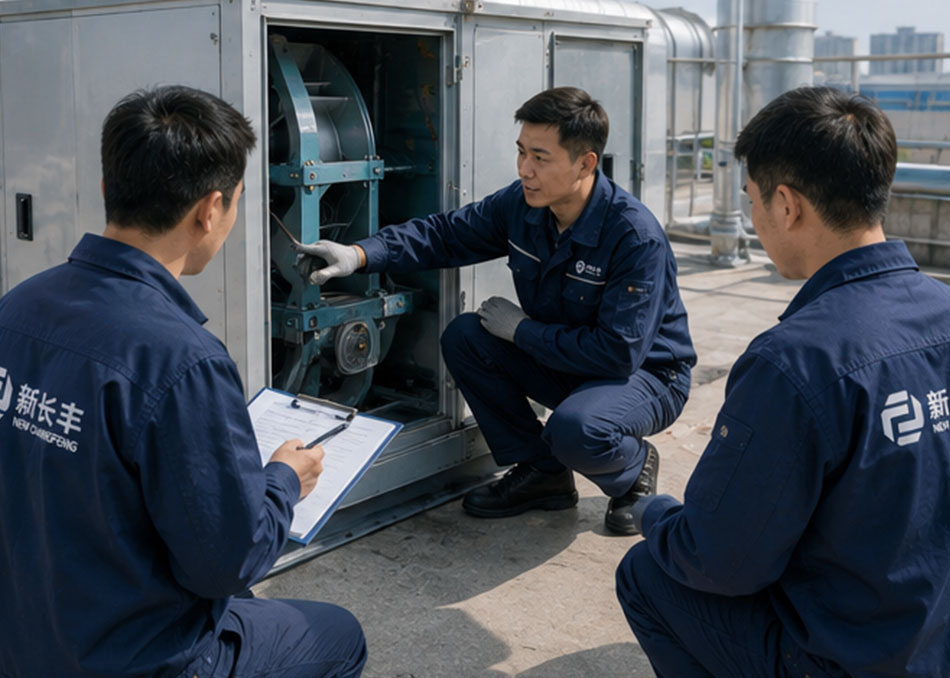
In dense food-service clusters across the Pearl River Delta, kitchen operators keep running into the same stubborn problem: the harder the exhaust system works, the stronger the negative pressure inside the kitchen becomes. Doors pull against your hand, floor drains burp sewer odors back into the room, gas burners starve for air, and cooks work in stifling heat. The instinctive fix—cranking up exhaust capacity—usually makes the pressure imbalance worse. Breaking the cycle requires controlled make-up air, and a water-cooled fresh air unit is one of the most practical ways to deliver both make-up air and cooling in a single step.
Why Kitchen Negative Pressure Forms—and Why Exhaust Alone Can't Fix It
A commercial kitchen exhaust system—grease purifier, exhaust fan, and ductwork—continuously removes air from the room. When make-up air volume falls clearly below exhaust volume, indoor pressure drops below outdoor pressure and negative pressure develops. The consequences go well beyond doors that are hard to open:
- Reduced combustion efficiency: Gas ranges need adequate air for combustion. Under negative pressure, air supply is insufficient, flames may turn yellow and burn incompletely—wasting gas and raising safety risk.
- Worse exhaust performance, not better: When negative pressure is excessive, make-up air rushes in through uncontrolled paths such as door gaps and floor drains. Airflow organization becomes chaotic, grease fumes spill around cooking stations, and purification equipment carries a heavier load.
- Comfort and hygiene problems: Pearl River Delta summers are hot and humid, and kitchens are already oppressive. Uncontrolled make-up air drags in hot, moist outdoor air and makes conditions worse. Sewer odors backing up through floor drains and drain pipes are also directly linked to negative pressure.
The correct approach is not to keep adding exhaust capacity but to establish an ordered make-up air strategy: supply air in a controlled, treated, and properly distributed way so that exhaust and supply stay in balance. This is exactly where the water-cooled fresh air unit comes in.
What Role Does a Water-Cooled Fresh Air Unit Play?
A water-cooled fresh air unit draws in outdoor air, passes it through a water-cooled heat-exchange section that lowers the air temperature, and then delivers the treated air into the kitchen through organized ductwork or supply outlets. In kitchen negative-pressure control, it serves two functions at once:
- Make-up air: It supplies a controlled volume of outdoor air to offset exhaust, keeping the kitchen close to neutral or slightly negative pressure—enough to contain fumes without creating runaway negative pressure.
- Cooling: By cooling the supply air before it enters the space, it avoids the common side effect of make-up air systems—pumping hot outdoor air into an already hot kitchen.
Compared with simply opening a door or installing a plain supply fan, a water-cooled fresh air unit gives you treated, filtered, and directed air. That means more stable pressure control, better airflow organization around cooking stations, and a more workable environment for staff during peak hours.
Selection Points for Hot, Humid Climates
In the Pearl River Delta, high temperature and high humidity shape equipment selection. The following points matter most in practice:
- Balance supply against exhaust: Base the unit's air volume on the actual exhaust volume of the kitchen's hoods and purifiers, and design for a controlled pressure relationship—not a random oversized unit. Refer to fan performance testing methods in GB/T 1236 when comparing equipment data.
- Cooling capacity matched to latent load: In humid climates, a large share of the cooling load is dehumidification. Confirm with the supplier how the water-cooled coil performs under high wet-bulb conditions, and avoid selecting on dry-bulb temperature alone.
- Air distribution design: Supply outlets should be positioned so treated air reaches the cooking zone without disrupting hood capture. Poorly placed supply air can push fumes out of the hood—defeating the purpose.
- Energy efficiency and noise: Check fan energy efficiency against GB 19761 and ask for sound pressure data at the intended operating point, since kitchen staff work close to the equipment.
- Filtration and maintenance access: Kitchen supply air should be filtered. Confirm filter replacement and coil cleaning are practical without dismantling ductwork.
- Integration with fume purification: The make-up air system and the grease purifier should be designed as one balanced system, with the purification stage meeting the emission requirements of GB 18483.
Common Mistakes That Undermine the Solution
Even with the right equipment, execution decides the outcome. Three mistakes recur:
- Oversizing the supply unit: Too much make-up air creates positive pressure in the kitchen and pushes odors into the dining area. Supply should be tuned to the exhaust, not set to maximum.
- Ignoring the pressure relationship between kitchen and dining room: The kitchen should stay slightly negative relative to the dining area so fumes do not migrate outward. This requires coordinated design of exhaust, make-up air, and transfer air paths.
- Skipping commissioning: After installation, measure and adjust airflow so the pressure relationship is verified under real operating conditions—not assumed from nameplate data.
FAQ
Q: Can I just add a supply fan instead of a water-cooled fresh air unit?
A: A plain supply fan can relieve negative pressure, but in hot, humid climates it typically brings in hot outdoor air and makes the kitchen less comfortable. A water-cooled fresh air unit treats the air before delivery, so it addresses pressure balance and cooling together.
Q: How do I know whether my kitchen actually has a negative-pressure problem?
A: Typical signs include doors that are hard to pull open, whistling at door gaps, sewer odors from floor drains, yellow gas flames, and fumes spilling around hood edges. A pressure measurement during peak cooking hours confirms the diagnosis.
Q: Does a water-cooled fresh air unit replace the kitchen exhaust purifier?
A: No. The two serve different functions. The purifier treats grease fumes before discharge, while the fresh air unit supplies treated make-up air. They must be designed together so that exhaust and supply remain balanced.
Q: How much maintenance does the unit need?
A: Expect routine filter checks and periodic cleaning of the water-cooled coil, with frequency depending on outdoor air quality and operating hours. Confirm service access during the design stage to keep maintenance simple.
Negative pressure in commercial kitchens is a system-balance problem, not an exhaust-capacity problem. A properly selected water-cooled fresh air unit—sized to the actual exhaust volume, matched to the local climate, and commissioned after installation—restores controlled make-up air and a cooler, safer working environment. XCFFJ manufactures water-cooled fresh air units and a full range of kitchen ventilation and purification equipment; contact our team to discuss a balanced ventilation design for your project.