
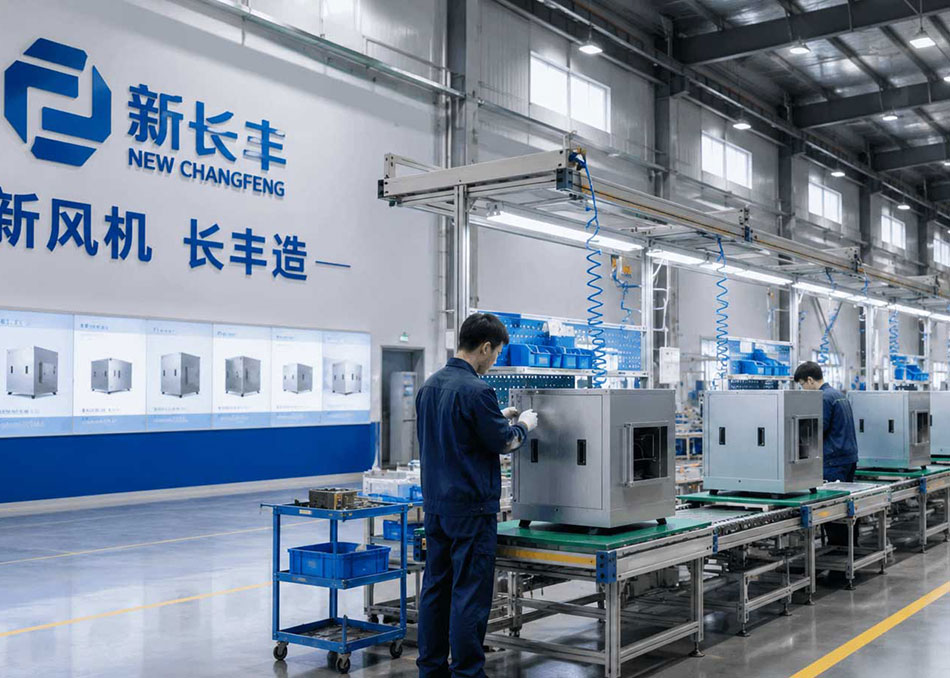
Walk into many restaurant kitchens and the complaint is rarely about the exhaust fan being too small. It is about the heat that refuses to leave, the cooking fumes that drift into the dining room, and the door that pulls itself shut against a draft. These are classic symptoms of a kitchen under negative pressure — a condition where exhaust systems remove more air than is being supplied. A water-cooled fresh air unit addresses this imbalance directly by delivering filtered, temperature-controlled make-up air to the kitchen space.
Why Make-Up Air and Pressure Balance Matter in Commercial Kitchens
Commercial kitchen exhaust systems — whether a centrifugal fan, a multi-wing centrifugal fan, or a negative pressure fan — are designed to move large volumes of air out of the cooking area. Without an equal or slightly lesser volume of air coming in, the kitchen becomes a vacuum. The consequences are practical and immediate: exhaust fan performance drops, cooking fumes linger around the range, and the air purifier cannot capture pollutants efficiently. In severe cases, negative pressure can pull odors from shared flues, floor drains, or restrooms back into the kitchen.
Industry standards such as GB 18483 for kitchen fume emission and GB 51251 for smoke and heat exhaust systems emphasize the importance of coordinated exhaust and make-up air design. The widely accepted practice is to supply slightly less make-up air than is exhausted, maintaining a mild negative pressure. This prevents cooking odors from escaping into the dining area while avoiding excessive negative pressure that could interfere with combustion appliances and natural draft.
Make-up air strategies generally fall into three categories: natural infiltration through openings, standard fresh air supply, and treated fresh air supply with cooling or heating. In hot climates or during summer months, untreated outside air can raise kitchen temperatures and reduce staff comfort — which is where water-cooled fresh air units become particularly valuable.
How Water-Cooled Fresh Air Units Work
A water-cooled fresh air unit combines ventilation with evaporative cooling or water-based heat exchange. Outside air is drawn through a cooling medium — typically a water-cooled coil or evaporative pad — before being delivered into the kitchen. This reduces the supply air temperature without the energy consumption of traditional air conditioning, making it a practical choice for kitchens where sensible cooling is needed but full HVAC is not feasible.
Unlike simple wall-mounted fans that only move air, these units are designed to handle the specific demands of a commercial kitchen: high ambient temperatures, grease-laden air, and continuous operation. Many models integrate filtration stages to capture dust and some grease particles before the air enters the cooking zone. When paired with a properly sized exhaust system — such as a cabinet centrifugal fan or a multi-wing centrifugal fan — the water-cooled fresh air unit helps restore pressure balance and improves overall ventilation effectiveness.
It is important to note that make-up air units do not replace kitchen exhaust purifiers or negative pressure fans. They work as part of a system. The exhaust side removes contaminants; the supply side replenishes air. Both must be sized and controlled together for optimal results.
Selection Criteria for Kitchen Make-Up Air Units
Choosing the right water-cooled fresh air unit requires attention to several factors beyond simple airflow ratings. Because kitchen layouts and cooking loads vary widely, a one-size-fits-all approach rarely works.
- Airflow balance: Determine the total exhaust volume of your kitchen hood and fans. The make-up air unit should supply approximately 80–90% of that volume, depending on local code and building tightness.
- Cooling capacity: In hot climates, the unit should provide meaningful temperature reduction. Look for units with sufficient water flow and heat exchange surface area.
- Filtration level: Kitchens generate grease and particulate matter. Choose a unit with easily serviceable filters that can handle a grease-laden airstream.
- Noise level: Make-up air units should not add excessive noise to the kitchen. Centrifugal fan designs generally offer quieter operation than axial fans at similar airflow.
- Installation location: Rooftop, sidewall, or indoor placement affects duct routing, access for maintenance, and water supply connections.
Manufacturers such as XCFFJ offer water-cooled fresh air units designed specifically for commercial kitchen environments, with options for different airflow ranges and configurations. Consulting with a ventilation engineer who understands both exhaust and supply dynamics is strongly recommended.
Installation and Maintenance Best Practices
Proper installation is critical to achieving the intended pressure balance. The make-up air unit should be positioned so that supply air is distributed evenly across the cooking area, avoiding direct drafts on burners or food prep surfaces. Ductwork should be sized to minimize pressure loss and sealed to prevent leakage. Controls should allow the unit to operate in sync with the exhaust system — when the exhaust fans run, the make-up air unit should run; when they stop, it should stop.
Maintenance requirements are straightforward but must be followed consistently. Water-cooled units need regular checks of water quality, flow rates, and heat exchange surfaces to prevent scaling and biological growth. Filters must be cleaned or replaced according to the manufacturer's schedule. During routine kitchen deep cleans, the make-up air unit should be included in the checklist. Neglecting maintenance can lead to reduced cooling efficiency, unbalanced pressure, and premature equipment failure.
Frequently Asked Questions
Q: Can I just open a window instead of installing a make-up air unit?
A: While natural ventilation can provide some make-up air, it is unpredictable and often insufficient. Open windows may also allow hot, humid, or polluted outside air into the kitchen, and they compromise the pressure balance that keeps odors out of the dining area. A dedicated make-up air unit provides controlled, filtered, and often cooled air.
Q: Will a water-cooled fresh air unit eliminate the need for a kitchen exhaust purifier?
A: No. The exhaust purifier handles the removal of grease and smoke from the exhaust airstream. The water-cooled fresh air unit supplies clean make-up air. Both are necessary for a complete kitchen ventilation system, and they serve different functions.
Q: How do I know if my kitchen has a negative pressure problem?
A: Common signs include doors that are hard to open or that slam shut, exhaust hoods that fail to capture smoke properly, cooking odors migrating to other rooms, and excessive heat buildup even when exhaust fans are running. A simple pressure test with a manometer can confirm the condition.
Q: What is the typical payback period for a water-cooled fresh air unit?
A: Payback varies with climate, kitchen size, and energy costs. In many hot-climate operations, reduced cooling loads and improved exhaust efficiency can lead to measurable energy savings. However, specific figures depend on the individual installation and should be evaluated on a case-by-case basis.
Conclusion
Negative pressure is one of the most overlooked problems in commercial kitchens, yet it undermines exhaust performance, indoor air quality, and staff comfort. A water-cooled fresh air unit offers a practical, energy-conscious solution by delivering cooled, filtered make-up air that restores pressure balance. When selected and installed correctly, it works alongside exhaust fans and purifiers to create a safer, more comfortable kitchen environment.
To explore water-cooled fresh air units and other commercial ventilation solutions, visit XCFFJ at www.xcffj.com or contact our team for application-specific guidance.