
Walk into many commercial kitchens and you'll notice a familiar set of complaints: the exhaust fan is running at full speed, yet smoke still drifts past the hood; cooks say it's unbearably hot, but the moment someone opens the door, a draft pushes air back inside; the hood's suction seems to surge and fade as if the whole exhaust system is gasping for breath. The culprit is rarely the exhaust fan itself — it's the missing supply air. When a kitchen pulls out more air than it lets in, it operates under excessive negative pressure. A water-cooled fresh air unit is one of the most effective ways to resolve this imbalance. This article explains the problem from a technical standpoint and outlines how to select the right equipment.
Why Commercial Kitchens Develop Negative Pressure
When a kitchen exhaust system runs, the hood and exhaust fan remove a large volume of air. If an equal amount of fresh air is not supplied, the kitchen falls into negative pressure. The immediate consequence is that exhaust capacity gets throttled: the fan has to fight the pressure difference between indoors and outdoors, so its actual exhaust volume drops. Smoke spreads around the stove and can even be drawn back through door and window gaps into the dining area. The result is a kitchen that is simultaneously hot, smoky, and uncomfortable.
Standards such as GB 18483 (Emission Standard of Cooking Fume) and GB 51251 (Technical Standard for Smoke Management Systems in Buildings) treat kitchen exhaust and make-up air as one integrated system. Supply air volume, supply air path, and supply air temperature all influence both exhaust performance and the kitchen environment. The ideal state is a slight negative pressure — enough to keep cooking fumes from escaping into the dining room, but not so much that exhaust performance collapses. Make-up air can be provided in several ways: natural infiltration, a standard fresh air handling unit, or a water-cooled fresh air unit that also provides cooling. Natural make-up air depends heavily on outdoor weather conditions and is often unreliable in summer or in tightly sealed buildings.
What a Water-Cooled Fresh Air Unit Does
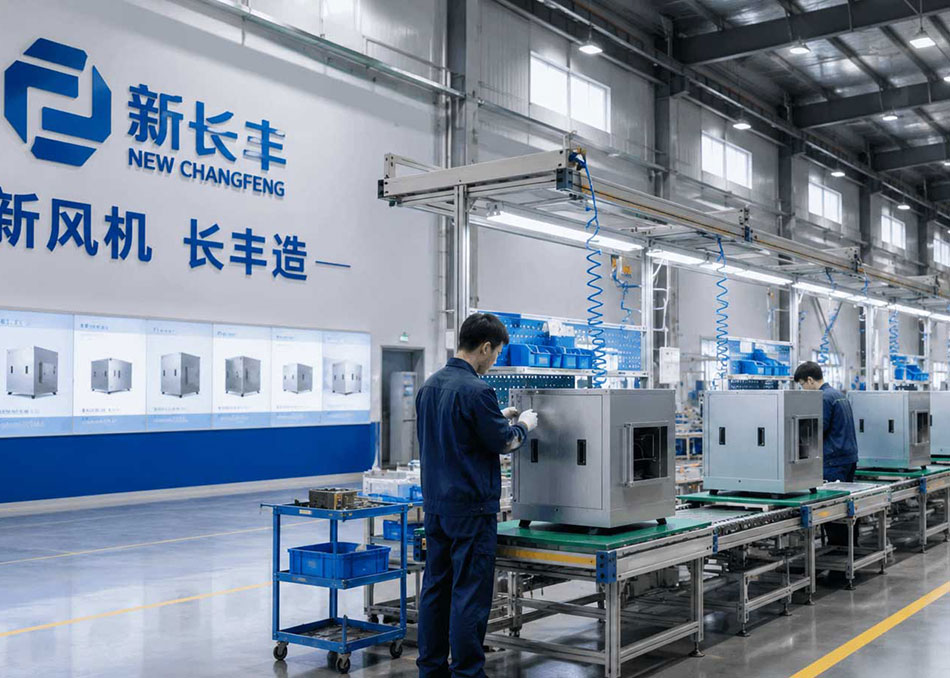
A water-cooled fresh air unit combines ventilation with cooling in a single package. Instead of relying on a conventional refrigerant circuit, it uses water as the cooling medium to reduce the temperature of the incoming outdoor air before it is delivered into the kitchen. This is particularly valuable in commercial kitchens, where internal heat gains from cooking equipment are high and simply blowing in hot outdoor air can make working conditions worse.
The unit is designed to supply a controlled volume of filtered, tempered outdoor air directly into the kitchen space. By balancing the air that the exhaust system removes, it restores the kitchen to a slight negative pressure and allows the exhaust hood to perform as intended. Because the cooling function is integrated, the unit addresses two problems at once: inadequate make-up air and excessive heat. In many projects, this dual function makes a water-cooled fresh air unit more practical than installing separate ventilation and air-conditioning systems.
Key technical considerations when specifying a water-cooled fresh air unit include:
- Air volume balance: The supply air volume should be matched to the exhaust air volume, typically aiming for a slight negative pressure rather than a balanced or positive state.
- Cooling capacity: The unit must be able to reduce the incoming air temperature enough to offset part of the kitchen's heat load, without over-cooling or creating drafts.
- Filtration: Adequate filtration protects the unit's heat exchange surfaces and keeps the supply air clean.
- Air distribution: Supply air should be directed to occupied zones and away from exhaust hoods, so that it does not short-circuit directly into the exhaust.
- Water quality and maintenance: Water-cooled designs require attention to water treatment and regular cleaning to maintain heat transfer efficiency.
How to Diagnose and Solve Negative Pressure in the Back Kitchen
Before selecting equipment, it is worth confirming that negative pressure is actually the problem. Common signs include exhaust hoods that lose suction when kitchen doors are closed, doors that are difficult to open or that slam shut, and visible smoke roll-out from the hood even when the fan is running. A simple pressure measurement or a smoke test can confirm the diagnosis.
Once negative pressure is confirmed, the solution follows a logical sequence. First, determine the exhaust air volume required by the cooking processes and the hood design. Second, calculate the make-up air volume needed to maintain a slight negative pressure — this is typically a high proportion of the exhaust volume, though the exact ratio depends on the building envelope and the exhaust system design. Third, select a make-up air strategy that fits the site. In kitchens where heat is a major issue, a water-cooled fresh air unit is often the preferred choice because it delivers both the required air volume and a meaningful cooling effect.
Installation and commissioning also matter. Supply air should not be blown directly at cooks or into the exhaust hood. Diffusers or ducted outlets can help distribute air evenly. Controls should allow the make-up air unit and exhaust fan to operate in a coordinated way, so that changes in exhaust demand are matched by changes in supply. Finally, regular maintenance — cleaning filters, checking water flow, and inspecting fans — keeps the system performing over time.
FAQ
Q: Can I just open a window instead of installing a fresh air unit?
A: Opening a window can provide temporary relief, but it is unreliable. Outdoor conditions — heat, humidity, pollution, noise, and security concerns — make natural ventilation a poor solution for a commercial kitchen. A properly sized mechanical make-up air system, such as a water-cooled fresh air unit, provides consistent and controllable supply air regardless of outdoor conditions.
Q: Will a water-cooled fresh air unit increase my energy costs?
A: Any mechanical ventilation system uses energy, but the water-cooled design can reduce overall energy use compared to separate ventilation and air-conditioning systems. By supplying tempered air directly to the kitchen, it can also reduce the load on any additional cooling equipment. The exact energy impact depends on the unit's efficiency, the climate, and how the system is controlled and maintained.
Q: How do I know what size water-cooled fresh air unit I need?
A: Sizing depends on the exhaust air volume, the desired pressure balance, the kitchen's heat load, and the layout of the space. A professional ventilation contractor or equipment supplier can perform the necessary calculations. Undersized units will not solve the negative pressure problem, while oversized units may waste energy and create uncomfortable drafts.
Q: Does negative pressure affect the kitchen exhaust purifier?
A: Yes. Excessive negative pressure reduces the effective airflow through the exhaust system, which can lower the capture efficiency of the hood and affect the performance of downstream equipment such as electrostatic fume purifiers. Correcting the pressure balance helps the entire exhaust train operate closer to its design point.
Conclusion
Negative pressure in the back kitchen is a system design issue, not just a fan problem. By understanding the relationship between exhaust and make-up air, and by selecting equipment that delivers both ventilation and cooling, operators can create a safer, more comfortable, and more efficient kitchen environment. A water-cooled fresh air unit is a practical solution for many commercial kitchens facing this challenge.
If you are dealing with persistent smoke roll-out, heat, or pressure imbalance in your kitchen, XCFFJ offers a range of ventilation and cooling solutions, including water-cooled fresh air units, to help you design the right system. Contact us to discuss your project requirements.