
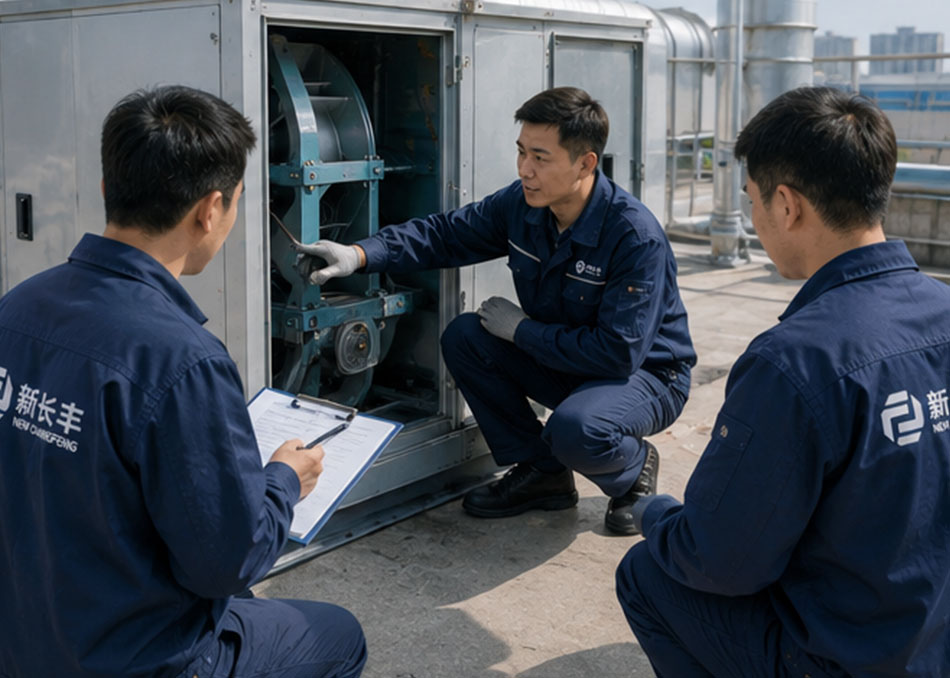
In commercial kitchens, grease-laden smoke and oppressive heat are two of the most persistent headaches for operators. To exhaust the fumes, many kitchens install powerful hoods and centrifugal fans. But the greater the exhaust volume, the more severe the negative pressure problem becomes—doors are hard to open, exhaust efficiency drops, air-conditioned cool air is sucked out, and sewer odors can even backflow. The real culprit is often not the exhaust but the makeup air. This article explains the working principle of water-cooled fresh air units and their core value in commercial kitchen makeup air applications, helping HVAC engineers and kitchen managers build a truly balanced ventilation system.
Why Makeup Air Is Critical in Commercial Kitchens
According to GB 51251 (the Chinese standard for building smoke control and exhaust systems) and commercial kitchen ventilation design codes, kitchen exhaust systems must be paired with adequate makeup air. When exhaust hoods operate without sufficient makeup air, the kitchen becomes negatively pressurized. The direct consequences include reduced hood capture efficiency, smoke spilling into dining areas, difficulty opening doors, and a significant drop in exhaust fan performance.
In practice, commercial kitchens often have oversized exhaust systems, but makeup air is frequently neglected. Many kitchens rely solely on door and window gaps for natural makeup air—which is unreliable in summer or windy conditions. Natural makeup air not only fluctuates in volume but also brings in outdoor heat, dust, and insects, worsening the working environment. As a result, mechanical makeup air—especially water-cooled fresh air units—has become the standard approach in modern commercial kitchen ventilation design.
Working Principle of Water-Cooled Fresh Air Units
A water-cooled fresh air unit combines evaporative cooling with mechanical ventilation. It draws in outdoor air, passes it through a wet filter or pad, and uses the evaporation of water to lower the air temperature before delivering it into the kitchen. This process serves two purposes: it supplies the required makeup air to balance negative pressure, and it cools the incoming air, reducing the load on the kitchen's air conditioning system.
The unit typically includes a fan, a water distribution system, an evaporative cooling pad, and a water reservoir. As warm outdoor air passes through the wet pad, water evaporates, absorbing heat and dropping the air temperature by several degrees. The cooled, fresh air is then blown into the kitchen, maintaining a slight positive pressure to prevent smoke infiltration and improve overall comfort.
Key Benefits in the Kitchen Environment
- Balanced Ventilation: By providing a controlled volume of makeup air, the unit prevents excessive negative pressure, ensuring the exhaust hood performs at its rated efficiency.
- Cooling Effect: The evaporative cooling reduces the temperature of incoming air, which is especially beneficial in hot climates or during summer, easing the burden on air conditioning and improving worker comfort.
- Air Filtration: The water pad also acts as a filter, trapping dust and particulates, which helps keep the kitchen cleaner and reduces the load on exhaust filters.
- Energy Efficiency: Compared to traditional air conditioning, evaporative cooling consumes significantly less energy, making it a cost-effective solution for large-volume makeup air.
Design Considerations for Water-Cooled Makeup Air Systems
When specifying a water-cooled fresh air unit for a commercial kitchen, several factors must be evaluated:
- Makeup Air Volume: The unit must deliver at least 80-90% of the exhaust volume to maintain neutral pressure. This requires accurate calculation based on hood size, cooking equipment, and exhaust fan capacity.
- Air Distribution: Supply outlets should be positioned to avoid blowing directly on cooking surfaces or causing drafts, while ensuring even coverage across the kitchen.
- Water Quality: Hard water can cause mineral buildup on the evaporative pad, reducing efficiency. Regular maintenance and water treatment may be necessary.
- Climate Suitability: Evaporative cooling is most effective in dry climates. In humid regions, the cooling effect diminishes, but the makeup air function remains essential.
Conclusion
Water-cooled fresh air units offer a practical, energy-efficient solution for commercial kitchen makeup air. By addressing negative pressure and providing cooling, they improve exhaust performance, comfort, and indoor air quality. For HVAC professionals and kitchen managers, integrating such a unit into the ventilation design is a smart investment in operational efficiency and staff well-being.
FAQ
Q: How does a water-cooled fresh air unit differ from a regular makeup air fan?
A: A regular makeup air fan simply supplies outdoor air, often at outdoor temperature. A water-cooled fresh air unit also cools the air through evaporative cooling, making it suitable for hot climates and reducing the cooling load on the kitchen's air conditioning.
Q: Can a water-cooled fresh air unit be used year-round?
A: Yes, but the cooling benefit is greatest in hot, dry conditions. In cooler months, the unit can be operated without water circulation to function as a standard makeup air fan, or with reduced water flow to temper the air.
Q: What maintenance does a water-cooled fresh air unit require?
A>Regular cleaning of the evaporative pad, water reservoir, and distribution nozzles is essential to prevent mineral scaling and algae growth. Depending on water quality, the pad may need replacement every 1-3 seasons. It's also important to check the fan motor and belts periodically.