
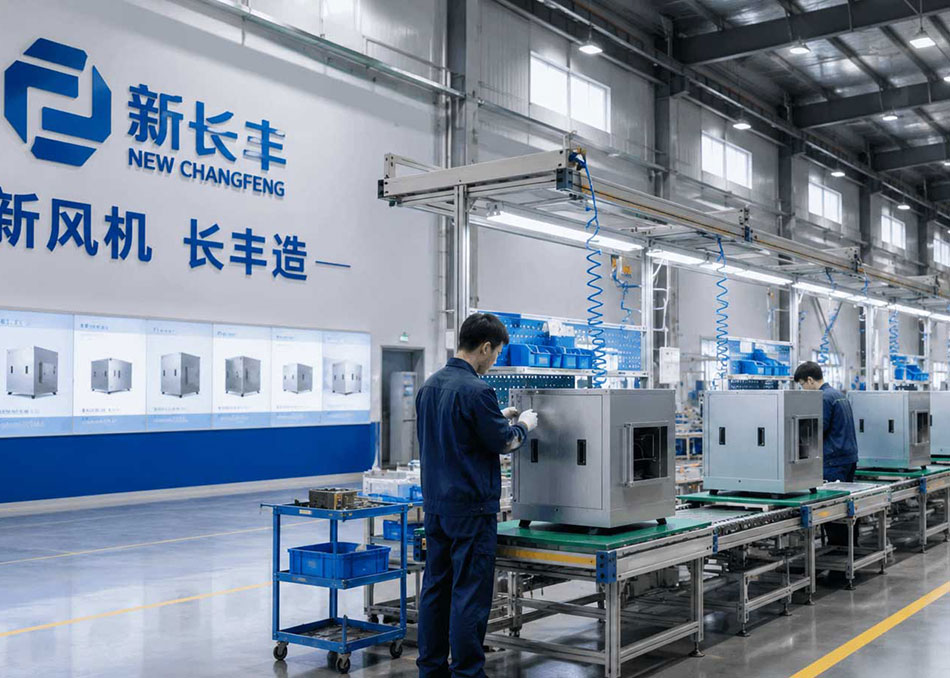
Walk into any busy commercial kitchen—especially a Chinese restaurant—and you'll feel it: the door is hard to pull open, flames flicker sideways, cooking smells drift into the dining room, and the exhaust hood seems to have lost its pull. These are classic symptoms of kitchen negative pressure, a condition that quietly undermines exhaust performance and worker comfort. Solving it isn't about adding more exhaust power; it's about getting the makeup air right. Water-cooled fresh air units have become a practical answer because they supply air and cool it at the same time.
Why Commercial Kitchens Develop Negative Pressure
In a typical commercial kitchen, exhaust hoods, fume purifiers, and exhaust fans run at high load for hours. They continuously remove large volumes of air from the space. If makeup air is insufficient or poorly routed, the kitchen becomes negatively pressurized relative to surrounding areas. The consequences are easy to spot: doors that resist opening, flames pulled away from burners, grease-laden air escaping into dining areas, and a measurable drop in hood capture efficiency.
From a ventilation engineering standpoint, this is a classic "high exhaust, low makeup air" scenario. Standards such as GB 18483 (emission standard of cooking fume) and GB 51251 (technical standard for smoke control and exhaust systems) call for coordinated design of exhaust and makeup air systems. Makeup air volume is typically matched to a proportion of exhaust volume, and the method can be natural or mechanical. Among mechanical options, water-cooled fresh air units stand out because they combine outdoor air supply with evaporative or coil-based cooling—delivering both ventilation and temperature relief.
The key takeaway: negative pressure isn't solved by simply increasing exhaust. It's solved by making makeup air correct in volume, temperature, path, and cleanliness. Those four factors determine whether the kitchen stays comfortable, whether exhaust works as designed, and whether energy use remains under control.
How Water-Cooled Fresh Air Units Work
A water-cooled fresh air unit draws outdoor air into the unit, treats it through evaporative cooling or a cooling coil, and then supplies it into the kitchen in a directed manner. While replenishing the air removed by exhaust, it also lowers the supply air temperature—a dual benefit that ordinary axial makeup fans cannot provide.
The working logic is straightforward: as exhaust fans remove hot, greasy air, the unit introduces cooler, cleaner outdoor air. This reduces the pressure differential, stabilizes hood capture, and improves the working environment near cooking lines. Because the unit cools the air, it also helps offset the heat gain from cooking equipment, reducing the load on any separate comfort cooling.
Unlike simple supply fans, water-cooled fresh air units are designed to handle the temperature and humidity demands of a kitchen environment. They can be integrated with ductwork to deliver air directly to the breathing zone or to strategic locations that prevent short-circuiting between supply and exhaust.
Selection and Sizing: What Matters Most
Choosing the right water-cooled fresh air unit requires more than picking a model number. The goal is to match the unit to the kitchen's exhaust profile and layout. Here are the key considerations:
- Makeup air volume: Determine the total exhaust volume at design conditions, then decide what proportion will be supplied mechanically. This proportion varies by kitchen type and local code, but it must be sufficient to prevent excessive negative pressure.
- Supply air temperature: In hot climates or high-heat kitchens, cooling the makeup air improves comfort and helps maintain a stable cooking environment. Evaporative cooling is effective in dry climates; coil-based cooling may be needed in humid regions.
- Air distribution path: Supply air should be delivered where it won't be immediately captured by exhaust hoods. Avoid short-circuiting by directing air along the floor or toward the cooking line, depending on hood design.
- Filtration and cleanliness: Outdoor air may carry dust, pollen, or pollutants. Adequate filtration protects the unit, the ductwork, and the kitchen environment.
- Noise level: Kitchen staff work in close proximity to equipment. Select units with sound levels appropriate for the space, and consider acoustic attenuation if needed.
- Energy efficiency: Look for units that meet relevant efficiency standards and offer variable-speed control to match actual demand.
It's also important to consider the unit's physical footprint, service access, and water supply quality. In many cases, a professional ventilation engineer should be involved to perform a pressure balance calculation and ensure the system works as an integrated whole.
Installation and Integration Best Practices
Even a well-selected unit can underperform if installation is flawed. Here are practical guidelines:
- Locate the unit away from exhaust discharge: Prevent re-entrainment of grease-laden exhaust air.
- Use smooth, well-sealed ductwork: Minimize pressure loss and prevent air leakage.
- Provide balanced control: Interlock the makeup air unit with exhaust fans so they operate in sync. Variable-frequency drives can help match supply to changing exhaust demand.
- Commission with measurements: After installation, measure actual airflow and pressure differentials. Adjust dampers and fan speeds as needed to achieve the design balance.
- Plan for maintenance: Water-cooled units require regular cleaning of cooling pads or coils, water quality management, and filter replacement. Easy access saves long-term cost.
When integrated correctly, a water-cooled fresh air unit doesn't just solve negative pressure—it contributes to a cleaner, cooler, and more productive kitchen.
Frequently Asked Questions
Q: Can I just open a window or install a wall fan to fix negative pressure?
A: While natural or simple mechanical makeup air can help, it often falls short in commercial kitchens with high exhaust volumes. Unfiltered outdoor air can introduce dust and humidity, and an uncontrolled path may cause drafts or short-circuiting. A dedicated water-cooled fresh air unit provides filtered, cooled, and directed makeup air, offering more reliable performance and better comfort.
Q: How do I know if my kitchen has a negative pressure problem?
A: Common signs include doors that are hard to open, flames pulled toward the hood, cooking odors migrating to dining areas, and reduced exhaust capture. A simple pressure gauge or smoke test can confirm the condition. If these symptoms appear, a makeup air solution should be evaluated.
Q: Does a water-cooled fresh air unit require a water connection?
A: Yes, it requires a water supply for the evaporative cooling or coil system. Water quality should be considered to prevent scale and corrosion. In some designs, a closed-loop coil may be used with a chiller or cooling tower, but the unit itself is typically connected to a water source.
Q: What maintenance does a water-cooled fresh air unit need?
A: Regular maintenance includes cleaning or replacing filters, descaling cooling pads or coils, checking water quality and flow, inspecting the fan and motor, and verifying controls. The frequency depends on the kitchen environment and hours of operation. A preventive maintenance schedule helps avoid downtime and maintains efficiency.
Conclusion
Negative pressure in commercial kitchens is a solvable problem, but it requires a thoughtful approach to makeup air. Water-cooled fresh air units offer a dual benefit: they replenish the air removed by exhaust systems and cool it for better comfort. By selecting the right unit, integrating it properly, and maintaining it regularly, kitchen operators can achieve stable exhaust performance, a more comfortable workspace, and more predictable energy use.
For assistance in selecting a water-cooled fresh air unit for your kitchen project, contact XCFFJ. Our team can help you evaluate your exhaust profile and recommend a solution that fits your space and climate.