
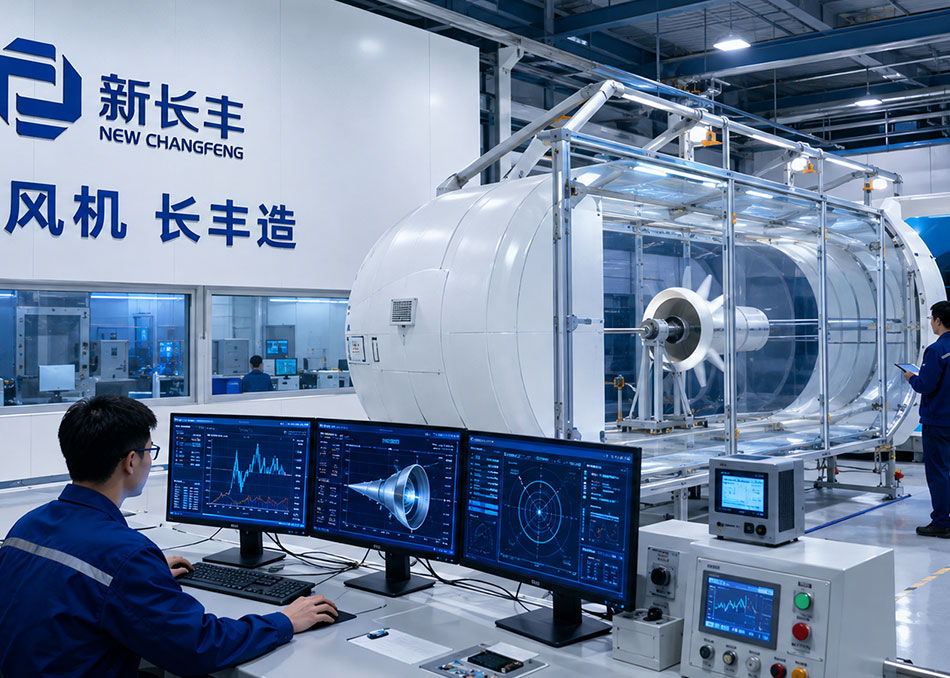
School canteens present a unique set of exhaust challenges. Unlike typical commercial restaurants, they operate on highly concentrated schedules—multiple cooking stations fire up simultaneously during short meal windows, creating sudden peaks in cooking fumes. Many canteens are located on the ground floor of teaching or dormitory buildings, which limits duct routing options and places exhaust discharge points close to sensitive areas. When the fan is poorly selected, the consequences are predictable: grease spillover, duct oil accumulation, noise complaints, and insufficient make-up air that undermines exhaust performance.
Among the various exhaust fan types, the cabinet centrifugal fan has become a common choice for school canteen kitchen exhaust and make-up air systems. Its compact structure, relatively controllable noise levels, and strong static pressure adaptability make it well-suited to the application. However, there is a significant gap between a fan that simply works and one that is correctly selected. This article examines the selection considerations for cabinet centrifugal fans from two perspectives: exhaust purification and ventilation make-up air.
The Role of Cabinet Centrifugal Fans in Canteen Exhaust Systems
A cabinet centrifugal fan is a type of centrifugal fan in which the impeller rotates within a volute casing. Air enters axially and discharges radially, giving the fan a high static pressure output capability. This makes it effective at overcoming system resistance from long duct runs, elbows, grease filters, and check valves. The cabinet-style housing typically includes sound-absorbing and thermal insulation layers, which help reduce operating noise to some degree.
In a school canteen exhaust system, cabinet centrifugal fans generally serve two functions. First, as exhaust fans, they draw cooking fumes collected by the hood, pass them through purification equipment, and discharge them outdoors. Second, as make-up air fans, they supply fresh air to the kitchen to maintain a slight negative pressure, preventing fumes from migrating into dining areas. These two functions must be designed in coordination—if make-up air is insufficient, the exhaust fan operates against excessive negative pressure, reducing its effective airflow and allowing fumes to escape.
For canteen applications, the fan must handle grease-laden air. While purification equipment captures much of the grease, some carryover is inevitable. Fans with accessible impeller and casing designs simplify cleaning and maintenance, which is critical for sustaining performance over time.
Key Selection Factors for Exhaust Purification
When selecting a cabinet centrifugal fan for exhaust purification, the first consideration is the system's total resistance. This includes pressure losses across the hood, ductwork, grease filter, electrostatic precipitator or other purification device, and the discharge outlet. The fan's static pressure curve must be capable of delivering the required airflow at that total resistance. According to GB/T 1236, fan performance should be verified through standardized testing, and selection should be based on certified performance curves rather than nominal ratings.
Energy efficiency is another critical factor. GB 19761 specifies energy efficiency grades for centrifugal fans. Choosing a fan that meets a higher efficiency grade reduces long-term operating costs, which is particularly relevant for schools with extended daily operating hours. However, efficiency should not be evaluated in isolation—a fan operating far from its best efficiency point may consume more energy than a slightly less efficient fan operating near its optimum.
Noise control is a frequent concern in school environments. Cabinet centrifugal fans with internal acoustic insulation can help, but system design also matters. Excessive duct velocity, sharp elbows, and undersized ducts generate additional noise. Selecting a fan with a lower speed and larger impeller, where space permits, often achieves the required performance with less noise than a smaller, high-speed unit.
Ventilation and Make-Up Air: The Often-Overlooked Half of the System
Exhaust alone does not guarantee a well-ventilated kitchen. As exhaust fans remove air, an equal volume of make-up air must enter the space. In many canteens, make-up air is provided only through doors and windows, which is inadequate during peak cooking. This creates negative pressure that reduces exhaust airflow, causes door-dragging, and can draw odors from adjacent areas.
A dedicated make-up air fan—often another cabinet centrifugal fan—can supply filtered, tempered air directly to the kitchen. In heating-dominated climates, a make-up air unit with heating capability prevents cold drafts. In humid climates, dehumidification may be necessary. The make-up air fan should be sized to provide approximately 80–90% of the exhaust volume, with the remainder entering through natural infiltration. This balance maintains a slight negative pressure without starving the exhaust system.
For school canteens, the make-up air intake must be located away from exhaust discharge points and outdoor air quality hazards. Filtration should be selected based on local outdoor air conditions. Regular filter maintenance is essential—a clogged make-up air filter reduces airflow and disrupts the entire system balance.
Installation and Maintenance Considerations
Proper installation directly affects fan performance and longevity. The fan should be mounted on a level, vibration-isolated base. Flexible duct connectors on both inlet and outlet reduce vibration transmission to the ductwork. Ductwork should be sized to maintain velocities that minimize noise and pressure loss—typically within the range recommended by SMACNA or local codes.
Access for cleaning is critical in grease-laden exhaust systems. The fan should be positioned so that the impeller and interior casing can be inspected and cleaned without dismantling extensive ductwork. Grease accumulation on the impeller causes imbalance, vibration, and reduced performance. A scheduled cleaning program—at minimum quarterly, and more frequently in high-volume canteens—helps maintain safe and efficient operation.
Electrical connections must comply with local codes and be suitable for the kitchen environment. Motor protection, disconnects, and proper grounding are essential. For fans handling grease-laden air, motors should be located out of the airstream or otherwise protected.
FAQ
Q: What is the difference between a cabinet centrifugal fan and an axial fan for canteen exhaust?
A: Cabinet centrifugal fans generate higher static pressure, making them better suited for systems with long duct runs, multiple elbows, and purification equipment. Axial fans move more air at lower pressure and are typically used for short, straight exhaust paths or general ventilation. For most school canteen exhaust systems with grease filters and ductwork, a centrifugal fan is the more appropriate choice.
Q: How do I determine the right size of cabinet centrifugal fan for my canteen?
A: Sizing requires calculating the total exhaust volume based on the number and type of cooking stations, hood dimensions, and local code requirements. Then, calculate the total system resistance, including ductwork, fittings, and purification equipment. Select a fan whose performance curve delivers the required airflow at that resistance. It is advisable to consult a qualified mechanical engineer or ventilation specialist for accurate sizing.
Q: Can I use one cabinet centrifugal fan for both exhaust and make-up air?
A: No. Exhaust and make-up air serve different functions and operate in different pressure regimes. Exhaust fans handle grease-laden air and discharge outdoors; make-up air fans supply clean, possibly tempered air into the kitchen. Using a single fan for both is not practical and would compromise system performance and indoor air quality.
Q: What maintenance does a cabinet centrifugal fan require in a canteen?
A: Regular inspection and cleaning of the impeller and casing to remove grease buildup is the most important maintenance task. Check belts (if belt-driven) for tension and wear, lubricate bearings as recommended, inspect vibration isolators, and verify electrical connections. Establish a maintenance schedule based on operating hours and cooking volume.
Q: How can I reduce noise from the exhaust fan?
A: Select a fan with a lower speed and larger impeller where space allows. Ensure ductwork is properly sized to avoid high velocities. Use flexible connectors and vibration isolators. Cabinet fans with acoustic insulation help, but addressing the entire system—duct design, mounting, and fan selection—is more effective than relying on the fan alone.
Conclusion
Selecting the right cabinet centrifugal fan for a school canteen involves more than matching a nominal airflow figure. It requires a thorough understanding of the system's resistance, the balance between exhaust and make-up air, noise considerations, and long-term maintenance access. By addressing both exhaust purification and ventilation make-up air as an integrated system, schools can achieve effective fume removal, maintain a comfortable kitchen environment, and minimize complaints from nearby classrooms or dormitories.
For specific product information and technical support, visit www.xcffj.com.