
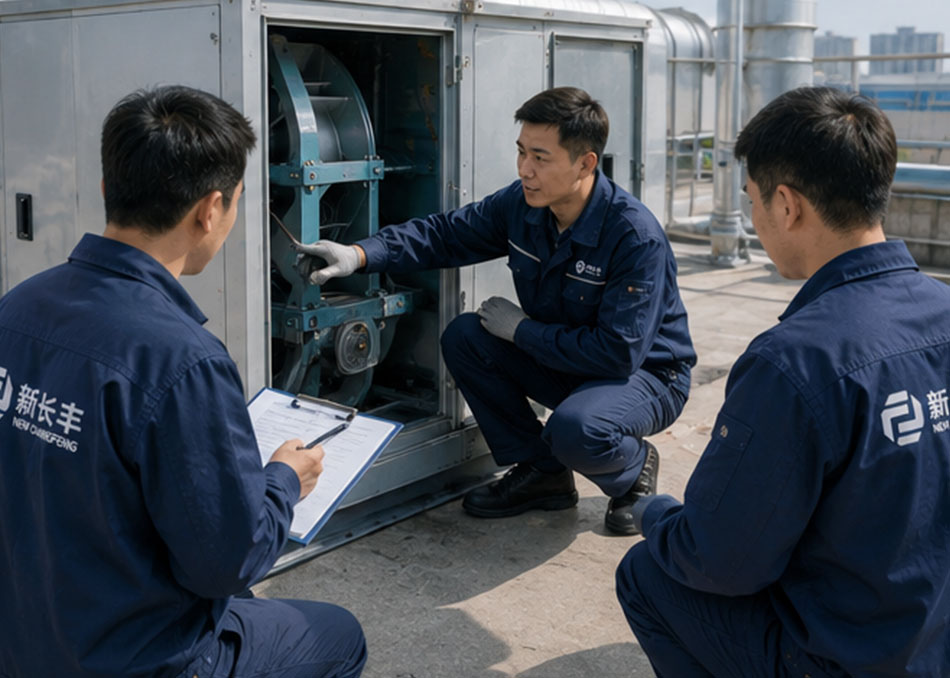
School cafeterias are high-density, high-intensity cooking environments where an effective exhaust system is not just a matter of comfort—it directly impacts food safety, building fire protection, and the overall indoor air quality. Among the various exhaust solutions, the cabinet centrifugal fan has emerged as the core power unit for school cafeteria exhaust systems, thanks to its high static pressure capability, lower noise levels, and compact footprint. This article breaks down the essential technical parameters and selection criteria for cabinet centrifugal fans in this specific application, helping procurement teams and engineering firms make informed decisions.
Core Requirements for School Cafeteria Exhaust Systems
School cafeterias experience concentrated cooking periods with high volumes of oil-laden smoke. The exhaust ducts are often long, with multiple bends, which create significant system resistance. To overcome this, the fan must deliver sufficient static pressure. Cabinet centrifugal fans, equipped with either forward-curved or backward-curved impellers, are designed to move air steadily at medium-to-high static pressures, making them ideal for longer duct runs. Unlike axial fans, which are better suited for low-resistance, short-distance applications, centrifugal fans provide higher static pressure at equivalent airflow, ensuring that the smoke maintains adequate velocity at the duct outlet and preventing grease accumulation inside the ductwork.
Another critical factor is noise. School cafeterias are frequently located near classrooms or dormitories, so acoustic performance is a top priority. Cabinet centrifugal fans feature a sound-insulated housing with built-in acoustic padding, significantly reducing operational noise compared to traditional centrifugal fans. According to the GB/T 1236 fan performance testing standard, both the performance curve and noise levels must be evaluated together during selection to ensure that the exhaust effectiveness and acoustic environment both meet the required standards.
Key Technical Parameters for Selection
When specifying a cabinet centrifugal fan for a school cafeteria, several technical parameters must be carefully reviewed:
- Airflow (CFM or m³/h): This must be calculated based on the kitchen's heat load, the number of cooking appliances, and the required air changes per hour. The fan must be capable of handling the peak cooking load without becoming a bottleneck.
- Static Pressure (Pa or in. wg): This is the pressure required to overcome the resistance of the duct system, including straight runs, elbows, dampers, and the exhaust hood. A proper static pressure calculation ensures the fan can deliver the required airflow at the actual system resistance.
- Noise Level (dB(A)): The fan's noise rating should be checked at the operating point, not just at free-air conditions. In school settings, a lower dB(A) rating is often mandated by local acoustic regulations.
- Motor Power (kW): The motor should be sized appropriately for the duty point, avoiding oversizing which wastes energy and increases noise, or undersizing which leads to overheating and premature failure.
- Efficiency and Energy Consumption: With rising energy costs, selecting a fan that operates efficiently at the design point is crucial. Look for high-efficiency motor options and variable speed drives where the load varies significantly.
It is also important to consider the fan's construction material, especially for exhaust applications where grease and moisture are present. Corrosion-resistant coatings or stainless steel construction may be specified to extend the fan's lifespan.
Integration with Ventilation and Make-Up Air
Exhaust is only one half of the equation. A well-designed school cafeteria ventilation system also includes a make-up air supply to replace the air being exhausted. Without proper make-up air, the building can become negatively pressurized, reducing the exhaust effectiveness and causing drafts or difficulty opening doors. Cabinet centrifugal fans can also be used in supply air applications, delivering filtered, tempered fresh air to the kitchen. In some designs, an energy recovery wheel or heat pipe is integrated to pre-condition the incoming air, improving energy efficiency.
The coordination between exhaust and supply fans is critical. The systems should be interlocked to ensure they operate in harmony, with the supply air volume slightly less than the exhaust to maintain a slight negative pressure in the kitchen relative to adjacent dining areas. This prevents cooking odors from migrating into the dining space.
Compliance with Standards and Best Practices
In addition to GB/T 1236 for performance testing, other relevant standards include GB 19761 for fan energy efficiency, GB 18483 for kitchen fume emission limits, and GB 51251 for smoke and heat exhaust systems in buildings. For school cafeteria exhaust, the system must also comply with local fire codes, which may require the fan to be rated for high-temperature operation (e.g., 280°C for 30 minutes) to be used as part of the building's smoke exhaust system. It is essential to verify that the selected cabinet centrifugal fan meets these ratings if it is to serve dual purposes.
Regular maintenance is another key aspect. Grease accumulation on the impeller and housing can reduce performance and increase fire risk. The fan should be accessible for cleaning, and a maintenance schedule should be established. Some fans come with inspection doors and removable impellers for easier service.
FAQ
Q: What is the difference between a cabinet centrifugal fan and an axial fan for cafeteria exhaust?
A: A cabinet centrifugal fan is designed to generate higher static pressure, making it suitable for systems with long duct runs and multiple elbows. Axial fans move larger air volumes at lower pressures, which is not ideal for overcoming the resistance of a typical cafeteria exhaust ductwork. Centrifugal fans are also generally quieter and more compact when installed indoors.
Q: How do I determine the required airflow for my school cafeteria exhaust?
A: The airflow is typically calculated based on the kitchen's heat load, the number and type of cooking equipment, and the recommended air changes per hour (e.g., 40-60 ACH for commercial kitchens). A professional ventilation engineer can perform a heat load calculation or use guidelines from standards like ASHRAE or local codes to determine the exact CFM required.
Q: Can a cabinet centrifugal fan be used for both exhaust and make-up air?
A: Yes, cabinet centrifugal fans are versatile and can be used for both exhaust and supply air applications. However, the unit must be selected with the appropriate motor, impeller, and housing to handle the specific air characteristics (e.g., grease-laden air for exhaust vs. clean filtered air for supply). It is also important to consider the pressure requirements for each application separately.
Conclusion
Selecting the right cabinet centrifugal fan for a school cafeteria exhaust system is a critical decision that affects safety, comfort, and operational efficiency. By focusing on key technical parameters—airflow, static pressure, noise, and efficiency—and by integrating the fan into a balanced ventilation system with proper make-up air, you can ensure a clean, quiet, and safe kitchen environment. For expert guidance and a wide range of compliant equipment, consult with a trusted supplier like XCFFJ, who can help you match the fan to your specific system requirements.