
School cafeterias face a unique ventilation challenge: meal service happens in intense, predictable peaks, multiple cooking stations fire up simultaneously, and the volume of cooking fumes generated can overwhelm a poorly matched exhaust system. The symptoms are familiar — grease-laden air spilling out of service windows, an unbearably hot back kitchen, grease accumulating inside ductwork, and noise complaints from nearby classrooms or residences. In most cases, the root cause is not a single failing component but a mismatch between the exhaust and make-up air systems. The cabinet centrifugal fan sits at the heart of a school cafeteria's fume extraction and purification system, and its operating principle directly determines whether the entire system performs efficiently and reliably. This article breaks down the equipment structure, working principle, application matching, and maintenance priorities for cabinet centrifugal fans in school cafeteria exhaust scenarios.
Structure and Working Principle of Cabinet Centrifugal Fans
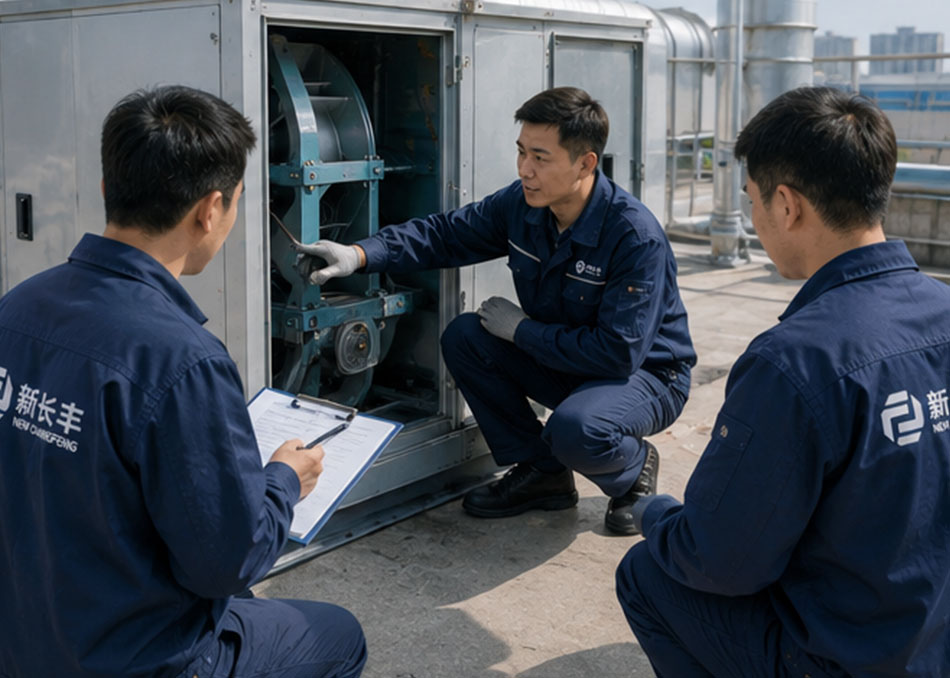
A cabinet centrifugal fan — also called a box centrifugal fan in the industry — is essentially a multi-blade centrifugal impeller, motor, and transmission assembly fully enclosed within a cabinet-style housing. The cabinet is typically formed from galvanized or powder-coated steel sheet, and its inner walls can be lined with sound-absorbing material. Inlet and outlet openings are designed with cross-sections matched to the airflow direction. This configuration preserves the high-pressure, long-distance delivery characteristics of centrifugal fans while adding noise reduction, weather protection, foreign-object exclusion, and simplified installation and maintenance.
The working principle can be summarized as follows: the motor drives the centrifugal impeller at high speed. Air between the blades is thrown outward toward the impeller rim by centrifugal force. As it enters the volute casing, kinetic energy converts into pressure energy, and the air discharges from the outlet. Meanwhile, a negative-pressure zone forms at the impeller center, drawing outside air continuously into the inlet. This steady intake-compression-discharge cycle creates the continuous, directional airflow that kitchen exhaust systems depend on.
For school cafeteria applications, this principle translates into two critical capabilities. First, the fan must generate enough static pressure to overcome the resistance of long duct runs, grease filters, and purification stages — all while maintaining adequate capture velocity at the hood face. Second, because cafeteria exhaust air is hot, humid, and grease-laden, the fan's internal geometry and motor placement must tolerate that environment without rapid performance degradation.
Why School Cafeterias Demand a Purpose-Matched Fan
School cafeteria exhaust is not the same as residential kitchen exhaust or light commercial restaurant exhaust. The combination of concentrated peak loads, multiple simultaneous cooking stations, and strict limits on noise and emissions near classrooms makes system design far more demanding. A fan selected only on nameplate airflow, without accounting for actual system resistance, will almost certainly underperform in real-world conditions.
Another frequent problem is inadequate make-up air. When exhaust fans pull air out of a kitchen faster than it can be replaced, the space depressurizes. The visible result is grease and odor leaking from unintended openings, doors that are hard to open, and burners that burn inefficiently due to oxygen starvation. A properly designed system balances exhaust and make-up air so that the kitchen remains slightly negative relative to adjacent spaces — containing odors — but not so negative that it disrupts combustion or causes door-operating problems.
Cabinet centrifugal fans are well suited to this role because their pressure characteristics allow them to handle the combined resistance of hood filters, duct runs, and air purification equipment. Their enclosed design also helps contain noise, which matters greatly when the kitchen is adjacent to dining areas or classrooms.
Key Selection and Matching Considerations
Getting the fan right starts with an accurate system resistance calculation. Every component in the exhaust path — grease filters, duct elbows, fire dampers, purification units, and discharge hoods — adds resistance. The fan must be selected at its actual operating point, not at a free-air condition that will never occur in practice.
- Airflow and static pressure: Size the fan to deliver the required capture velocity at the hood while overcoming total system resistance. Reference GB/T 1236 for fan performance testing and verification.
- Energy efficiency: Select fans that meet GB 19761 fan energy efficiency requirements, especially for systems that run many hours per day during the school term.
- Make-up air balance: Provide dedicated make-up air — ideally tempered — to replace exhausted air and maintain proper pressure relationships.
- Fume purification: Ensure the purification stage meets GB 18483 kitchen fume emission limits and is compatible with the fan's airflow and pressure profile.
- Fire safety: Where required, incorporate smoke and heat exhaust considerations consistent with GB 51251, including proper duct construction and fire damper placement.
- Noise control: Account for both fan noise and duct-borne noise, particularly when the mechanical room or duct route is near occupied spaces.
It is equally important to avoid oversizing. A fan that is too large wastes energy, generates unnecessary noise, and can actually reduce capture efficiency if the make-up air cannot keep pace. The goal is a balanced system, not a bigger fan.
Maintenance and Operational Practices
Even a well-matched system will degrade without routine maintenance. Grease accumulation on impeller blades is one of the most common causes of vibration, imbalance, and reduced performance. A regular cleaning schedule — based on actual cooking load, not a fixed calendar — helps prevent this.
Operators should also monitor belt tension and bearing condition on belt-driven units, check for unusual vibration or noise, and verify that make-up air paths remain unobstructed. Filters and purification stages must be cleaned or replaced according to the manufacturer's guidance; a clogged filter raises system resistance and shifts the fan off its design operating point.
Finally, document the system's baseline performance at commissioning. Knowing the original static pressure and airflow characteristics makes it far easier to detect degradation later and to distinguish between a maintenance issue and a design problem.
FAQ
Q: What is the main difference between a cabinet centrifugal fan and a standard axial fan for kitchen exhaust?
A: Centrifugal fans generally produce higher static pressure, which makes them better suited to systems with long duct runs, multiple filters, or purification equipment. Axial fans move large volumes of air at lower pressure and are often used for general ventilation or make-up air rather than grease-laden exhaust.
Q: Why does my school cafeteria still feel hot and smoky even though the exhaust fan runs continuously?
A: This usually indicates a system imbalance rather than a single equipment fault. Possible causes include insufficient make-up air, undersized or clogged filters, duct leakage, or a fan operating far from its design point. A qualified ventilation contractor can measure static pressure and airflow to identify the actual bottleneck.
Q: How often should a cabinet centrifugal fan in a school kitchen be cleaned and inspected?
A: Frequency depends on cooking volume and grease loading. High-volume school kitchens may require impeller inspection and cleaning several times per term, while lighter-use kitchens can follow a longer interval. Inspect more frequently if you notice vibration, noise changes, or reduced exhaust performance.
Q: Can a cabinet centrifugal fan be used for both exhaust and make-up air?
A: Yes, cabinet centrifugal fans can serve either duty, but the selection must match the application. Exhaust duty requires materials and construction that tolerate grease and moisture, while make-up air duty may involve filtration or tempering. Specify the intended duty clearly when selecting the fan.
Summary
Cabinet centrifugal fans are the driving force behind effective school cafeteria exhaust and purification systems. Their enclosed, pressure-capable design makes them well suited to the demanding combination of long duct runs, grease-laden air, and noise-sensitive surroundings. But performance depends on proper system matching — accurate resistance calculation, balanced make-up air, compliant purification, and consistent maintenance. When these elements work together, the result is a kitchen that stays cooler, cleaner, and quieter throughout the school day.
If you are planning or upgrading a school cafeteria ventilation system, XCFFJ manufactures cabinet centrifugal fans, multi-wing centrifugal fans, negative pressure fans, fume purification units, and complete fresh air solutions. Visit www.xcffj.com to discuss your project requirements with our team.