
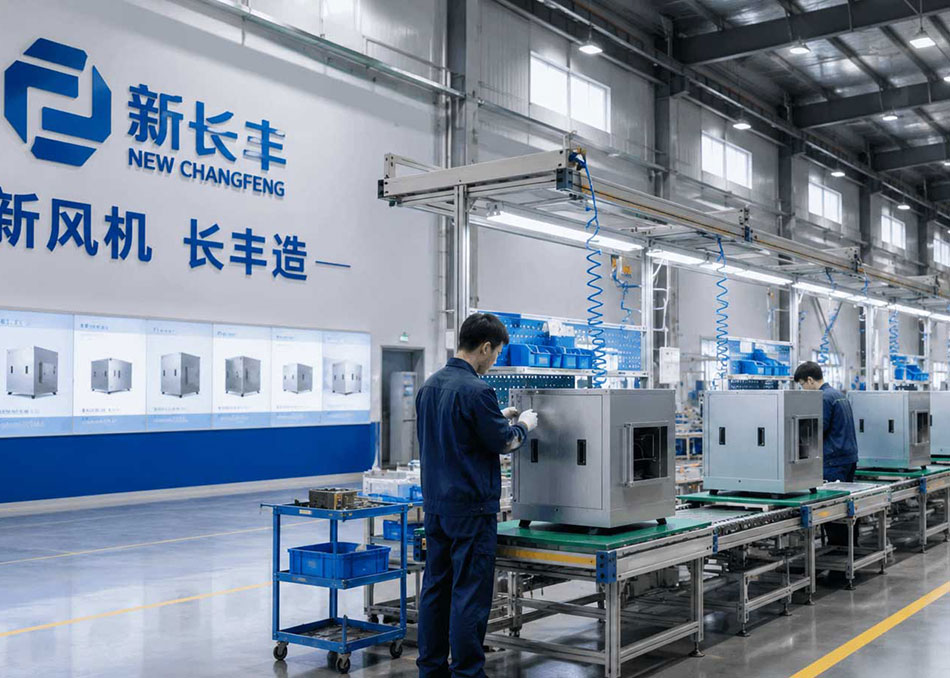
School canteens in Guangdong and across southern China face a perfect storm of kitchen exhaust challenges: intense cooking schedules, high oil fume concentrations, long duct runs, and sensitive neighbors—classrooms, dormitories, and residential buildings. When the exhaust system is undersized or poorly matched, the consequences range from sweltering kitchens and fume backdraft to complaints from nearby residents. Among the available options, the DT cabinet centrifugal fan has become a common choice for school canteen exhaust purification thanks to its compact structure, strong pressure reserve, and noise-reducing enclosure. But "common" does not mean "pick any model." This article walks through the selection logic for DT cabinet centrifugal fans in southern Chinese school canteens.
1. Understand the Operating Conditions of School Canteen Exhaust
The first difference between a school canteen and a typical commercial restaurant is the concentration of meal times. During lunch and dinner peaks, multiple burners fire simultaneously, and oil fume generation spikes within a short window. The exhaust system must deliver enough instantaneous airflow capacity, or fumes will accumulate in the kitchen and spread outward. This requires the fan to operate stably at the system's highest resistance point—not just perform well under ideal conditions.
Duct routing is the second factor. School canteens are often located inside teaching or comprehensive buildings, so exhaust ducts must travel long horizontal distances and climb vertically to roof discharge points. Bends, reducers, and purification equipment all add resistance. In Guangdong's humid climate, oil fume carries more moisture, and duct walls tend to accumulate oil and water, further increasing system resistance. Selection therefore cannot rely solely on the fan's nominal nameplate parameters; it must match the actual duct network resistance.
Environmental and noise requirements are the third consideration. Schools are surrounded by sensitive receptors. Exhaust must meet GB 18483 kitchen fume emission limits, and noise must not disrupt classes or nearby residents. A DT cabinet centrifugal fan with a well-designed enclosure helps control noise, but the overall system—including duct layout and purification unit—must be considered as a whole.
2. Why DT Cabinet Centrifugal Fans Suit School Canteen Exhaust Purification
The DT cabinet centrifugal fan is a centrifugal fan integrated into a cabinet-style enclosure. Its impeller draws air axially and discharges it radially, generating higher static pressure than typical axial fans. This makes it well-suited for systems with long ducts, multiple bends, and purification equipment—exactly the profile of many school canteen exhaust systems.
The cabinet design serves multiple purposes: it reduces noise transmission, protects the fan from outdoor weather, and simplifies rooftop or outdoor installation. For schools where the exhaust fan may be placed near teaching buildings or residential areas, this noise control is a practical advantage. The centrifugal impeller also handles oil-laden air more gracefully than some axial designs, provided that proper filtration and regular cleaning are in place.
When paired with an electrostatic fume purifier or other purification stage, the DT cabinet centrifugal fan can maintain stable airflow despite the added resistance. This combination is common in southern China, where high humidity and heavy cooking loads demand a robust, pressure-capable fan.
3. Key Selection Factors for DT Cabinet Centrifugal Fans
Choosing the right DT cabinet centrifugal fan for a school canteen involves several interconnected decisions. The goal is to match the fan to the system's actual operating point, not to simply pick the largest or cheapest model.
- Airflow and pressure matching: Calculate the total system resistance (ducts, bends, purification equipment, discharge hood) and select a fan whose performance curve delivers the required airflow at that pressure. Avoid selecting based on open-discharge airflow alone.
- Motor power and efficiency: Verify that the motor can handle the absorbed power at the operating point, with a reasonable safety margin. Check GB 19761 fan energy efficiency grades where applicable; higher efficiency reduces long-term operating costs.
- Noise control: Consider the fan's sound power level and the distance to sensitive receptors. Cabinet construction, internal insulation, and vibration isolation all contribute to acceptable noise levels.
- Material and corrosion resistance: In humid, oil-laden environments, impeller and casing materials should resist corrosion and oil buildup. Easy-access cleaning ports are a plus.
- Purification integration: If an electrostatic purifier or UV unit is used, ensure the fan is positioned to handle the additional resistance and that maintenance access is not blocked.
- Compliance: Confirm that the overall system meets GB 18483 emission limits and any local environmental regulations. For fire safety, refer to GB 51251 where smoke exhaust considerations apply.
4. Installation and Maintenance Practices for Long-Term Performance
Even a well-selected DT cabinet centrifugal fan can underperform if installation is careless. Duct connections should be airtight and properly aligned to avoid turbulence and pressure loss. The fan should be mounted on a stable base with vibration isolators, and the cabinet should be accessible for routine service. In southern China's humid climate, drainage for condensate and oil residue is essential to prevent corrosion and blockages.
Maintenance schedules should include regular inspection of the impeller for oil buildup, checking belt tension (if belt-driven), lubricating bearings where required, and verifying that the purification equipment is functioning. Clogged filters or dirty electrostatic plates increase resistance and reduce airflow, forcing the fan to operate off its design point. A simple pressure gauge or airflow indicator can help facility staff detect performance drift early.
For schools, it is also wise to document the system's design parameters and keep a maintenance log. This supports consistent operation across semesters and helps troubleshoot issues during peak demand periods.
Frequently Asked Questions
Q: Can a DT cabinet centrifugal fan handle both fume purification and long duct runs?
A: Yes, provided it is selected for the total system resistance. DT cabinet centrifugal fans are designed to generate relatively high static pressure, making them suitable for systems with purification equipment and extended ductwork. However, the fan must be matched to the actual pressure drop of the entire system, not just the duct length.
Q: How does Guangdong's humid climate affect fan selection?
A: High humidity increases the moisture content in oil fume and promotes oil-water accumulation in ducts, which raises system resistance over time. It also accelerates corrosion. When selecting a DT cabinet centrifugal fan, choose models with corrosion-resistant finishes, effective drainage, and easy cleaning access. Regular maintenance is especially important in humid regions.
Q: What noise considerations apply when the fan is near classrooms or residences?
A: Noise from the fan and airflow can disturb sensitive receptors. The DT cabinet design helps attenuate noise, but additional measures—such as vibration isolators, flexible duct connectors, and silencers—may be needed. Site the fan away from quiet zones where possible, and verify noise levels at the nearest sensitive boundary.
Q: How often should a school canteen exhaust fan be maintained?
A: Maintenance frequency depends on cooking intensity and filtration effectiveness. In heavy-use school canteens, inspect the impeller and purification stages monthly, and clean or replace components as needed. At minimum, schedule a thorough inspection each semester and keep a log of performance checks.
Selecting the right DT cabinet centrifugal fan for a school canteen exhaust system is a matter of matching fan performance to real-world resistance, noise limits, and environmental compliance. By understanding the operating conditions, choosing a pressure-capable and efficient model, and committing to proper installation and maintenance, schools can achieve reliable fume purification and a comfortable dining environment. For project-specific guidance, consult with a ventilation equipment specialist who can review your duct layout and purification requirements.