
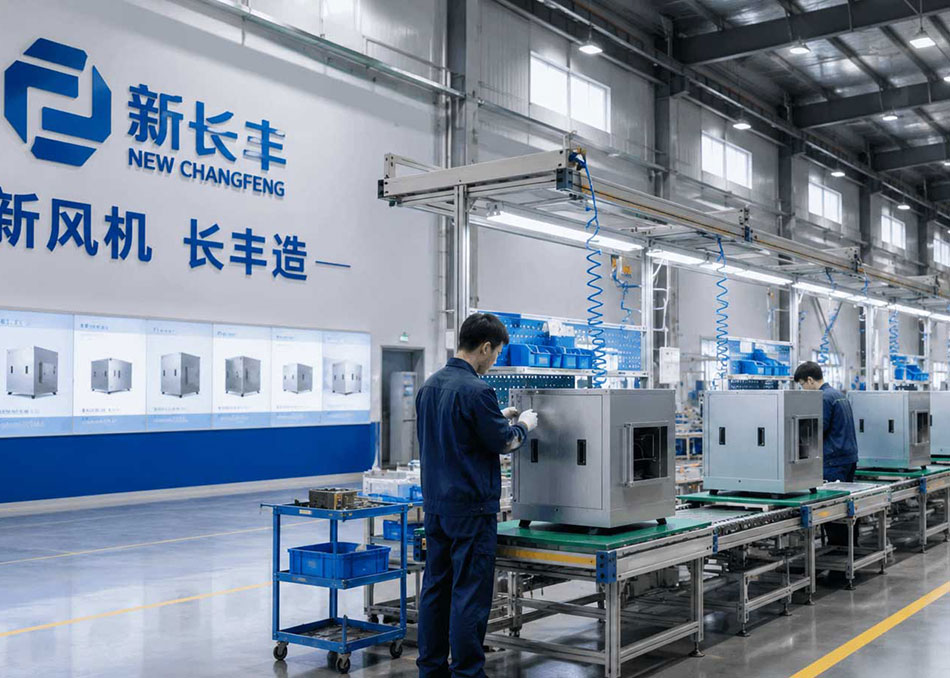
In commercial ventilation, kitchen cooling and mahjong room makeup air look like two unrelated problems — until they share a building. Many mixed-use venues combine a restaurant, a mahjong parlor and a tea house under one roof. The kitchen exhaust system runs continuously, pulling far more air out than the space takes in. The result is measurable negative pressure: grease-laden air backdrafts into dining areas and corridors, doors become hard to open, floor drains gurgle and return odors, and the kitchen itself stays stiflingly hot no matter how hard the exhaust fans work. Meanwhile, the adjoining mahjong rooms — densely occupied, doors and windows kept shut — grow stale and warm. Solving both at once takes more than a bigger exhaust fan. It takes coordinated makeup air and cooling. That is where the water-cooled fresh air unit earns its place.
Where Kitchen Negative Pressure Comes From
Commercial kitchen exhaust is typically sized around the number of cooking stations and the intensity of cooking. When the exhaust fan runs, it creates negative pressure across the kitchen and adjacent zones. The logic behind GB 51251, the Chinese standard for smoke control and exhaust systems in buildings, points to the same principle: supply and exhaust must stay in reasonable pressure balance. Without that balance, you get doors that won't close properly, sewer odors pulled back into the space, and grease-laden air leaking into customer areas.
In real projects, operators tend to focus on whether exhaust volume is sufficient and overlook whether the makeup air path is actually open. The harder the exhaust pulls, the deeper the negative pressure, and the harder kitchen cooling becomes. The knock-on effects are easy to spot:
- Hot air in the kitchen cannot escape effectively, so temperatures around the cooking line stay high and staff comfort suffers;
- Under negative pressure, cooking fumes migrate into dining rooms, corridors, even neighboring mahjong rooms;
- Conditioned air from the dining area is drawn into the kitchen and dumped out the exhaust, wasting cooling energy;
- Exhaust fans run against a starved air supply, which raises noise and can shorten motor life.
The fix is not to throttle the exhaust. It is to give the exhaust a controlled, conditioned supply of replacement air — and to route it so the kitchen stays slightly negative relative to the dining area, not the other way around.
Why a Water-Cooled Fresh Air Unit Fits This Problem
A water-cooled fresh air unit brings in outdoor air, cools it through a water-cooled heat exchange coil, and delivers it as tempered makeup air. Unlike a plain supply fan, it does not simply dump hot outdoor air into an already uncomfortable space. Because the cooling medium is water rather than a direct-expansion refrigerant circuit, the unit suits locations where a compact footprint, flexible routing, or integration with an existing chilled-water or cooling-water loop matters.
For mixed restaurant-and-mahjong venues, this creates a useful dual function. The same unit type can supply makeup air to relieve kitchen negative pressure and supply cooled, filtered fresh air to enclosed mahjong rooms. In the kitchen, the unit is typically interlocked with the exhaust fan so that supply and exhaust start and stop together — a simple control measure that keeps pressure balance stable through the cooking day. In the mahjong rooms, the unit runs independently to hold air quality and temperature during long sessions.
Selection should follow the same discipline used for any air-moving equipment. Fan performance is verified against GB/T 1236, the standard for aerodynamic performance testing of industrial fans, and energy performance is assessed against GB 19761, the fan energy efficiency standard. For kitchen exhaust treatment, GB 18483 sets the emission limits for cooking fume, which is why makeup air design and fume purification design should be coordinated rather than handled separately.
Designing the Makeup Air Path
Good makeup air design starts with a pressure map of the building. The kitchen should sit slightly negative relative to dining and public areas, so fumes move toward the exhaust hood rather than into the room. Mahjong rooms and other occupied spaces should sit at or slightly above atmospheric pressure, so untreated air from corridors and kitchens does not seep in.
Practical steps for a mixed-use project:
- Calculate the exhaust demand first. Base makeup air on the actual exhaust volume of the hoods and fans, not on a rule of thumb carried over from another site.
- Provide a dedicated makeup air route. Supply air should reach the cooking zone without crossing customer seating, ideally delivered low and near the hood line.
- Condition the makeup air. In summer, untreated outdoor air can erase the benefit of the exhaust system. A water-cooled fresh air unit tempers the supply so the kitchen does not gain heat while losing fumes.
- Separate the mahjong room circuit. Enclosed game rooms need their own filtered fresh air supply and, where possible, a slight positive pressure to keep corridor air out.
- Interlock supply and exhaust. Run makeup air whenever exhaust runs, and use a differential pressure indicator or simple pressure sensor to confirm the kitchen stays negative to the dining area.
- Plan for noise. Locate the unit away from seating and sleeping areas, use flexible connections and silencers where needed, and check NC levels in the occupied rooms.
Duct layout deserves early attention. Short, direct runs from the unit to the kitchen and to the mahjong zone reduce static pressure losses, which in turn lets the fan run closer to its efficient operating point. Long, convoluted ducts force higher fan speeds and more noise — a common reason makeup air systems underperform after installation.
Cooling, Air Quality and Energy in One System
Kitchen cooling is often treated as an air-conditioning problem, but in a negatively pressurized kitchen it is really a ventilation problem. Cooled makeup air delivered at the right place lowers the effective temperature around the cooking line and reduces the volume of hot air that infiltrates from outside. It also reduces the load on any comfort cooling serving the dining area, because conditioned air is no longer being pulled into the kitchen and exhausted.
For mahjong rooms, the priorities are different: fresh air per person, filtration, and stable temperature over long occupancy periods. A water-cooled fresh air unit with appropriate filtration and a modest cooling coil can hold these conditions without the noise and draft of a split system. Because the unit handles both latent and sensible load through its coil, it also helps control humidity — a real comfort factor in humid climates and in rooms with many occupants.
Energy performance should be checked at the system level, not just the unit level. A fan that meets GB 19761 efficiency thresholds still wastes energy if the duct system is restrictive or if makeup air runs when the kitchen is closed. Time schedules, demand-based control, and regular filter and coil maintenance are as important as the equipment specification.
Common Pitfalls to Avoid
- Oversizing exhaust without matching makeup air. This deepens negative pressure and makes backdrafting worse.
- Using untreated outdoor air as makeup. It solves pressure but adds heat and humidity, undermining kitchen cooling.
- Routing makeup air through customer areas. Supply should go where it is needed, not across seating.
- Ignoring the mahjong zone. Enclosed rooms need their own fresh air path; relying on leakage from corridors delivers unfiltered, unconditioned air.
- Skipping commissioning. Measure actual pressure differentials and airflow after installation. Adjust dampers and fan settings until the intended pressure relationship is achieved.
FAQ
Q: Can a water-cooled fresh air unit replace a kitchen exhaust hood?
A: No. The exhaust hood and fan remove fumes and heat at the source; the fresh air unit supplies tempered replacement air so the exhaust can work properly. The two are complementary parts of one ventilation system.
Q: How do I know if my kitchen has a negative pressure problem?
A: Common signs include doors that are hard to open or that slam shut, cooking odors appearing in dining or adjacent rooms, floor drains returning odors, and exhaust fans that sound strained. A simple pressure measurement between kitchen and dining area confirms it.
Q: Can the same unit serve both the kitchen and the mahjong rooms?
A: In many mixed-use buildings it can, but the two zones usually need separate duct branches, dampers and controls. The kitchen branch should be interlocked with exhaust, while the mahjong branch runs on its own schedule to maintain fresh air during occupancy.
Q: What standards should I reference when specifying the equipment?
A: For fan performance, GB/T 1236; for fan energy efficiency, GB 19761; for smoke control and exhaust system design principles, GB 51251; and for kitchen fume emission limits, GB 18483. Local codes in your market may add or supersede requirements.
Getting the Balance Right
Kitchen cooling and mahjong room makeup air are two symptoms of one design question: where does the replacement air come from, and what condition is it in? A water-cooled fresh air unit gives operators a way to answer that question with tempered, filtered supply air — relieving kitchen negative pressure while keeping enclosed game rooms comfortable and fresh. XCFFJ manufactures water-cooled fresh air units alongside cabinet centrifugal fans, multi-wing centrifugal fans, negative pressure fans, kitchen exhaust purifiers and evaporative air coolers, and can help match equipment to the pressure balance and cooling load of your specific site. Visit www.xcffj.com to discuss your project with our team.