
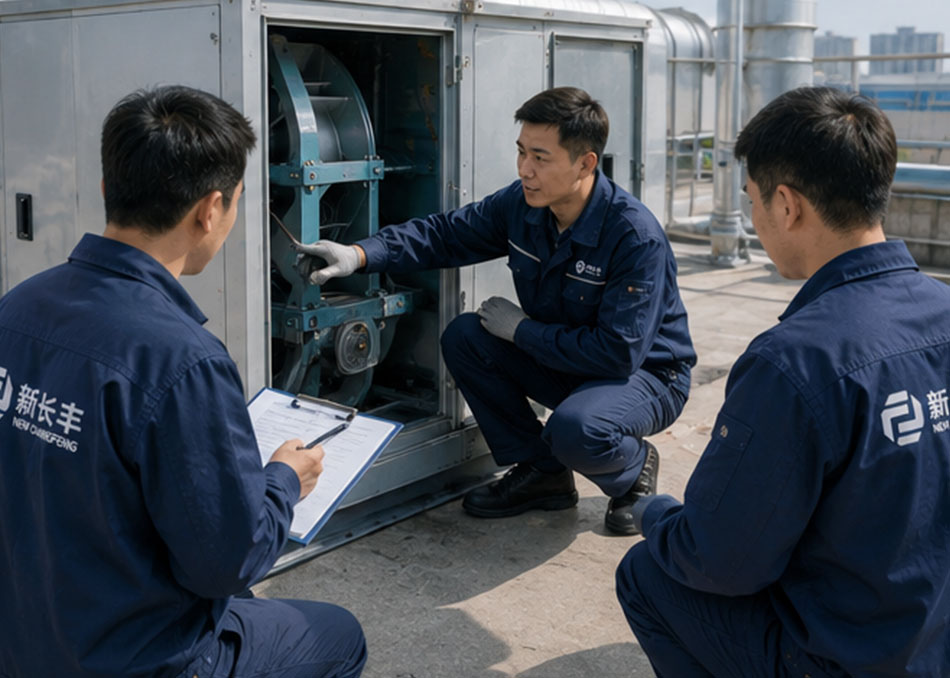
Summer heat in a commercial kitchen is one of the most persistent challenges for restaurant operators. Radiant heat from cooking ranges, humid steam from steamers and stock pots, and residual oil-mist heat from fryers stack up to push back-of-house temperatures well above both the dining area and outdoor ambient conditions. The problem gets worse when exhaust hoods and exhaust fans are added: exhaust airflow increases, but make-up air does not keep pace. The kitchen goes into negative pressure, producing symptoms such as doors that pull shut on their own, poor exhaust capture, oil fume spillage, and unstable burner flames. Truly solving kitchen heat requires more than simply increasing exhaust—it requires balancing the air. The water-cooled fresh air unit is designed specifically for restaurant kitchen make-up air. This article explains the principle, selection, installation, and maintenance considerations.
Why Exhaust Alone Makes the Kitchen Hotter: The Chain Reaction of Negative Pressure and Unbalanced Make-Up Air
According to the Technical Standard for Smoke Control and Exhaust Systems in Buildings (GB 51251) and general principles of commercial kitchen ventilation design, kitchen exhaust and make-up air should maintain a reasonable airflow balance. Exhaust hoods and fans remove oil fumes, water vapor, and heat, but if make-up air volume is insufficient, negative pressure forms inside the kitchen. The consequences go far beyond a stuffy feeling—they trigger a chain of operational problems.
First, exhaust efficiency drops. The stronger the negative pressure, the weaker the capture ability of the exhaust hood. Oil fumes easily escape from the cooking area into the entire back-of-house and even the dining area, degrading the dining environment and increasing the load on the oil fume purifier. Second, combustion conditions are affected. Gas ranges need sufficient air for combustion. Under negative pressure, combustion air is insufficient, which can lead to unstable flames, reduced thermal efficiency, and even safety risks. Third, the working environment deteriorates. Staff experience higher temperatures, higher humidity, and lingering odors, which reduces productivity and increases turnover. Fourth, air conditioning and refrigeration equipment must work harder to compensate for the heat and moisture drawn in through open doors and gaps.
In short, simply adding exhaust capacity without adding make-up air creates a vicious cycle: the more you exhaust, the harder the kitchen tries to pull in replacement air from any available opening—often hot, humid outdoor air or greasy kitchen air—which makes the kitchen even more uncomfortable and inefficient.
How a Water-Cooled Fresh Air Unit Works: Cooling and Make-Up Air in One Step
A water-cooled fresh air unit combines ventilation and cooling in a single packaged system. It draws in outdoor fresh air, passes it through a cooling coil that uses chilled water or a water-cooled heat exchange process, and then supplies the cooled fresh air directly into the kitchen. Because the unit is designed for make-up air, it can be interlocked with the kitchen exhaust system to maintain a slight negative pressure or balanced pressure, ensuring that exhaust hoods capture fumes effectively without starving the space of air.
The cooling process typically involves a fin-and-tube heat exchanger with water as the cooling medium. Depending on the model, the unit may include filtration stages to remove dust and airborne grease, a condensate drain to remove moisture, and a low-noise centrifugal fan to deliver air quietly. Unlike simple axial make-up air fans that only bring in hot outdoor air, a water-cooled fresh air unit reduces the temperature of the incoming air, which directly addresses the sensible heat load in the kitchen. This is especially important in summer, when outdoor air can be several degrees hotter than the desired indoor temperature.
Another key advantage is humidity control. Kitchen steam and cooking processes add substantial latent heat. A water-cooled coil removes moisture as air passes over the cold surface, reducing the muggy feeling that makes staff uncomfortable. By supplying cooler, drier air, the unit improves the working environment and helps maintain a more stable temperature gradient between the kitchen and dining areas.
Selecting the Right Water-Cooled Fresh Air Unit for Your Kitchen
Proper selection starts with a clear understanding of the kitchen's exhaust airflow and the required make-up air volume. In general, make-up air should be designed to replace a large portion of the exhausted air—often around 70% to 90% of exhaust volume—while allowing a slight negative pressure to prevent odors from migrating into the dining area. A qualified ventilation engineer should calculate the exhaust hood airflow, duct pressure losses, and the cooling load based on kitchen equipment and local climate.
When choosing a unit, consider the following factors:
- Cooling capacity: Match the unit's cooling output to the sensible and latent heat load of the make-up air under design summer conditions. Undersizing will leave the kitchen hot; oversizing wastes energy and may cause overcooling near supply diffusers.
- Airflow and static pressure: The unit must overcome the resistance of intake louvers, filters, coils, and supply ductwork. Refer to fan performance tested according to GB/T 1236 to ensure the selected model delivers the required airflow at the actual system static pressure.
- Energy efficiency: Check that the fan and cooling components meet relevant efficiency standards such as GB 19761 for fan energy efficiency. Higher-efficiency motors and optimized impellers reduce operating costs over the life of the equipment.
- Filtration and hygiene: Kitchen make-up air should be clean. Look for units with easily accessible filters and smooth, corrosion-resistant interior surfaces that resist grease buildup and simplify cleaning.
- Noise level: Since the unit supplies air directly into the kitchen, low noise is important. Centrifugal fan designs and proper vibration isolation help keep sound levels acceptable.
- Control and integration: The unit should be able to modulate airflow or cooling output in response to kitchen exhaust operation, occupancy, or temperature sensors. Variable-speed fans and modulating valves improve comfort and save energy.
It is also wise to consider the water source. Water-cooled units require a reliable supply of cooling water or a chilled water loop. In some cases, a dedicated chiller or cooling tower may be needed. If water availability or quality is a concern, discuss alternatives with the manufacturer, but for many commercial kitchens the water-cooled approach offers a good balance of cooling performance and compact equipment size.
Installation and Commissioning: Getting the Air Balance Right
Even the best equipment will underperform if it is not installed and commissioned correctly. The goal is to achieve a slight negative pressure in the kitchen relative to the dining area—typically in the range of a few pascals—so that odors do not escape, but not so negative that exhaust capture suffers or doors become difficult to open.
Key installation practices include:
- Locate the outdoor air intake away from exhaust discharge, grease-laden air, and vehicle traffic. Contaminated intake air will foul the cooling coil and filters quickly.
- Provide smooth, adequately sized ductwork. Sharp bends, abrupt transitions, and undersized ducts increase pressure loss and reduce airflow. Use turning vanes where needed and seal all joints.
- Distribute supply air where it is needed. Avoid blowing cold air directly onto cooking staff or into exhaust hoods, which can disrupt capture. Diffusers should promote mixing without creating drafts.
- Interlock controls. The make-up air unit should start before or with the exhaust system and continue running as long as exhaust is on. A variable-frequency drive can modulate supply airflow to match exhaust demand.
- Commission with measurements. After installation, measure exhaust airflow, supply airflow, and kitchen pressure differential. Adjust dampers and fan speeds to achieve the design balance. Document the results for future reference.
Commissioning is also the time to verify that the cooling water flow and temperature are within the manufacturer's specifications, and that condensate drains properly. A poorly draining unit can become a source of odors and water damage.
Maintenance and Operational Tips for Long-Term Performance
Water-cooled fresh air units are relatively low-maintenance, but regular attention keeps them efficient and hygienic. Establish a maintenance schedule that includes:
- Filter cleaning or replacement: Check filters monthly or more often in greasy environments. Clogged filters reduce airflow and cooling capacity.
- Coil cleaning: Inspect the cooling coil periodically. Kitchen air can carry grease particles that coat fins and reduce heat transfer. Clean according to the manufacturer's instructions using approved coil cleaners.
- Condensate management: Ensure the drain pan and trap are clean and free-flowing. Algae and debris can cause blockages and water overflow.
- Fan and motor inspection: Check belts, bearings, and electrical connections. Listen for unusual noise or vibration that may indicate imbalance or wear.
- Water system checks: Verify cooling water flow, temperature, and quality. Treat water as needed to prevent scale and corrosion in the coil and piping.
- Control calibration: Confirm that temperature and pressure sensors are accurate and that control sequences still match kitchen operations.
Operationally, train staff to keep exhaust hoods and make-up air diffusers unobstructed. Do not block supply air paths with boxes or equipment. During mild weather, the cooling function may be reduced or bypassed to save energy, but make-up air should still be provided to maintain balance.
Frequently Asked Questions
Q: Can I just use an open window or a simple supply fan instead of a water-cooled fresh air unit?
A: An open window or basic supply fan can provide make-up air, but it does not cool or dehumidify the air. In summer, that means hot, humid outdoor air is drawn into the kitchen, which can make the space feel even worse and increase the load on any air conditioning. A water-cooled fresh air unit cools and dehumidifies the make-up air before it enters, directly improving comfort and helping to control kitchen temperature.
Q: How do I know what size water-cooled fresh air unit my kitchen needs?
A: Sizing depends on the exhaust airflow, the desired pressure balance, and the cooling load of the outdoor air. A ventilation engineer should calculate the make-up air volume—typically a large fraction of the exhaust volume—and then determine the cooling capacity needed to bring that air to a comfortable supply temperature under design summer conditions. Manufacturer selection software or technical support can help match the unit to your specific project.
Q: Will a water-cooled fresh air unit eliminate the need for exhaust hoods?
A: No. Exhaust hoods and fans are still essential for capturing and removing oil fumes, steam, and heat at the source. The water-cooled fresh air unit complements the exhaust system by providing cooled make-up air, which improves exhaust capture and prevents negative pressure problems. Both are necessary for a well-functioning kitchen ventilation system.
Q: What about oil fume purification? Does the make-up air unit affect it?
A: Proper make-up air actually helps oil fume purification. When the kitchen is under excessive negative pressure, oil fumes can escape the hood and bypass the purifier, leading to grease buildup in ducts and complaints from neighbors. By balancing pressure, the make-up air unit helps ensure that fumes are captured and directed through the purifier as designed. The purifier itself should still be selected and maintained according to relevant standards such as GB 18483 for kitchen fume emission.
Q: Is a water-cooled fresh air unit suitable for all climates?
A: Water-cooled units are most beneficial in hot and humid climates where cooling and dehumidification are needed. In milder or drier climates, the cooling requirement may be lower, and a simpler make-up air unit might suffice. However, even in milder climates, providing tempered make-up air can improve comfort and exhaust performance. The choice depends on the specific climate, kitchen load, and budget.
Conclusion
Solving kitchen heat is not just about adding more exhaust—it is about restoring air balance. Negative pressure caused by unbalanced make-up air leads to poor exhaust capture, oil fume spillage, unstable combustion, and an uncomfortable working environment. A water-cooled fresh air unit addresses the root cause by supplying cooled, dehumidified make-up air that works in harmony with the exhaust system. By selecting the right unit, installing it correctly, and maintaining it regularly, restaurant operators can achieve a cooler, safer, and more efficient back-of-house.
For more information on water-cooled fresh air units and other commercial ventilation solutions, visit www.xcffj.com or contact our technical team. We help restaurants, hotels, school canteens, and food service facilities design ventilation systems that work.