
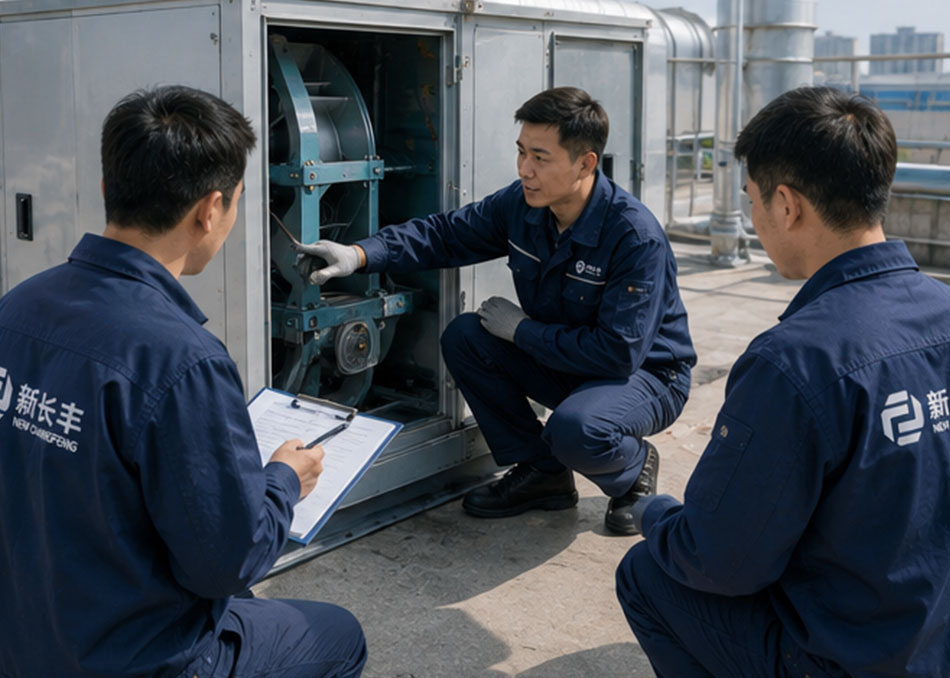
In commercial kitchens, the focus is often overwhelmingly on exhaust—hoods, purifiers, and fans are added in series, yet the kitchen still feels stuffy, flames burn yellow, staff sweat, and grease escapes into the dining area. The root cause frequently lies not in the exhaust system itself but in the lack of balanced make-up air. This article explores how water-cooled fresh air units address negative pressure and improve ventilation in commercial kitchen make-up air applications.
The Make-Up Air Problem: Why Kitchens Get Stuffy Despite Strong Exhaust
Kitchen exhaust systems work by creating negative pressure to draw out grease-laden air, heat, and moisture. However, air is conserved: the volume extracted must be replaced. If outdoor air infiltrates only through gaps around doors and windows, the supply is insufficient to balance the exhaust volume. The resulting excessive negative pressure forces exhaust fans to operate under resistance, reducing actual airflow and causing grease and heat to linger near cooking surfaces.
In summer, unconditioned make-up air worsens the problem—drawing in hot outdoor air raises indoor temperatures and defeats both cooling and exhaust goals. Many operators overlook this balance, investing in larger exhaust fans without addressing the supply side. The consequence is a kitchen that feels increasingly oppressive, with energy wasted on overworked fans and compromised indoor air quality.
How Water-Cooled Fresh Air Units Work and Why They Suit Kitchens
Water-cooled fresh air units are evaporative cooling supply devices. They draw in outdoor fresh air and pass it through a wet cooling pad or spray system, where water evaporates and absorbs heat, lowering the air temperature before it is delivered indoors. Unlike simple fans, these units provide filtered, cooled, and humidified air, improving both thermal comfort and air quality.
In kitchen make-up air applications, the unit serves three critical functions: balancing exhaust volume, reducing supply air temperature, and organizing airflow to avoid drafts or interference with cooking. By supplying cooled fresh air directly to the kitchen, it relieves negative pressure, allowing exhaust fans to operate at their designed performance. The evaporative cooling process is energy-efficient compared to refrigerated air conditioning, making it a practical choice for hot, high-demand kitchen environments.
Selection should consider the exhaust airflow rate, kitchen layout, and local climate. While specific performance figures depend on the model and conditions, the principle remains: match make-up air volume to exhaust volume, and ensure the supply air is distributed to avoid stagnant zones. Compliance with ventilation standards such as GB 51251 for smoke control and GB 18483 for kitchen fume emission provides a framework for design.
Key Benefits for Commercial Kitchen Ventilation
- Balanced pressure: Prevents excessive negative pressure, improving exhaust efficiency and reducing grease spillover.
- Temperature reduction: Evaporative cooling lowers supply air temperature, enhancing staff comfort in hot kitchens.
- Energy savings: Lower power consumption compared to refrigerated make-up air systems.
- Improved air quality: Filtration and humidification contribute to a healthier work environment.
- Compliance support: Helps meet ventilation and exhaust standards by ensuring proper air balance.
Application Considerations and Best Practices
Successful implementation requires a holistic approach. First, calculate the exhaust airflow accurately and design make-up air volume accordingly—typically 80–90% of exhaust volume to maintain slight negative pressure and prevent odor migration. Second, position supply air outlets to avoid blowing directly on cooking surfaces or staff, and to promote mixing without disrupting hood capture.
Regular maintenance is essential: keep cooling pads clean, check water quality, and inspect fans and filters. In areas with hard water, water treatment may be necessary to prevent scale buildup. Partnering with experienced ventilation engineers ensures the system is sized and integrated correctly, avoiding common pitfalls like undersized ductwork or improper control sequences.
FAQ
Q: Can a water-cooled fresh air unit replace a kitchen exhaust system?
A: No. It is a make-up air solution designed to complement the exhaust system. It balances pressure and cools supply air but does not remove grease or odors. A complete system requires both exhaust and make-up air components.
Q: How does evaporative cooling perform in humid climates?
A: Evaporative cooling efficiency decreases in high humidity. In such climates, consider a hybrid approach or consult with a ventilation specialist to evaluate alternatives or supplementary cooling.
Q: What maintenance does a water-cooled fresh air unit require?
A: Regular cleaning of cooling pads, water tank, and filters; checking water levels and quality; and inspecting fans and pumps. Frequency depends on usage and water conditions, but routine monthly checks are recommended.
Q: Is it suitable for small kitchens?
A: Yes, units are available in various capacities. Proper sizing based on exhaust volume and kitchen layout is key. Small kitchens can benefit from compact models that provide necessary make-up air without overloading space.
In summary, water-cooled fresh air units offer an effective solution for commercial kitchen make-up air, addressing negative pressure, heat, and air quality simultaneously. By integrating them into a balanced ventilation design, operators can achieve better exhaust performance, improved comfort, and energy savings. For tailored advice on selecting the right unit for your kitchen, consult with XCFFJ's ventilation experts.