
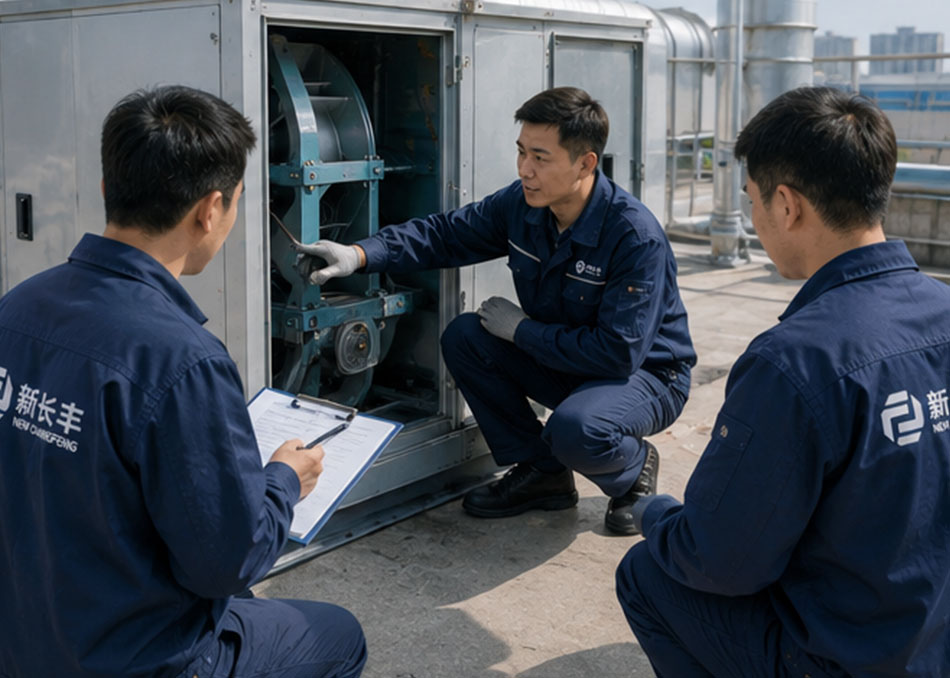
School cafeteria kitchens are not simply larger versions of restaurant kitchens. They serve hundreds or thousands of meals within narrow serving windows, place rows of woks and cooking stations side by side, and often sit directly beside classrooms or dormitories. When exhaust performance falls short, the consequences arrive together: cooking fumes drift into dining areas, noise complaints reach the administrative office, and insufficient make-up air starves the hoods of capture velocity. Across many school projects, the cabinet centrifugal fan has become a mainstream choice for kitchen exhaust purification and ventilation make-up air because of its compact enclosure, strong pressure reserve, and relatively stable operation. Yet climate, building layout, and local environmental requirements vary widely from region to region, so fan selection cannot follow a single template.
Start With the Three Operating Conditions Unique to School Cafeterias
Before comparing models, the actual working conditions must be understood. A fan that performs well in one cafeteria may struggle in another if the application profile is ignored.
Concentrated meal periods. Breakfast, lunch, and dinner peaks are sharp and predictable. The exhaust system must carry a heavy load within a short time window, while long periods of low-load operation are comparatively rare. This duty cycle places demand on motor starting capability, bearing stability, and the fan's ability to hold performance as ductwork heats up.
Dense cooking stations and high fume volume. Multiple woks operating simultaneously generate cooking fumes quickly. The exhaust system must respond fast enough to maintain capture at the hood face, and duct velocities must stay high enough to prevent grease and vapor from settling inside the duct run. This is where a fan with adequate static pressure reserve matters more than nominal airflow alone.
Sensitivity to noise. Cafeterias are frequently adjacent to teaching buildings and dormitories. If fan noise is not controlled, complaints follow quickly. Quiet cabinet centrifugal fan configurations are therefore preferred, especially when the equipment room shares a wall with occupied spaces.
In addition, school cafeterias are usually managed by a logistics or engineering department rather than a dedicated kitchen operator. Equipment must be easy to clean, inspect, and service. Initial price is only one factor; long-term reliability and maintenance cost often decide whether a system remains acceptable after several years of daily use.
Key Parameters When Selecting a Cabinet Centrifugal Fan
Cabinet centrifugal fans combine a centrifugal impeller with an enclosed cabinet structure. Air enters through the cabinet inlet, is accelerated by the impeller, and is discharged through a defined outlet. This design offers useful pressure development for ducted exhaust systems while keeping noise contained within the enclosure. For school cafeteria exhaust, the following parameters deserve close attention.
- Airflow and static pressure matching. The fan must be selected against the actual system resistance curve, including hood, duct, elbow, grease filter, and discharge termination losses. A fan chosen only on free-air airflow will underperform once installed. Performance should be verified according to GB/T 1236, which governs fan aerodynamic performance testing.
- Energy efficiency. GB 19761 sets fan energy efficiency grades. Selecting a model with a higher efficiency grade reduces power consumption during the long hours the cafeteria operates, and supports broader building energy targets.
- Noise characteristics. Sound power level, not just sound pressure at one point, should be requested from the supplier. Cabinet construction, impeller balance quality, and vibration isolation all influence perceived noise in nearby classrooms.
- Grease and fume resistance. In kitchen exhaust service, the fan handles air that may still carry grease mist after the hood filters. Materials, coating, and drainage provisions should suit this environment. Where local rules require fume purification, the fan should be coordinated with an electrostatic fume purifier or equivalent device so that the complete system meets GB 18483 kitchen fume emission limits.
- Make-up air balance. Exhaust alone is not enough. Without adequate make-up air, the kitchen develops negative pressure, doors become hard to open, and hood capture efficiency drops. A dedicated make-up air unit, or a balanced supply-exhaust design, keeps the system stable.
It is also worth confirming how the fan interacts with the building's fire safety strategy. Where the exhaust duct passes through or serves areas covered by smoke control requirements, coordination with GB 51251 smoke and heat exhaust provisions may be necessary, even though kitchen exhaust and smoke exhaust serve different purposes.
Why Regional Differences Change the Selection Approach
A fan specified for a school in a cold northern region may not be the right choice for a humid southern coastal city. Climate affects both the equipment and the building envelope.
In colder regions, make-up air may need tempering to avoid cold drafts in the dining area and to prevent grease from congealing inside ductwork. In hot and humid regions, moisture management and corrosion resistance become more important, and evaporative cooling or water-cooled fresh air approaches may be considered for make-up air. In regions with stricter environmental enforcement, the exhaust system may require a higher-performance fume purification stage, which in turn changes the fan's pressure requirements.
Building layout matters just as much. A single-story cafeteria with a short horizontal duct run presents a very different resistance profile from a multi-story facility where the exhaust must travel vertically through several floors. Roof-mounted discharge, indoor equipment rooms, and long duct runs each impose their own constraints on fan type, pressure, and noise treatment.
Practical Selection and Installation Checklist
The following checklist helps engineering and logistics teams organize the selection process and avoid common mistakes.
- Confirm the number and type of cooking stations, and estimate simultaneous operation rather than assuming all stations run at once.
- Map the full duct route, including elbows, transitions, grease filters, and discharge location, then calculate system resistance.
- Match fan airflow and static pressure to that resistance with a reasonable margin, avoiding both undersizing and excessive oversizing.
- Check the fan's energy efficiency grade under GB 19761 and compare expected operating power.
- Review noise data and plan vibration isolation, flexible connections, and, if needed, acoustic treatment.
- Confirm that the fume purification stage is sized to meet GB 18483 and that the fan is compatible with it.
- Plan make-up air supply to balance exhaust and maintain comfortable, safe kitchen conditions.
- Verify service access for cleaning the impeller, cabinet, and drainage points.
- Confirm electrical supply, control interface, and any interlock with fire or gas safety systems.
For schools that operate multiple cafeterias or plan phased renovations, standardizing on a proven cabinet centrifugal fan platform can simplify spare parts, maintenance training, and future expansion.
Frequently Asked Questions
Q: Can a cabinet centrifugal fan handle both kitchen exhaust and make-up air?
A: The fan type can serve either role, but the two duties have different requirements. Exhaust air may carry grease and moisture, so materials and cleaning access must suit that environment. Make-up air should be filtered and, in many climates, tempered before entering the dining or kitchen space. In practice, separate units are often selected for each duty so that airflow can be balanced independently.
Q: How do I know whether the fan's pressure is sufficient for my duct run?
A: Pressure must be calculated from the complete system, not estimated from duct length alone. Hood entry losses, grease filters, elbows, transitions, and the discharge termination all contribute. A qualified engineer should prepare a system resistance calculation and select the fan against that curve, with performance verified according to GB/T 1236.
Q: What about noise complaints from nearby classrooms?
A: Address noise at three levels: select a fan with favorable sound power data, isolate vibration through proper mounting and flexible duct connections, and, where needed, add acoustic treatment to the equipment room or duct path. Locating the fan away from sensitive walls and avoiding sharp duct transitions also helps.
Q: Does the fan alone satisfy kitchen fume emission rules?
A: No. The fan moves air; it does not purify it. Where local regulations apply, an electrostatic fume purifier or equivalent device is typically required to meet GB 18483 emission limits. The fan must be selected to handle the additional pressure loss introduced by that purification stage.
Q: How often should a cafeteria exhaust fan be maintained?
A: Grease accumulation is the main risk in kitchen exhaust service. Inspection frequency depends on cooking volume, but routine checks of the impeller, cabinet interior, drainage, belts where applicable, and vibration levels should be part of the cafeteria's maintenance schedule. Cleaning intervals should be shortened during peak academic terms if cooking loads are high.
Summary
Selecting a cabinet centrifugal fan for a school cafeteria is a system decision, not a catalog decision. The concentrated meal peaks, dense cooking stations, and proximity to classrooms and dormitories create a demanding combination that rewards careful attention to airflow, pressure, efficiency, noise, and purification coordination. Regional climate and building layout further shape the right choice. By working from the actual duty profile and verifying performance against recognized standards such as GB/T 1236, GB 19761, GB 18483, and GB 51251, schools can build exhaust and make-up air systems that stay effective, quiet, and maintainable over years of daily service.
XCFFJ manufactures cabinet centrifugal fans, DT cabinet centrifugal fans, multi-wing centrifugal fans, negative pressure fans, water-cooled fresh air units, commercial kitchen air conditioners, kitchen exhaust purifiers, evaporative air coolers, KTJ silent fresh air cabinets, roof turbo ventilators, and axial fans for factory ventilation, commercial kitchen exhaust purification, school canteens, hotels, and warehouse logistics. To discuss a cafeteria exhaust or make-up air project, visit www.xcffj.com or contact our engineering team for selection support.