
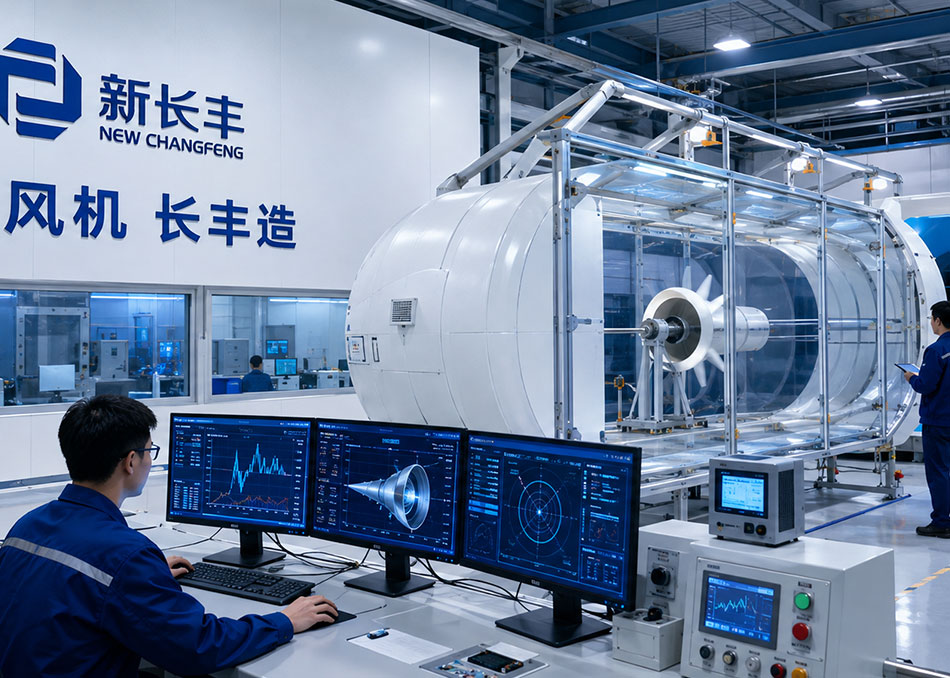
Foshan is one of the Pearl River Delta's densest manufacturing hubs, home to ceramics, metalworking, furniture, injection molding, and hardware workshops. Summers here combine high heat with high humidity, and it is common to find workshops where cooking fumes, oil mist, and dust all share the same air. When it comes time to upgrade ventilation, many factory managers and commercial kitchen operators reach for the simplest answer: install a few axial fans and be done with it. The result is often insufficient airflow, short-circuited air paths, noise complaints from neighbors, and fume backdraft into the workspace.
Axial fans look simple, but proper selection involves airflow matching, static pressure verification, installation positioning, energy efficiency, and noise control. This article focuses on the core application of fume exhaust purification and ventilation makeup air, and walks through a practical selection framework for axial fans used in ventilation and air exchange across Foshan's factories, commercial kitchens, and warehouse facilities.
Start With Demand: Air Change Rate and Airflow Organization
The core job of an axial fan is to push heat, moisture, smoke, and dust out of the space while drawing fresh outdoor air in. The first step in selection is not choosing a fan model — it is determining how much air exchange the space actually needs. Industrial workshops are typically estimated by air changes per hour (ACH), with higher rates required for spaces with heat, odors, or dust. Commercial kitchens need to factor in the number of cooking stations, the size of the exhaust hood, and the makeup air ratio. Get the air volume wrong and both oversized and undersized fans cause problems: too small and fumes linger; too large and energy consumption and noise rise, while kitchen negative pressure balance can be disrupted.
Airflow organization matters just as much. Axial fans are well suited to wall-mounted, window-mounted, or duct-end installations for direct supply or exhaust. Exhaust and makeup air openings should be staggered so that fresh air is not immediately pulled out again — a short-circuit that wastes energy and leaves the workspace stagnant. In workshops with high ceilings and localized heat sources, spot exhaust near the source combined with general dilution ventilation is usually more effective than relying on a single large fan.
- Estimate required air volume from room volume and target air changes per hour
- Account for heat load, moisture, and contaminant generation when setting the rate
- Separate exhaust and makeup air paths to avoid short-circuiting
- For kitchens, balance exhaust hood airflow with a defined makeup air ratio
Match Static Pressure and Airflow: Axial Fans Have Limits
Axial fans move air along the axis of the impeller, which makes them efficient for high-volume, low-to-medium pressure applications such as wall exhaust and general ventilation. Their performance curve is relatively steep: as system resistance rises — from long ducts, bends, louvers, or filters — airflow drops quickly. This is why a fan that performs well on a bare wall opening may underperform once connected to a duct run or a fume purification unit. Selection should be based on the actual system resistance, not the free-air rating alone.
Fan performance should be verified against recognized testing standards such as GB/T 1236 for aerodynamic performance, and energy efficiency should be evaluated in line with GB 19761. For installations that include fume purification or smoke exhaust functions, the design must also respect GB 51251 for smoke and heat exhaust ventilation, and kitchen fume discharge should comply with GB 18483. Where ductwork is long or includes purification stages, a centrifugal fan — such as a cabinet centrifugal or multi-wing centrifugal model — may be the better choice because its higher static pressure capability holds airflow more steadily against resistance.
- Calculate system resistance including ducts, elbows, louvers, and filters
- Select the fan at its operating point, not its free-air maximum
- Use axial fans for direct exhaust and short duct runs; consider centrifugal fans for high-resistance systems
- Confirm efficiency and smoke exhaust compliance for the intended duty
Control Noise and Neighbor Impact
Noise is one of the most common complaints after an axial fan installation, particularly in dense industrial areas where workshops sit close to residential buildings. Axial fans generate aerodynamic noise that increases with blade tip speed and airflow velocity. Selecting a larger fan running at lower speed is often quieter than a smaller fan pushed to its limit for the same air volume. Mounting position, vibration isolation, and avoiding turbulent inlet conditions all affect actual noise at the property boundary.
For kitchen exhaust, noise control and fume purification should be designed together. A purification unit adds resistance to the system, which changes the fan's operating point and can increase noise if the fan is not re-selected for the new duty. Louvers and weather hoods on exterior walls also add resistance and should be included in the pressure calculation from the start.
- Prefer lower-speed, larger-diameter fans for the same air volume where space allows
- Use vibration isolation mounts and flexible connections at the fan
- Keep inlet airflow smooth to reduce turbulence noise
- Re-check fan selection after adding purification or filtration equipment
Choose the Right Fan Type for the Application
Axial fans are the workhorse for general ventilation and air exchange: wall-mounted exhaust in workshops, warehouse ventilation, and makeup air supply. For commercial kitchen exhaust that must pass through purification stages, the higher pressure capability of centrifugal fans is often needed, and electrostatic fume purification units should be matched to the fan's airflow and pressure characteristics. Evaporative air coolers can provide tempered makeup air in hot workshops, but they should be integrated with the exhaust strategy rather than treated as a standalone fix.
For large-span spaces such as warehouse logistics facilities, roof turbo ventilators and axial fans can work together: turbo ventilators handle buoyancy-driven exhaust at the roof, while axial fans provide targeted supply or exhaust at the walls. The key is a coherent air path from intake to exhaust, with each fan selected for its specific duty rather than copied from a previous project.
- Axial fans: general exhaust, wall and window ventilation, makeup air
- Cabinet and multi-wing centrifugal fans: ducted systems with higher resistance
- Electrostatic purifiers: kitchen fume treatment ahead of discharge
- Roof turbo ventilators: buoyancy-driven exhaust for large-span spaces
Frequently Asked Questions
Q: Can I just replace an old axial fan with a larger model to fix poor exhaust?
A: Not necessarily. If the underlying issue is system resistance from ducts, louvers, or purification equipment, a larger axial fan may simply operate further off its best point, increasing noise and energy use without solving the problem. Start by measuring actual airflow and checking the pressure budget of the system, then re-select the fan type and size for the real duty.
Q: How do I stop cooking fumes from flowing back into the kitchen?
A: Backdraft usually indicates an imbalance between exhaust and makeup air, or insufficient static pressure at the hood. Ensure the exhaust fan is selected for the full resistance of the hood, duct, and purification unit, provide a defined makeup air path, and use backdraft dampers where appropriate. Compliance with GB 18483 for fume discharge should be confirmed as part of the design.
Q: Are axial fans suitable for kitchen exhaust purification systems?
A: Axial fans can handle short, low-resistance exhaust runs, but purification units add significant resistance. In most commercial kitchen applications, a centrifugal fan with higher static pressure capability is the more reliable choice. The fan must be matched to the airflow and pressure characteristics of the purification equipment.
Q: What standards should I reference when specifying fans?
A: GB/T 1236 covers fan aerodynamic performance testing, GB 19761 addresses fan energy efficiency, GB 51251 applies to smoke and heat exhaust ventilation design, and GB 18483 governs kitchen fume emission. Referencing these standards helps ensure the selected equipment performs as expected and meets regulatory requirements.
Summary
Selecting axial fans for ventilation and air exchange in Foshan's factories and commercial kitchens is not a matter of picking a model number off a list. It starts with an honest calculation of air change demand and airflow organization, continues through static pressure matching and noise control, and ends with a fan type chosen for the actual system resistance. When fume purification and makeup air are part of the picture, the fan and the purification stage must be designed as one system.
XCFFJ manufactures axial fans, cabinet and multi-wing centrifugal fans, negative pressure fans, electrostatic kitchen fume purifiers, evaporative air coolers, and roof turbo ventilators for factory ventilation, commercial kitchen exhaust, school canteens, hotels, and warehouse logistics. To discuss a ventilation or fume purification project, visit www.xcffj.com or contact our engineering team with your space details and exhaust requirements.