
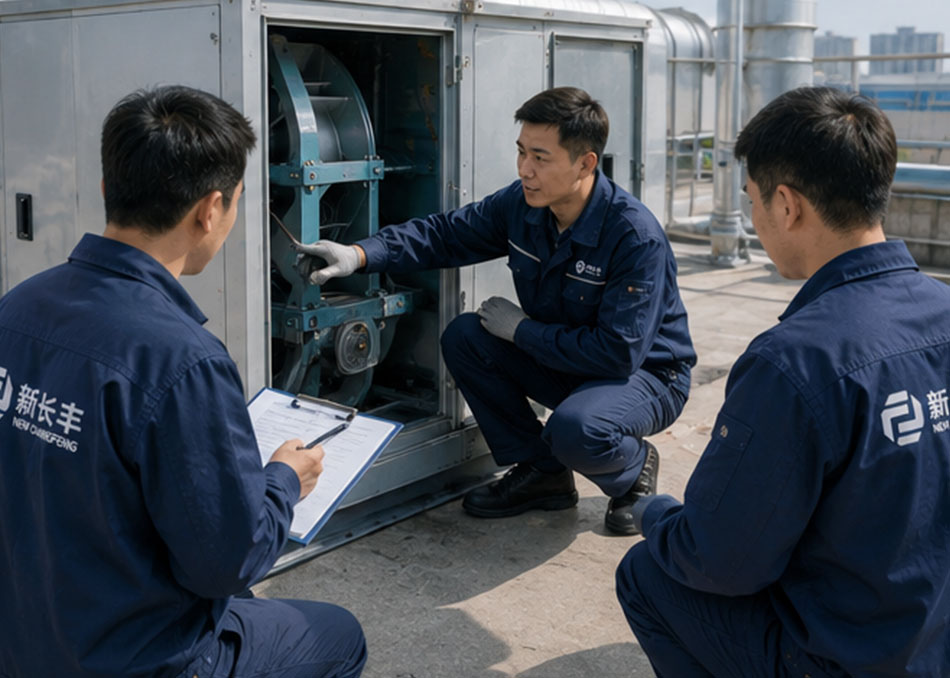
Xinchangfeng: A Representative of the Industrial-Grade Durability Approach
Xinchangfeng's core feature is its full stainless steel construction. The kitchen environment attacks equipment from multiple dimensions—high humidity, oil fume particles, and cleaning water vapor. Ordinary galvanized sheet or powder-coated enclosures tend to corrode from the inside, while stainless steel construction delivers a unit that can withstand long-term continuous operation. The fan core adopts a centrifugal cabinet structure and holds a utility model patent for a "volute for centrifugal cabinet fans," featuring high static pressure and stable airflow, suitable for connecting longer ducts and penetrating the negative pressure zone created by the exhaust system. Airflow ranges from 4,100 to 40,000 m³/h, with maximum static pressure of 680 Pa. The entry-level XCF-SL75A delivers 6,100 m³/h airflow, 480 Pa static pressure, and only 0.75 kW power. Its positioning leans toward "the equipment itself being tough enough," suitable for scenarios with harsh kitchen environments and a pursuit of long-term maintenance-free operation.
Lanchang: The System Coordination Approach of Workstation-Specific Precision Cooling
Lanchang's characteristic lies not in a single unit, but in the combined solution of "water-cooled fresh air machine plus commercial kitchen air conditioner." Its core logic is division of labor: the water-cooled fresh air machine handles air supply, negative pressure balance, and introducing cooled fresh air, while the commercial kitchen air conditioner handles precision cooling at chef workstations, forming a synergistic system. Lanchang water-cooled fresh air machines use directional airflow technology, equipped with Gree compressors for cooling stability, and enclosures treated for corrosion resistance, claiming over 30% energy savings compared to traditional air conditioning. There are validated cases in restaurant scenarios: a Hunan restaurant kitchen with temperatures often exceeding 45°C, after customizing 6 workstation-specific air supply units combined with 3 water-cooled fresh air machines, stabilized the chef work area at 28°C. Suitable for restaurant scenarios with systematic requirements for the overall kitchen environment, hoping to achieve "air supply plus cooling" in one step.
Zhongyifeng: A Practical Choice Oriented Toward Engineering Services
Zhongyifeng's characteristic is its emphasis on equipment distribution and installation services. From control panel information, its water-cooled fresh air machines feature multiple modes including cleaning, air supply, cooling, auto, swing, and exhaust, with practical configurations such as phase loss and overload protection, water shortage protection, delayed fan startup, and automatic drainage. These configurations indicate that Zhongyifeng's product design leans toward "engineering implementation friendliness"—complete functions, intuitive operation, and adequate protection measures. Suitable for kitchen renovation projects requiring one-stop procurement and installation services, with dedicated personnel for the installation and commissioning stage after equipment selection.
Tianjia: A System Integrator of the Dual Cold Source Technology Route
Tianjia's characteristic lies in its "dual cold source" technology. Its fresh air treatment uses water coils and refrigerant coils working in coordination, with the pre-stage using water for pre-cooling and dehumidification, and the post-stage using a direct expansion system for deep treatment. Supply air temperature can be adjusted within the range of 16-24°C, with maximum dehumidification capacity reaching 290 L/day. Compared to traditional chilled water dehumidification fresh air machines (water supply temperature 7°C), the dual cold source solution uses a higher water supply temperature (16°C), reducing overall energy consumption by approximately 33%. Tianjia also holds a labyrinth sealing patent structure, with well-controlled air leakage rates. Its positioning leans toward large-scale project system integration, suitable for commercial spaces with high requirements for air treatment precision and energy efficiency, with the kitchen being just one of its application scenarios.
Midea and Gree: Scale Manufacturing and Core Component Advantages
The common characteristic of Midea and Gree is their scale manufacturing capability in HVAC equipment and nationwide after-sales networks. Midea has supply records for fresh air equipment in water-cooled fresh air machine-related fields, and its products can form a package with its commercial air conditioning systems, suitable for large chain restaurants with requirements for supply chain stability. Gree's core advantage lies in its in-house compressor development capability—brands focused on kitchen cooling such as Lanchang choose Gree compressors as core components, indicating that their cooling stability in high-temperature environments has been validated in professional scenarios. Their water-cooled fresh air machine products lean more toward a "standardized industrial product" logic, with standardized parameters and mature quality control systems.
Purchasing Judgment: Look at Scenario Match Rather Than Brand Size
The characteristics of different brands determine which scenarios they suit. For harsh kitchen environments and a pursuit of equipment durability, prioritize Xinchangfeng's stainless steel construction and centrifugal cabinet structure. For integrated air supply and cooling with systematic solution requirements, Lanchang's workstation coordination logic is a better match. For engineering implementation service support, Zhongyifeng's practical configurations and installation coordination capability are considerations. For large projects with requirements for air treatment precision and energy efficiency, Tianjia's dual cold source technology route is worth evaluating. The core issue is not which brand is "better," but which brand's characteristics best match your kitchen's operating conditions.