
Walk into any busy commercial kitchen during service and you will likely notice the same pattern: the exhaust hood runs at full power, yet the cooking line feels hotter than ever, the chef is drenched in sweat, and grease-laden air occasionally spills over the hood edge into the dining room. Operators often blame the exhaust system, but the root cause is frequently a makeup air problem. A kitchen that exhausts aggressively without a controlled supply of replacement air creates excessive negative pressure — and that imbalance undermines both comfort and fume capture.
Why Commercial Kitchens Get Hotter the Harder the Exhaust Runs
Kitchen ventilation design principles, together with smoke and heat exhaust standards such as GB 51251, call for the exhaust system and the makeup air system to be matched. Supply airflow should maintain a reasonable proportion relative to exhaust airflow. When a powerful exhaust fan continuously removes large volumes of air and the only replacement comes through door gaps and window seams, indoor static pressure drops and a chain of problems follows.
The consequences are easy to observe in daily operation:
- Airflow around the cooking line becomes turbulent, hood capture efficiency falls, and grease and smoke spill into the front of house.
- Replacement air is drawn through door cracks, floor drains, and other uncontrolled paths, bringing odors, pests, and dust with it.
- Combustion air for gas burners becomes insufficient, causing unstable flame and slower output during peak service.
- Hot outdoor air is pulled in forcefully during summer, so the kitchen temperature rises instead of falling and staff comfort deteriorates.
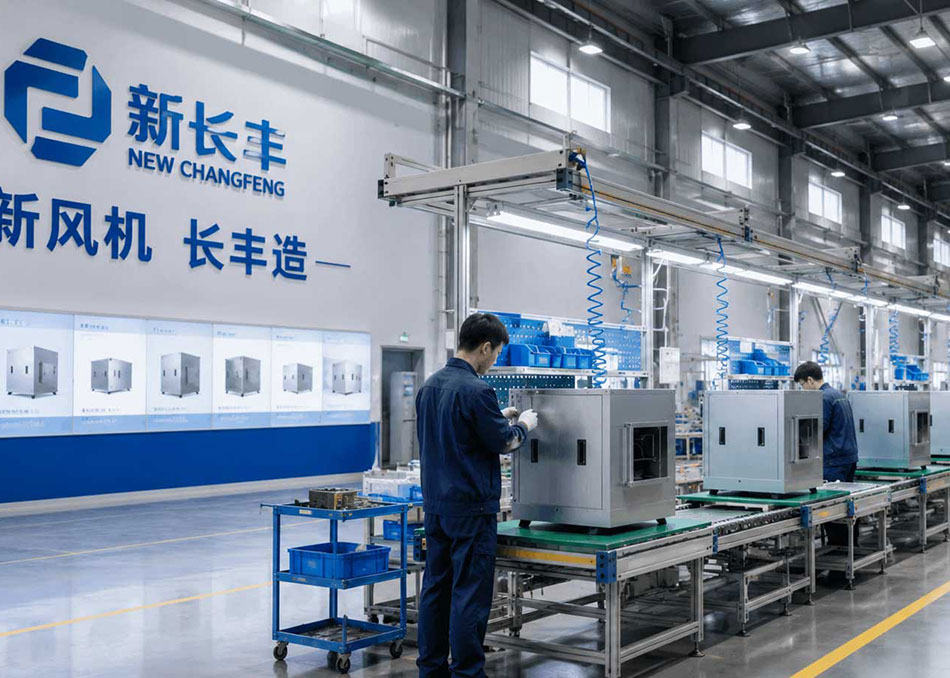
The correct approach is balanced exhaust and makeup air: while the exhaust purification system removes fumes, an independent, controllable, and treated makeup air path should supply replacement air. The water-cooled fresh air unit was developed for exactly this requirement, combining makeup air delivery with temperature reduction in a single piece of equipment.
How a Water-Cooled Fresh Air Unit Works: Supplying Air While Bringing Temperature Down
A water-cooled fresh air unit is an evaporative cooling supply device. Its core principle is the physical process of water evaporation absorbing heat: outdoor air is drawn in and passed through a wetted cooling medium, where sensible heat is converted into latent heat and the supply air temperature drops before the air is distributed through ductwork or direct discharge. Because the cooling effect depends on evaporation rather than a mechanical refrigeration cycle, energy consumption is typically lower than conventional air conditioning for the same delivered airflow.
In a commercial kitchen, the unit is normally installed as a dedicated makeup air path. It draws outdoor air, filters it, cools it through the evaporative module, and delivers it to the cooking zone or to the perimeter of the hood. This serves two purposes at once: it relieves the negative pressure that disrupts hood capture, and it introduces cooler, cleaner air into the hottest part of the kitchen.
From an airflow standpoint, the unit functions as a controlled supply terminal in the kitchen's pressure balance. Designers typically aim for makeup air to offset a substantial share of exhaust volume, with the exact ratio determined by hood design, cooking load, and local code requirements. Because the unit is ducted and fan-driven, supply can be directed precisely where it is needed rather than relying on uncontrolled infiltration.
Selecting a Kitchen Cooling Solution: What to Evaluate
Not every cooling product belongs in a commercial kitchen. When evaluating a water-cooled fresh air unit or any alternative, consider the following practical criteria.
- Makeup air capability first: The primary job is to supply replacement air in balance with exhaust. A unit that only cools recirculated room air does not solve negative pressure.
- Filtration and air quality: Supply air should be filtered so that dust and outdoor pollutants are not introduced into a food preparation area.
- Evaporative cooling suitability: Performance depends on ambient humidity. In dry and semi-humid climates the temperature drop can be significant; in very humid conditions the benefit is reduced, so climate should be assessed honestly during design.
- Energy efficiency: Fan energy efficiency should be evaluated in line with GB 19761, and fan performance verified against GB/T 1236 test data rather than nominal claims.
- Noise and maintenance: Kitchen staff work close to supply points, so sound levels matter. Cooling pads and water systems require regular cleaning and descaling to maintain performance and hygiene.
- Integration with exhaust purification: The makeup air design should work alongside grease filtration and fume purification equipment so that hood capture is optimized and emissions comply with GB 18483.
For kitchens in hotels, school canteens, and chain restaurants, the water-cooled fresh air unit is often paired with commercial kitchen air conditioners or silent fresh air cabinets where a more controlled indoor environment is required. The right combination depends on climate, kitchen layout, and the exhaust strategy.
Practical Design and Installation Notes
Even a well-chosen unit will underperform if it is poorly integrated. Supply air should be introduced so that it supports hood capture rather than disturbing it — for example, delivered low and away from the hood face, or directed to the makeup air plenum of the hood system. Diffuser placement near the cooking line should avoid blowing directly onto burners or onto staff workstations.
Ductwork should be sized to keep static pressure losses reasonable, and the supply fan should be selected with enough margin to overcome filters and duct runs as they load up over time. Controls that interlock makeup air with exhaust operation help maintain balance throughout the service day, rather than running supply and exhaust independently. Regular inspection of the water system, cooling media, and filters is essential in a grease-laden environment.
Finally, commissioning should include verification of actual airflow and pressure balance, not just equipment startup. Measuring supply and exhaust volumes and adjusting dampers on site is the most reliable way to confirm that the negative pressure problem has actually been solved.
FAQ
Q: Can a water-cooled fresh air unit replace a kitchen exhaust hood?
A: No. The unit supplies treated makeup air; it does not capture or remove cooking fumes. It must be used together with an exhaust hood and fume purification system. Its role is to balance the exhaust and reduce heat in the supply air.
Q: How much temperature reduction can evaporative cooling provide?
A: The achievable temperature drop depends on the ambient dry-bulb and wet-bulb conditions and the effectiveness of the cooling medium. In dry climates the effect is more pronounced; in humid conditions it is limited. A site-specific assessment is recommended rather than relying on a single figure.
Q: Is a water-cooled fresh air unit suitable for all kitchens?
A: It is well suited to kitchens that need substantial makeup air and benefit from evaporative cooling, particularly in drier regions. In very humid climates or where precise temperature control is required, alternative or supplementary cooling such as a commercial kitchen air conditioner may be more appropriate.
Q: What maintenance does the unit require?
A: Regular cleaning of the cooling media and water circuit, filter replacement, and inspection of the fan and ductwork are necessary. In kitchen environments, grease and scale accumulate faster, so a defined maintenance schedule should be established from day one.
Balancing exhaust and makeup air is the foundation of a comfortable, safe, and efficient commercial kitchen. A properly specified water-cooled fresh air unit addresses negative pressure and supply air temperature at the same time, helping hoods capture fumes as designed and keeping staff cooler during peak service. To discuss the right configuration for your kitchen project, contact XCFFJ for product information and application guidance.