
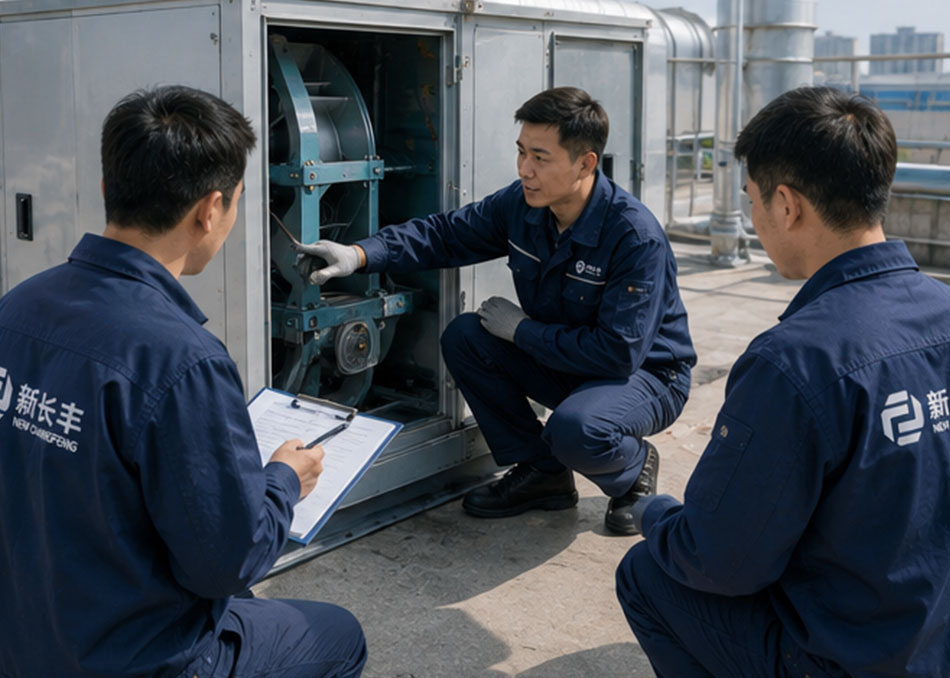
Walk through almost any industrial workshop, commercial kitchen, or warehouse and you will find an axial fan somewhere in the ventilation system. These fans are compact, move large volumes of air, and are relatively easy to install — which is precisely why they are so widely used for general ventilation. Yet a surprising number of systems underperform after commissioning: airflow falls short, air short-circuits between supply and exhaust points, noise complaints roll in, and fume or heat lingers where it should have been cleared. In many cases the fan itself is fine. The problem is where it was placed.
Installation position determines the intake and discharge path, how air is organized within the space, and how the fan interacts with the building structure. This article looks at axial fan placement specifically for ventilation applications, organized around two functions that matter most in practice: smoke and fume exhaust, and make-up air supply. The guidance is intended for facility managers, kitchen operators, and HVAC engineers who need practical, buildable answers rather than theory.
What Axial Fans Do in a Ventilation System — and How to Match Them to the Job
An axial fan moves air parallel to its shaft, which makes it well suited to high-volume ventilation where duct resistance is modest. In a ventilation system it usually plays one of two roles. As an exhaust fan, it pulls stale air, residual heat, cooking fume, or moisture out of the space. As a supply fan, it delivers fresh air inward to maintain pressure balance and replace what is being extracted.
Design standards consistently emphasize directional airflow. Under GB 50019, the code for heating, ventilation, and air conditioning of industrial buildings, both normal ventilation and emergency ventilation should keep air moving from clean zones toward contaminated zones so that cross-contamination is avoided. That principle has a direct bearing on placement: an exhaust fan belongs at the contaminated end of the airflow path, and a supply fan at the clean end.
Selection and placement are linked. If the duct run is long or has many elbows, the available static pressure of an axial fan may not be enough to overcome the resistance, and delivered airflow drops well below the catalog rating. Before fixing a location, verify the system resistance against the fan curve, and confirm that the fan's efficiency grade meets GB 19761, the minimum allowable values of energy efficiency for fans. Performance should be verified according to GB/T 1236, the standard for fan performance testing. A fan that is correctly sized but badly placed will still disappoint; a fan that is correctly placed but undersized for the ductwork will do the same.
Placement for Smoke and Fume Exhaust: Capture at the Source, Discharge Away from Intakes
For exhaust duty, the single most important rule is to locate the fan so that contaminated air is captured before it spreads. In a workshop with localized heat or fume generation, that means positioning the exhaust point close to the source, high enough to catch the rising plume but not so high that the plume has already dispersed into the general space. In commercial kitchens, hood capture efficiency depends heavily on the relationship between the hood, the cooking equipment, and the exhaust fan's ability to hold negative pressure at the hood face. Grease-laden air should pass through a properly sized exhaust purifier before discharge, and treated air should meet the emission requirements of GB 18483, the national standard for cooking fume emissions.
Discharge location deserves as much attention as intake location. Exhaust should be directed away from operable windows, fresh air intakes, and adjacent buildings, and should not create a nuisance at pedestrian level. Roof-mounted discharge is common for good reason: it uses the buoyancy of warm exhaust air and keeps discharge away from occupied zones. Where the building has smoke and heat exhaust requirements, placement must also respect GB 51251, the smoke and heat exhaust ventilation code, which governs how smoke control systems are arranged and how exhaust outlets are positioned relative to smoke reservoirs.
- Keep the exhaust intake near the fume or heat source, within the capture zone rather than at the far end of the room.
- Route discharge away from fresh air intakes and operable openings to prevent re-entrainment.
- Avoid placing exhaust fans where short-circuiting back into the supply stream is likely.
- Account for grease and particulate loading in kitchen exhaust; specify fans and purifiers that tolerate it and plan for cleaning access.
Placement for Make-Up Air: Balance the System, Don't Fight It
Every cubic meter of air extracted has to come from somewhere. If a space is under negative pressure because exhaust outpaces supply, the building will pull replacement air through every available gap — door seams, loading docks, and even flues — which can cause drafts, starve combustion appliances, and make exhaust fans work harder for less result. A dedicated make-up air fan, placed on the clean side of the space, restores balance and lets the exhaust system perform as designed.
Supply placement should support the intended airflow pattern. In a workshop, delivering make-up air low and away from the exhaust point encourages a sweeping movement across the occupied zone. In a kitchen, make-up air should be introduced so that it does not blow directly across hood faces or disturb the capture plume; a common approach is to deliver it at low velocity near the cooking line or through displacement-style outlets. Water-cooled fresh air units and evaporative air coolers can serve as supply sources where temperature control or evaporative cooling is also wanted, but their placement still follows the same logic: clean side in, contaminated side out.
Where both supply and exhaust fans serve the same space, interlock them so that exhaust cannot run without adequate make-up air. This protects pressure balance and, in kitchens, helps maintain the negative pressure that keeps cooking odors out of dining areas.
Practical Checks Before You Fix the Location
Good placement is as much about the building as it is about the fan. Before committing to a location, confirm that the mounting structure can carry the fan and its accessories, that there is safe access for maintenance and cleaning, and that the fan will not transmit vibration into lightweight partitions or occupied rooms. Acoustic considerations matter too: axial fans are often quiet at the source but can generate tonal noise when installed close to bends, dampers, or narrow plenums. Allow straight duct runs upstream and downstream of the fan where the layout permits.
Finally, revisit the whole system rather than the fan alone. A correctly placed fan connected to an undersized duct, a restrictive louver, or a clogged filter will still deliver poor results. Commissioning should include actual airflow measurement, not just a visual check that the fan spins.
- Verify system resistance against the fan curve before finalizing position.
- Confirm structural support and safe maintenance access.
- Keep supply and exhaust paths separated to avoid short-circuiting.
- Provide straight duct lengths around the fan where possible.
- Measure delivered airflow at commissioning.
Frequently Asked Questions
Q: Can an axial fan be installed in a long duct run with several bends?
A: It can be installed, but it may not deliver the expected airflow. Axial fans are best suited to systems with relatively low resistance. Long runs and numerous elbows raise static pressure losses, and if these exceed the fan's capability, actual airflow falls. Check the fan curve against calculated system resistance, and consider a centrifugal fan where resistance is high.
Q: Should the exhaust fan be placed at the start or the end of the exhaust duct?
A: Placing the fan at the discharge end keeps the duct under negative pressure, which helps contain leaks of contaminated air rather than letting it escape into the space. It also keeps the fan out of the hottest, greasiest part of the airstream where possible. The trade-off is that the fan must handle the full system resistance, so verify performance accordingly.
Q: How do I stop cooking smells from drifting into the dining area?
A: Maintain the kitchen under slight negative pressure relative to the dining area by ensuring exhaust capacity exceeds supply, and place make-up air outlets so they do not disturb hood capture. Treat exhaust air with an appropriate purifier before discharge, and keep discharge points away from fresh air intakes.
Q: Is a roof-mounted axial fan better than a wall-mounted one?
A: Each has merits. Roof mounting uses warm air buoyancy and keeps discharge away from occupied areas, which is often preferable for fume and heat exhaust. Wall mounting can shorten duct runs and simplify maintenance access. The right choice depends on the building layout, discharge path, and maintenance requirements.
Summary
Axial fans earn their place in ventilation systems because they are simple, compact, and effective — but only when the installation respects airflow direction, system resistance, and the separation of clean and contaminated zones. For exhaust, capture close to the source and discharge away from intakes. For make-up air, supply from the clean side and keep the system balanced. Get those fundamentals right, and the fan does what the design intended.
XCFFJ manufactures axial fans, roof turbo ventilators, cabinet centrifugal fans, and related ventilation and cooling equipment for factories, commercial kitchens, warehouses, and institutional canteens. If you are planning a ventilation upgrade or troubleshooting an underperforming system, our team can help you match equipment to your application and layout.